
NEED TO KNOW
The Bronx Zoo is considering relocating its last elephant, Patty, to a Tennessee sanctuary after the death of Happy, an elephant that lived in the same habitat as Patty
Happy, who died in May, was known for her self-awareness and sparked a landmark animal rights case
Experts and advocates urged the move, as elephants are highly social and Patty is now the only elephant at the zoo
The Bronx Zoo is considering relocating its last remaining elephant to a Tennessee sanctuary following the death of Happy, the beloved Asian elephant whose life sparked a landmark animal rights battle and changed how many people view elephant cognition.
According to Gothamist, officials with the Wildlife Conservation Society (WCS), which operates the Bronx Zoo, are evaluating whether 57-year-old Patty, who shared a habitat with Happy before her death, should be moved to The Elephant Sanctuary in Hohenwald, Tenn., a 3,000-acre refuge that is home to 12 elephants.
The discussion follows Happy’s death in late May at age 55. Zoo officials said she was euthanized after experiencing worsening age-related health problems, including declining organ function. A necropsy later revealed severe arthritis and several large, inoperable uterine tumors, according to The Independent.
According to a statement from WCS, Patty is “healthy and doing well” and continues to enjoy multiple areas of her habitat while participating in enrichment activities with the keepers who have cared for her for decades.
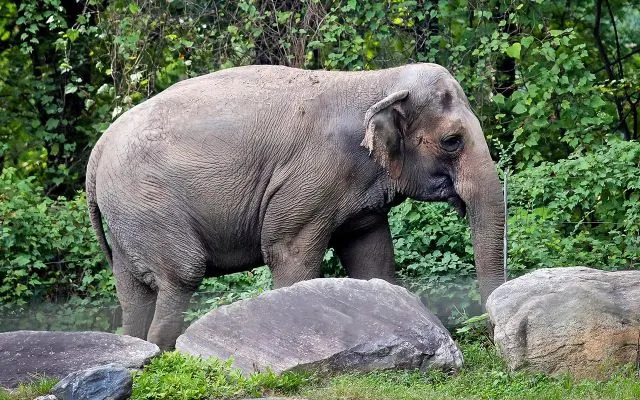
Bronx Zoo elephant “Happy” strolls inside the zoo’s Asia Habitat in New York on Oct. 2, 2018
Credit: Bebeto Matthews/AP
Happy’s death left Patty as the Bronx Zoo’s only remaining elephant and the last elephant living in New York City’s zoos.
“We want to make sure that we do the best thing for Patty,” Bronx Zoo Director Craig Piper told Gothamist.
Last month, Piper and three members of the elephant care team traveled to Tennessee to assess whether the sanctuary would be an appropriate fit. “We want to make sure that we feel that it would be the right move for her, and the risks would be outweighed by the potential gains,” he said.
Patty has lived at the Bronx Zoo since 1973, and WCS said some of her current keepers have worked with her for nearly 30 years, giving them an extensive understanding of her personality, behavior, medical history, and individual needs.
WCS said that relocating Patty would require months of voluntary training before she could be transported, with preparations likely to take at least a year. At 57 years old, Patty is approximately 12 years older than the median life expectancy for elephants living in North American zoos, and officials said transporting a geriatric elephant carries significant physical and psychological risks. They also noted that some older elephants have died following relocation.
PEOPLE reached out to the Wildlife Conservation Society for further comment.
Even so, many elephant experts say social animals like Patty benefit from living with other elephants.
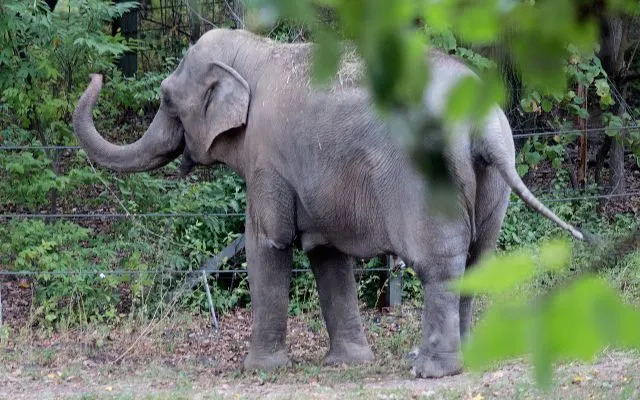
Patty, an Asian elephant kept in captivity at the Bronx Zoo, on October 16, 2019
Credit: Andrew Lichtenstein/Corbis/Getty
The Association of Zoos and Aquariums (AZA) recommends against keeping a single female elephant because the highly social animals naturally live in matriarchal family groups. While zoos can receive exemptions, the organization says social housing is the preferred standard.
WCS acknowledged that opportunities to socialize with other elephants are an important part of elephant welfare, but said decisions involving older elephants must also weigh factors including age, health, behavioral history, continuity of veterinary care, and the likelihood that an elephant will successfully integrate into a new herd. The organization noted that even some geriatric elephants living in sanctuaries are housed separately because of medical or behavioral needs.
Happy’s death has also renewed attention on the elephant’s extraordinary legacy.
Born in the wild in Asia, Happy arrived at the Bronx Zoo in 1977, where she later became the first elephant scientifically shown to recognize herself in a mirror. During a groundbreaking 2005 study by researchers from Columbia University and Emory University, Happy repeatedly touched a white “X” painted on her forehead after seeing her reflection, making her one of only a handful of nonhuman animals to pass the mirror self-recognition test, a widely recognized indicator of self-awareness.
She later became the focus of one of the most closely watched animal rights cases in the history of the United States.
In 2018, the Nonhuman Rights Project filed an unprecedented habeas corpus petition arguing that Happy should be legally recognized as a person with a right to bodily liberty and transferred to a sanctuary. Although New York’s highest court ultimately rejected the claim in a 5-2 decision in 2022, two judges issued forceful dissents, and legal scholars have described the case as a watershed moment for the animal rights movement.
Never miss a story — sign up for PEOPLE’s free daily newsletter to stay up-to-date on the best of what PEOPLE has to offer, from celebrity news to compelling human interest stories.
Now that Happy is gone, advocacy groups are once again urging the zoo to send Patty to a sanctuary.
The Nonhuman Rights Project has publicly called for the move, arguing Patty should not spend her remaining years alone. WCS stated it has consulted with colleagues at other accredited zoos, but stressed that no decision has been made.
“This isn’t about choosing a place; it’s about choosing what’s best for Patty,” the organization said, adding that its evaluation is being guided by science, veterinary expertise, and Patty’s individual welfare rather than public pressure.
Read the original article on People