
“Daidalon refers to the Greek myth of the inventor and artist Daedalus, father of Icarus, and Icarus’s tragic decision to fly using his father’s artificial wings. He flew too close to the sun, his wings. held together with wax, failed, and he plummeted to his death.”
— Rudolf Polanszky
Daidalon
Galerie Krinzinger
April 29–June 25, 2026
Vienna, Austria
A comprehensive exhibition devoted to Rudolf Polanszky is on view at Galerie Krinzinger, whose rooms—formerly a fin-de-siècle private officers’ casino—provide a historically charged architectural frame for this polymath artist. Since the mid-1970s, chance has informed his practice which extends across performance, film, video, photography, drawing, painting, sculpture, assemblage, and now through his current use of reconstructed industrial materials.
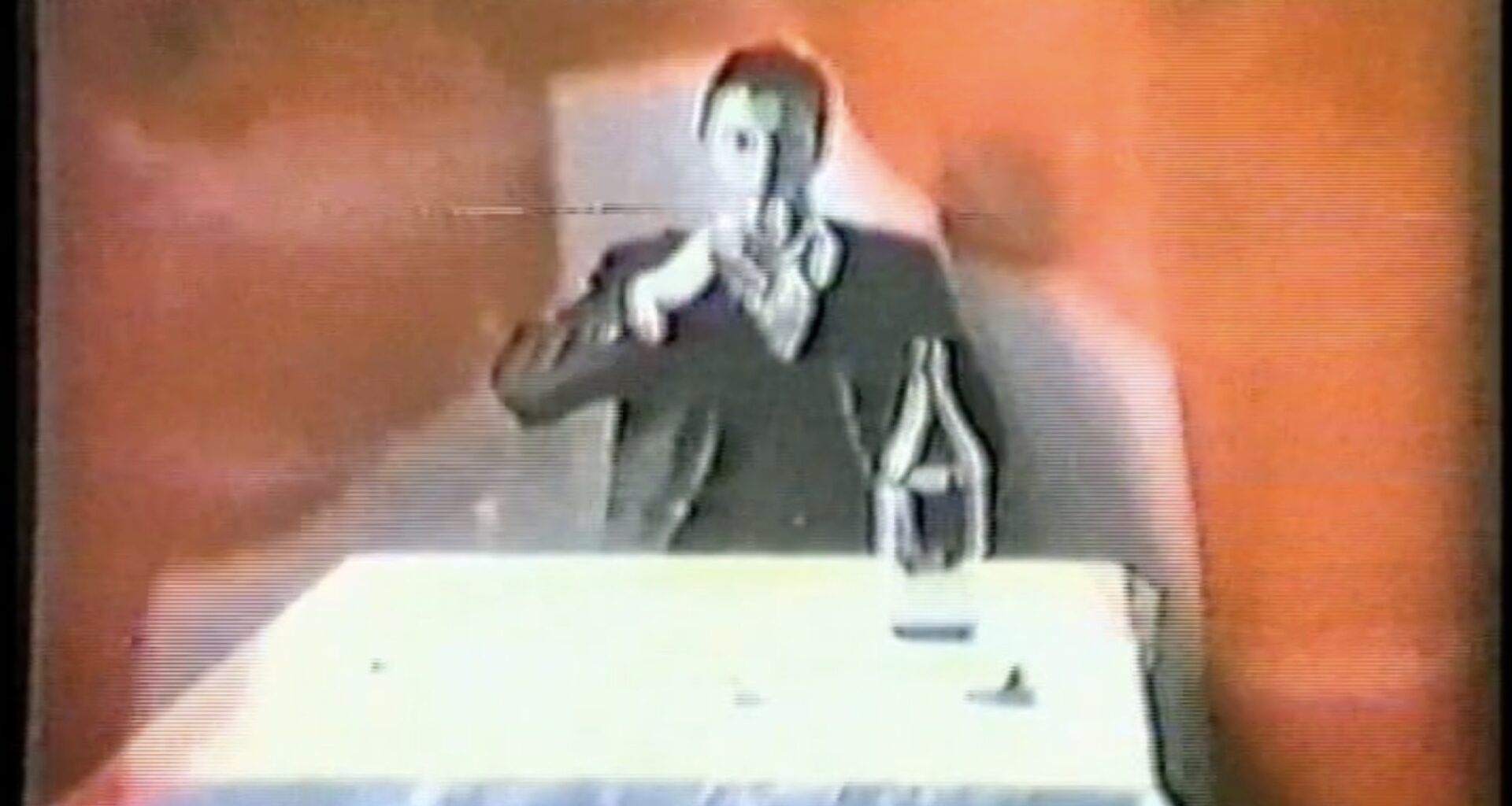
Upon entering the exhibition, the viewer is surrounded by monitors playing early performances for film and video. In the hand-colored film Zu einer Semiologie der Sinne [On a Semiology of the Senses] (1976), the artist sits at a table with a liter bottle of wine, a glass, an ashtray, and a seemingly endless supply of cigarettes. A classical-yet-carnivalesque soundtrack offsets his Alphaville look. The scene pulls you in, alternating between pathos, irony, and discomfort, especially when he vomits into a nearby bucket. The gesture remains unresolved when he lights another cigarette and refills his glass.
Even at his grittiest, Polanszky often refers to Greek mythology. This hand-colored film suggests Dionysus punishing Sisyphus, while a second performance on the opposite wall heightens the dark humor. Seen from behind, the artist doggedly plays the cello (without formal training) with his shaved head painted red. The instrument seems to moan as much as sing, turning the act of playing into a stubborn, partly-comic ordeal. Titled Cello, AKA Music for Dieter Roth (1985–89), the video becomes both an homage to Polanszky’s close friend and a string solo of ironic overtones and otherworldly blues.
The laughter these works may trigger is already tragic. Much of it ran deliberately counter to the grain of the dominant European art movements of the time: Art Informel, Actionism, Conceptual art, and the nostalgia of the Transavantgarde. The connection between this early work and his later production lies in opposition and collision. He resisted or satirized the surrounding styles, unsettling some of their claims. For example, apply the premise of Art Informel to the iconic film Sprungfederzeichnungen [Spring Notation] (1983). For the performance, he built a spring chair to traverse the studio and film frame, then sprang again with a loaded brush to mark a waiting scroll-like sheet of paper. The resulting work is less a conventional painting than an unstable, entropic musical score. Yet, it fulfills a checklist of elements associated with the brushy poetry of Art Informel and the prevailing strand of Austrian art at the time.