
The Mayor’s Office of Climate and Environmental Justice is trying something new.
The office picked 10 food carts in Queens to participate in a pilot program, which will last six months and test using rechargeable electric batteries instead of diesel generators.
What You Need To Know
The Mayor’s Office of Climate and Environmental Justice kicked off a new pilot program to test using rechargeable electric batteries instead of diesel generators
The office picked 10 food carts in Queens to participate in a pilot program
There are about 20,500 food carts across the city that use diesel generators to operate. New Yorkers are familiar with the sound of a loud, noisy generator. These new electric batteries are silent
If the pilot is successful, the goal is to scale it to all the food vendors across the city
The goal is to create safer working conditions for vendors, quieter streets for New Yorkers and a better environment for all.
There are about 20,500 food carts across the city that use diesel generators to operate. New Yorkers are familiar with the sound of a loud, noisy generator. These new electric batteries are silent.
“If we swapped out diesel generators for these renewable electric batteries for all of the street vendors across New York City, that would be the equivalent of reducing our carbon emissions by 120,000 metric tons of CO2. And that is like taking 30,000 cars off the road each year. So it’s a huge impact [on] our air quality and for the health and livelihood of our street vendors,” Louise Yeung, the city’s chief climate officer, told NY1.
Yeung said they picked Flushing Meadows as the place to test this out, as it serves millions of New York City residents and tourists.
If the pilot is successful, the goal is to scale it to all the food vendors across the city.
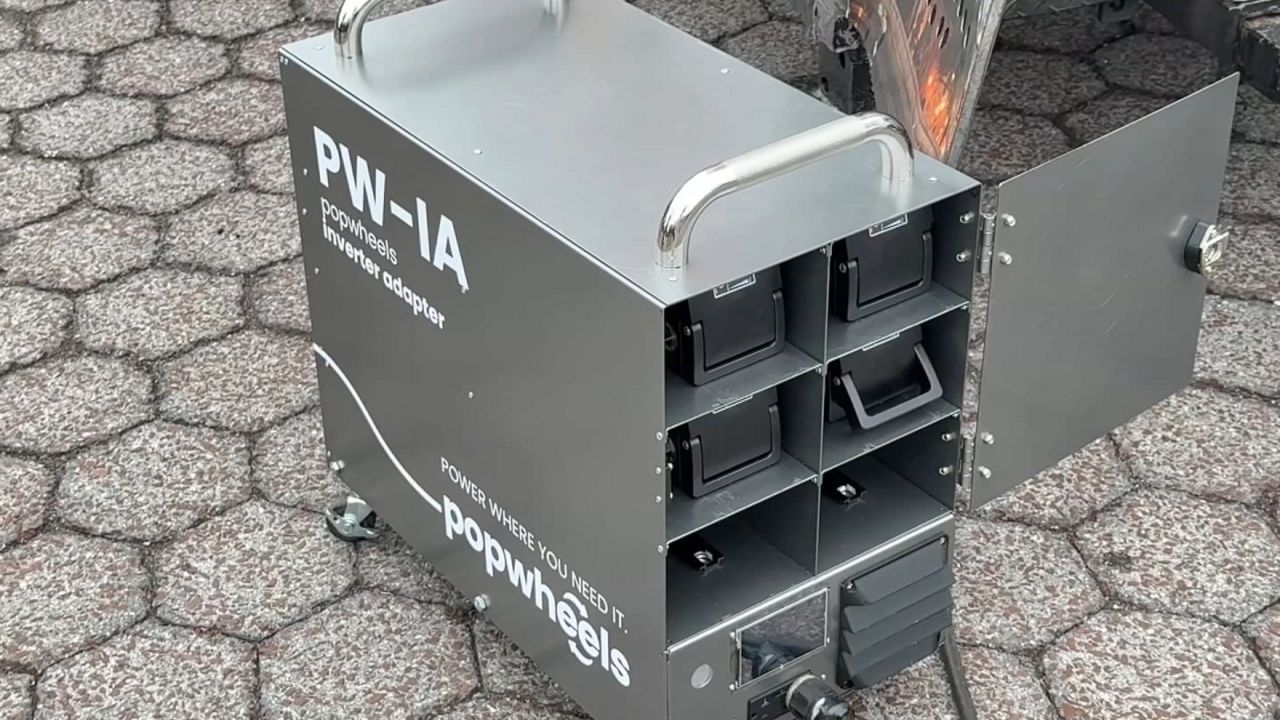
David Hammer, the co-founder of PopWheels, the battery company the city partnered with for the pilot, demonstrated how a PopWheels inverter adaptor fits right into a food cart where the generators normally go.
Hammer said using these batteries will not increase costs for the vendors.
“What you will spend on a daily basis subscribing to PopWheels and getting PopWheel batteries, even at full cost, even unsubsidized, is equivalent to what a street vendor would pay for gasoline today,” he told NY1. “Being clean is not enough. It has to be affordable.”
And it also has to be safe. Hammer says what sets PopWheels apart is a built in fire safety mechanism.
“If a battery actually were to have a thermal event in one of our cabinets, it actually gets ejected into a tank of fireproof material that fully extinguishes the fire. So we don’t simply try to prevent fires and contain fires, we can actually put them out,” he added.
Hammer said the average street vendor will need a pack of four PopWheels batteries to last a full day. However, since it’s a swappable system, PopWheels can size up or down depending on the need.
Mohamed Attia, the managing director of the Street Vendor Project, said he has been working toward finding a way to electrify food carts and food trucks for years.
“The generator hurts everyone,” Attia told NY1. “It impacts the air quality, it impacts all the residents and customers, but it impacts the vendors the most because the vendors themselves stand next to that generator for a very long time. It’s a 10 to 12 hour day shift. They stand next to the generator, inhaling all of these emissions into their systems, into their lungs.”
Advocates hope that if successful, the program would protect the safety of vendors and the environment.