
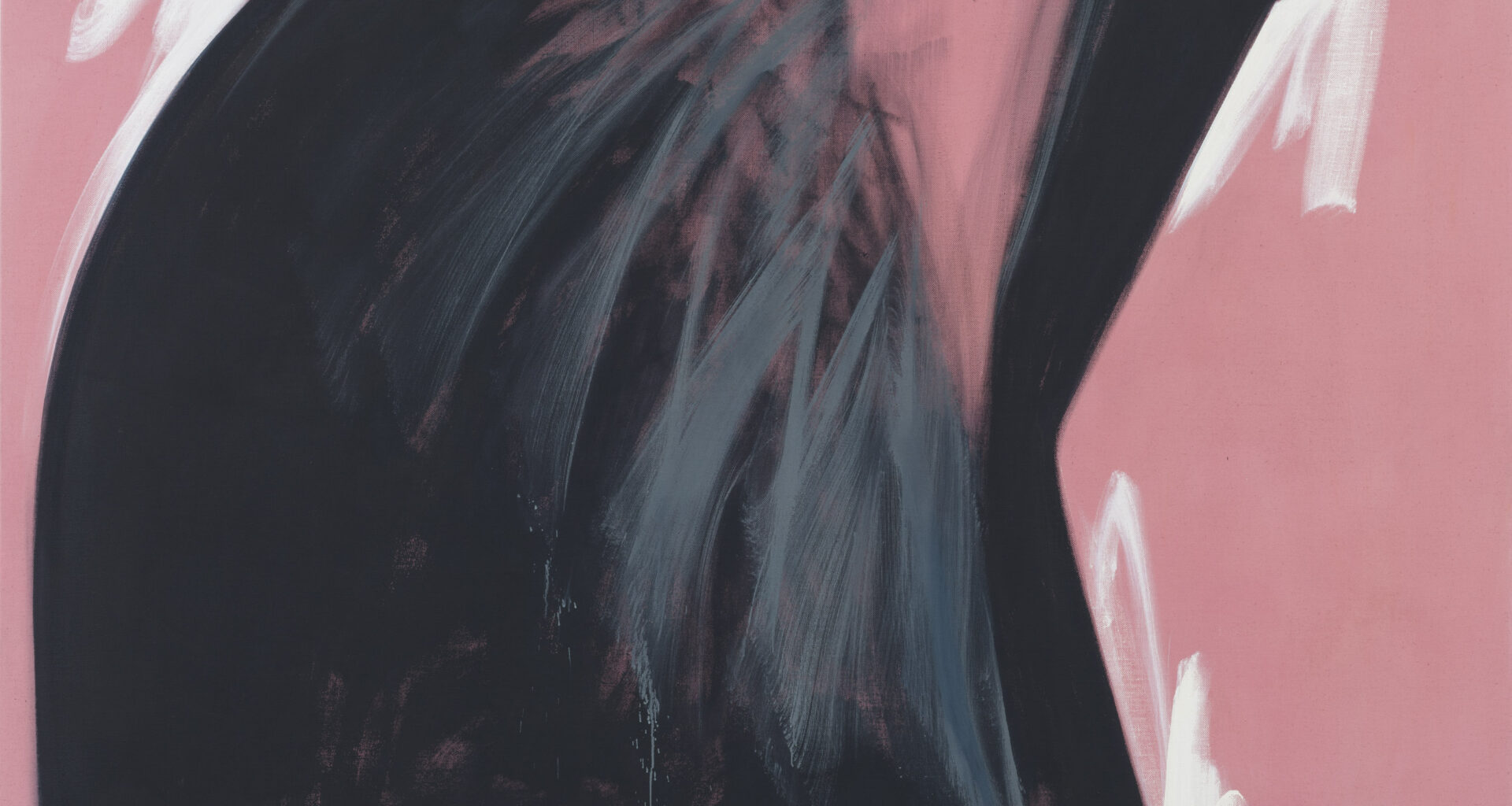
The Painting is a Door
Museum Franz Gertsch
March 21–August 30, 2026
Burgdorf, Switzerland
Paradaidha
Kunsthalle Darmstadt
March 29–August 30, 2026
Darmstadt, Germany
Two comprehensive retrospective exhibitions of Robert Zandvliet’s work are currently on view at the Museum Franz Gertsch in Burgdorf (curator: Andreas Fiedler) and at the Kunsthalle Darmstadt (curator: León Krempel), which, in addition to earlier works, focus primarily on key groups of works and individual pieces from the last sixteen years of his career.
Both exhibitions provide a striking testament to the development and versatility of this Haarlem, Netherlands–based artist, who has consistently explored painting at the intersection of figuration and abstraction since the mid-nineties. Zandvliet became known for his associative, abstract depictions of various everyday objects. Since the late nineties, he has focused primarily on landscape painting, which he approaches with equal freedom. The starting point for his paintings is always a concrete motif. At the center of his interest, however, is the question of how to find an adequate, new visual solution for this motif—one that does not merely replicate and confirm our visual habits and our knowledge of the subject.
Zandvliet’s “Seven Stones” series occupies the first room of the exhibition in Burgdorf. Here one can clearly see his uncompromising and experimental attitude towards his conceptual-philosophical approach—technically, painterly, and in terms of subject matter. This group of works, exhibited outside the Netherlands for the first time, is of central importance to Zandvliet’s artistic development. The creation of these works followed a lengthy process of reflection, doubt, and experimentation. Eventually Zandvliet found a solution for how a motif as simple as a stone could be detached from its natural state, reduced to its essence as an object, and artistically enhanced. Those unfamiliar with his work may at first be unsettled, if not overwhelmed, by the imposing scale of the work, the painterly roughness, and the rather muted, dark, achromatic color palette. If you give yourself and the paintings a little time, you quickly grasp the deep, inner calm and energy they radiate. Even from a distance, the unusual surface texture of these paintings stands out: the paint was applied not with brushes but with a paint roller, mostly in broad, mechanically rendered strokes and in very sparse quantities, so that the unpainted brown canvas remains visible over large areas. This has a decisive influence on these paintings, not only in terms of color but also in terms of spatial volume. Following this invigorating start, the exhibition’s title, The Painting is a Door, can be understood metaphorically: the “Seven Stones” open, so to speak, the door to the artist’s cosmos and reveal how he reimagines art history and painting (including his own) and subtly yet complexly links them to experiences from daily life.
Yellow (2019) consists of a bright yellow surface criss-crossed by horizontal lines and, roughly in the center of the composition, by a wide, gray-blue–toned strip outlined in black. What at first glance might seem like a nod to the geometric abstraction of Minimal art or Neo-Geo actually has a very specific background. The yellow refers to the regional trains operating in the Netherlands. Consequently, one imagines oneself standing on a platform while a train races past. What one sees is less the train itself than a yellow wall interrupted by the gray strip of the window front, on whose glass surface the surroundings behind us are reflected in silhouette.
Terra (2020) depicts simple roof tiles. Due to the unusual framing, the subject recedes into the background, and the rhythm of the richly nuanced orange-brown rectangular structure takes center stage. In the final room, one stands completely bathed in radiant light and is virtually embraced by the intense colors of the paintings. Paradaidha Zora (2023) marks the climax of the exhibition and creates a truly immersive experience. One looks, so to speak, from the perspective of an insect in a field, looking through a vast, vibrating sea of grain. The perspective is centered upward, directly into blinding, glistening sunlight, which is refracted in the atmosphere like a halo, thus making several suns appear in a spectrum ranging from dark yellow to the purest white. With stupendous technique, Zandvliet translates the natural experience of a dry, hot summer day into an ecstatic composition of light and color.