
Schoenbrun: There are a few dimensions of it in the movie. In the movie within the movie, we have Little Death [Jack Haven] and his helmet. It had to be something uncanny and subliminal, but something that would feel believable if maybe just a tiny bit off from what you would have actually seen in one of these movies. That ceiling vent? Literally, I was just staring up at the ceiling when I couldn’t sleep a few years ago, and I was like, “Oh, there it is!” It’s kind of like power lines, you know? This is surrounding us, but we don’t actually pay attention to it. That felt good and simple, not downstream from Friday the 13th or A Nightmare on Elm Street. It felt like it could exist alongside them believably.
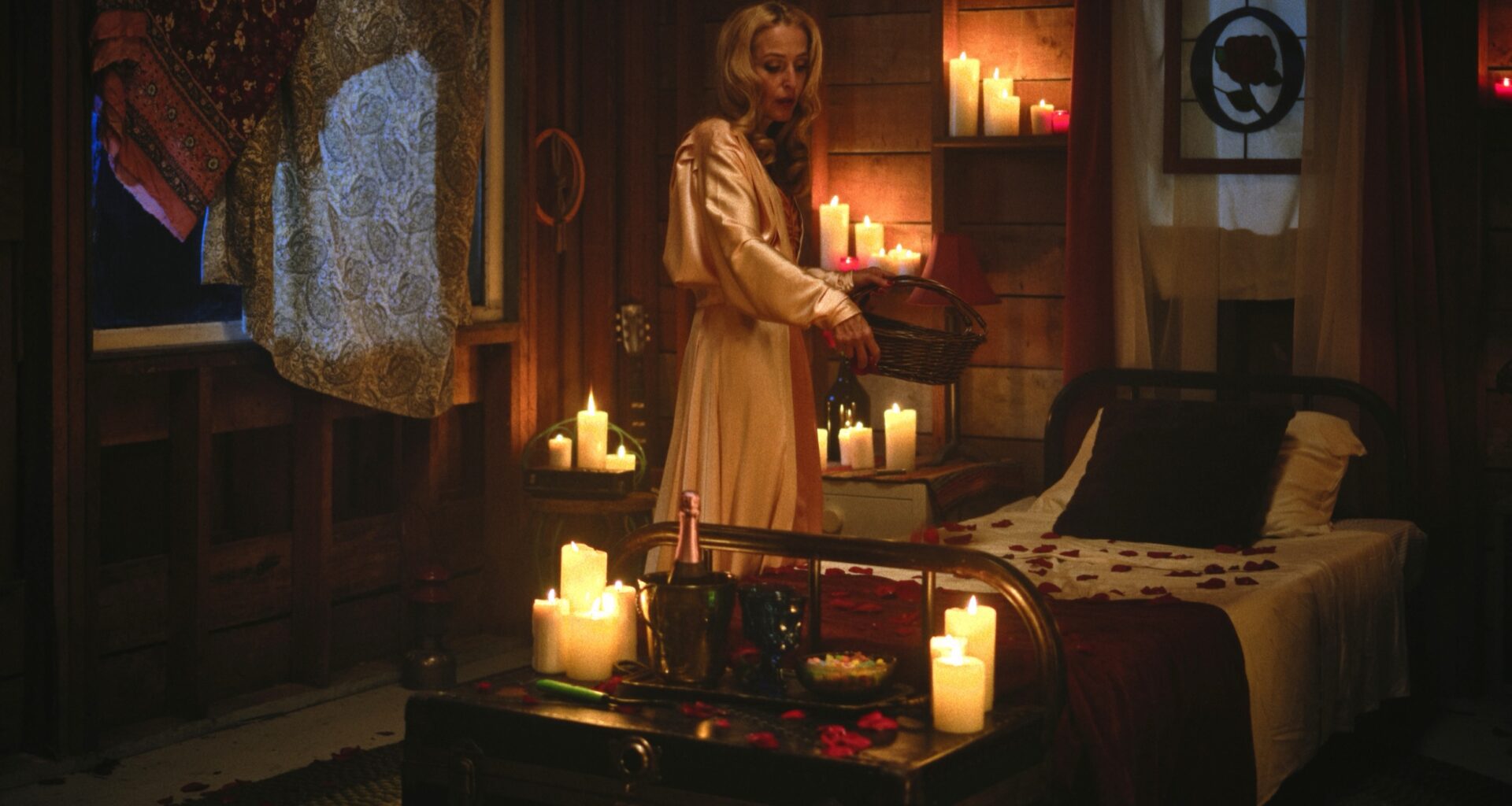
But then we get these different origin stories for him, right? There’s the origin story within the movie-within-the-movie of this trans kid who’s bullied and drowned and comes back for revenge, but then we also get Kris’s origin story that she pitches to the studio, which is a more expansive theoretical idea of what it means to be remaking this kind of iconography that mixes sex and death over and over again as a culture. Then you get Gillian [Anderson]’s character’s origin story that she tells at the campfire—her experience of coming into herself sexually that mixed trauma and desire and pleasure and pain. I hesitate to go too deep into my academic explanation of it though, because hopefully it’s generative material for people to dig through on their own.
Rail: In terms of your more academic orientation here, if you were to hand a casual viewer three books after watching this movie—things to spark the brains of people who are not familiar with this kind of material—what would they be?
Schoenbrun: I’m trying to think back to my reading list. Let me look it up… There’s this great book called Screening Sex by the film theorist Linda Williams that I read in the lead up to making the movie. It talks about the history of sex on screen, pre-code to now, and it talks a lot about the relationship between the audience and the sex scene: to what degree are you entering that scene in your own mind’s eye? I read that literally right before production, and it felt very, very, helpful.
Then there’s Eroticism: Death and Sensuality by Georges Bataille. It’s a collection of his nonfiction writing about sex and the taboo around it as a line that we all socially and culturally construct. It’s in the construction of that line that desire likes to dwell.
Rail: I love it when Bataille just stunts on Foucault like that.
Schoenbrun: Yeah, totally [laughing]. Then, finally, you know, the obvious one would be Carol J. Clover’s Men, Women, and Chain Saws, but I think my third would be some Gilles Deleuze. When I first started talking about this movie, I would describe it as a “Deleuzian slasher.” What I meant by that is that it’s a slasher that works from the fundamentally optimistic viewpoint of humans as desiring machines. It’s a slasher where that sex-and-death line would be so screwed that you want to confront the possibilities of the slasher rather than the moralizing horrors of the slasher.
Rail: Maybe that’s why it’s more effective as a meta-slasher than the most recent Scream movie.
Schoenbrun: Totally. I saw Scream 7—maybe I shouldn’t have, but those movies meant so much to me. I woke up at like 4 a.m., and I was so upset that I wrote this down—let me read it to you. “Scream 7 felt grotesque, a complete energy void, a rotten husk of a movie that no one involved is even pretending is anything more than a cynical cash grab. In this way, it’s a pretty good encapsulation of our moment.”
Rail: [Laughing] While you were up staring at the ceiling vent that inspired Little Death?
Schoenbrun: [Laughing] Angry about what’s become of my beloved Scream franchise.
Rail: So when you’re pulling all these things together as you write, how do you balance those tones in your head?
Schoenbrun: You just think a lot about the experience of watching the movie, you know? It becomes harder and harder the deeper in you get, but you try to put yourself in an audience’s shoes and figure out what’s going to walk them through a confounding experience. With this one, I was really interested in making a movie that was very inviting. It was important to me early on to make the decision with myself that this wasn’t like a mix of six genres, but that this was a romance with slasher spice added. The heart of the movie is a romantic comedy.
Then structurally? I’m so bored by three-act structure, clearly [laughs]. I’m always trying to invent new forms to hold someone’s attention, and a big guidepost for me was this movie mirroring the act of queer sex in its structure. The queer sex that I’ve had that’s felt good starts with a lot of talking, maybe eating some junk food together and getting comfortable, then it starts, then it stops, then it starts again. It leaves a lot of space for warmth and the creation of a zone that can be both scary and safe. So that was a goal.
Rail: That completely rocks. In terms of the super-independent queer film scene that’s come up in the past couple of years—with things like the Castration Movie Anthology, The People’s Joker, Alice Maio Mackay’s movies, and on and on—what are you most excited about right now?
Schoenbrun: It’s been really moving for me to meet Alice and Vera Drew and Louise Weard and Avalon Fast and feel for the first time since transition that I’ve found a group of filmmakers who are peers in conversation with each other trying to create work that’s doing something that isn’t currently in our post-woke commercial machine where even the quote unquote “arthouse indie movies” look like they were filmed at WeWork. Like, Annapurna Sriram’s Fucktoys thrilled me beyond measure. It’s such a miracle of a movie. I remember watching The Love Witch for the first time and just being like, “How the fuck does this exist? And thank god it exists!” That was the feeling watching Fucktoys.
Those guys’ movies have all really moved me and made me feel like less alone as a filmmaker. I’d love to spend a week watching microbudget films made by people who aren’t white dudes. I want to start some kind of festival, mostly just so I can engage with these movies and engage with what culture is being made out there that isn’t being surfaced.