
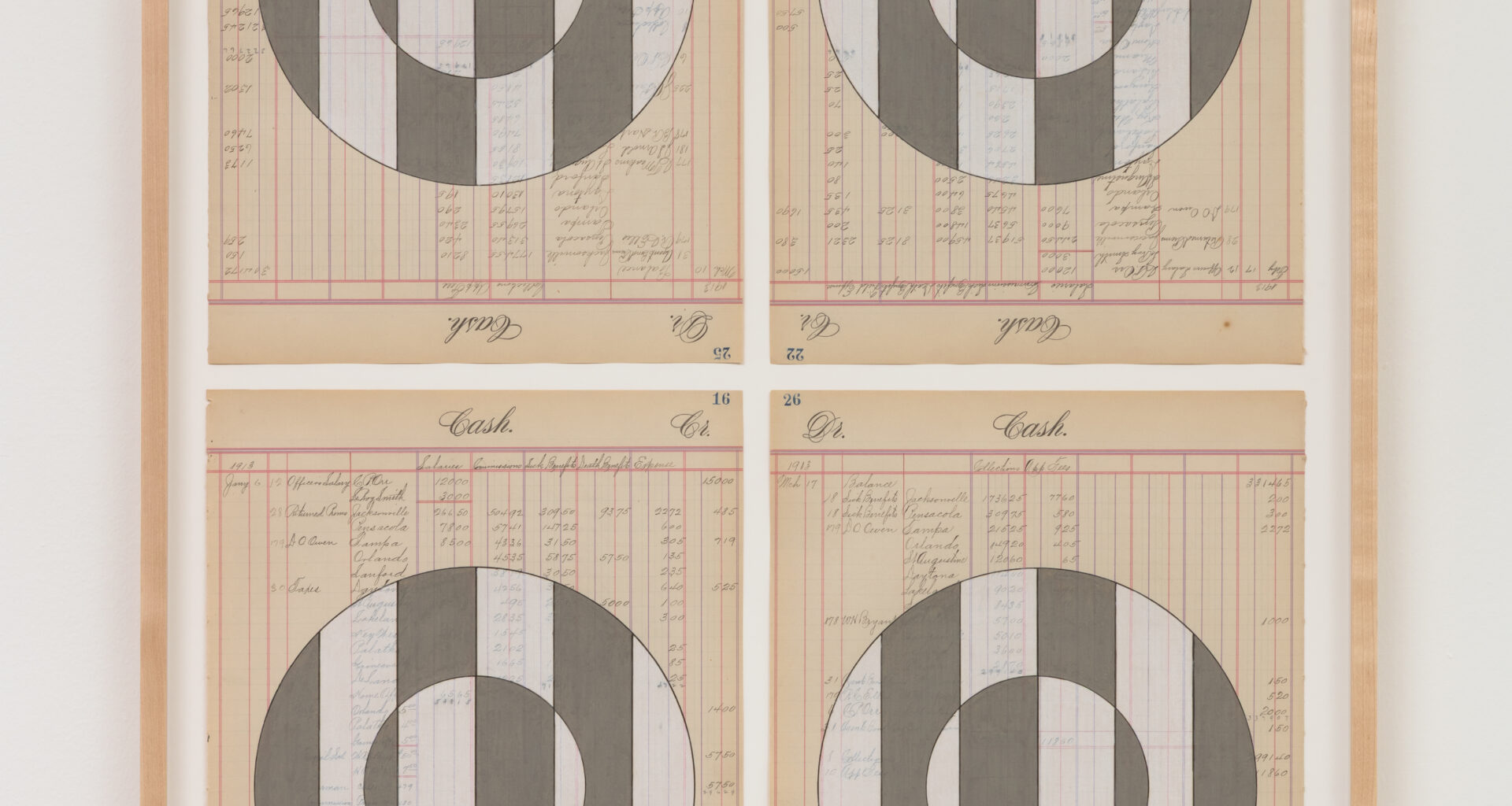
Celestial Observations
Diane Rosenstein Gallery
May 30–July 11, 2026
Los Angeles
This focused exhibition was my introduction to the work of Terran Last Gun and, among more important things, it snapped me out of the far-from-enthusiastic response to nearly all of the emails and PDFs I receive touting the next great thing. I’m a bit late to his work’s arrival, as it was included in installations such as the 12th SITE SANTA FE International Biennial last year, and this is his second solo exhibition with Diane Rosenstein Gallery. Last Gun is an enrolled citizen of the Piikani Nation, one of four nations known as the Niitsitapi [Real People], information that is visually infused into and activated by his work—somehow simultaneously quiet and vibrant drawings on paper, presented alone or in groups, made with ink and colored pencil, utilizing predominately circle and square forms.
The paper he uses is not just any paper; instead, his work exists within the tradition of Indigenous ledger art of the Great Plains from the late nineteenth and early twentieth centuries. The product of a growing scarcity of animal hides as supports, and the availability of found pages from “official” ledgers, its inventiveness and narrative sophistication remains compelling in tremendous surviving examples. At first glance, narrative seems not to be a goal for Last Gun, as his contributions to each page are unapologetically abstract. However, he extends the “story” of this way of working by carefully adding large abstract (and geometric) forms to each page. These forms themselves are divided into sections of parallel stripes and/or perpendicular squares, all infilled with care and consistency with bright, yet calm—because of the qualities of colored pencil—color.
Color and shape, form and structure, order and clarity all resonate in Last Gun’s drawings because of his ability to align Piikani approaches to them with key moments of geometric abstraction, whether modernist or way, way before. The hybridity of their compositions challenges, if not implicates, the facts and figures recorded on their supports in regimented penmanship. (The pages range from 1905 to 1936.) A work like Ancient Futurism Is Now (2026) infuses four ledger pages from 1913 that account for various incomes (“Officers salary,” so seemingly military) and expenses (sick and death benefits) with four circular shapes, each containing a smaller circle, all with vertical stripes (think Daniel Buren, in a way) washed onto the surface in white and an especially rich gray. Despite their subtlety, the circles are emphatic, not quite targets but definitely aims.