
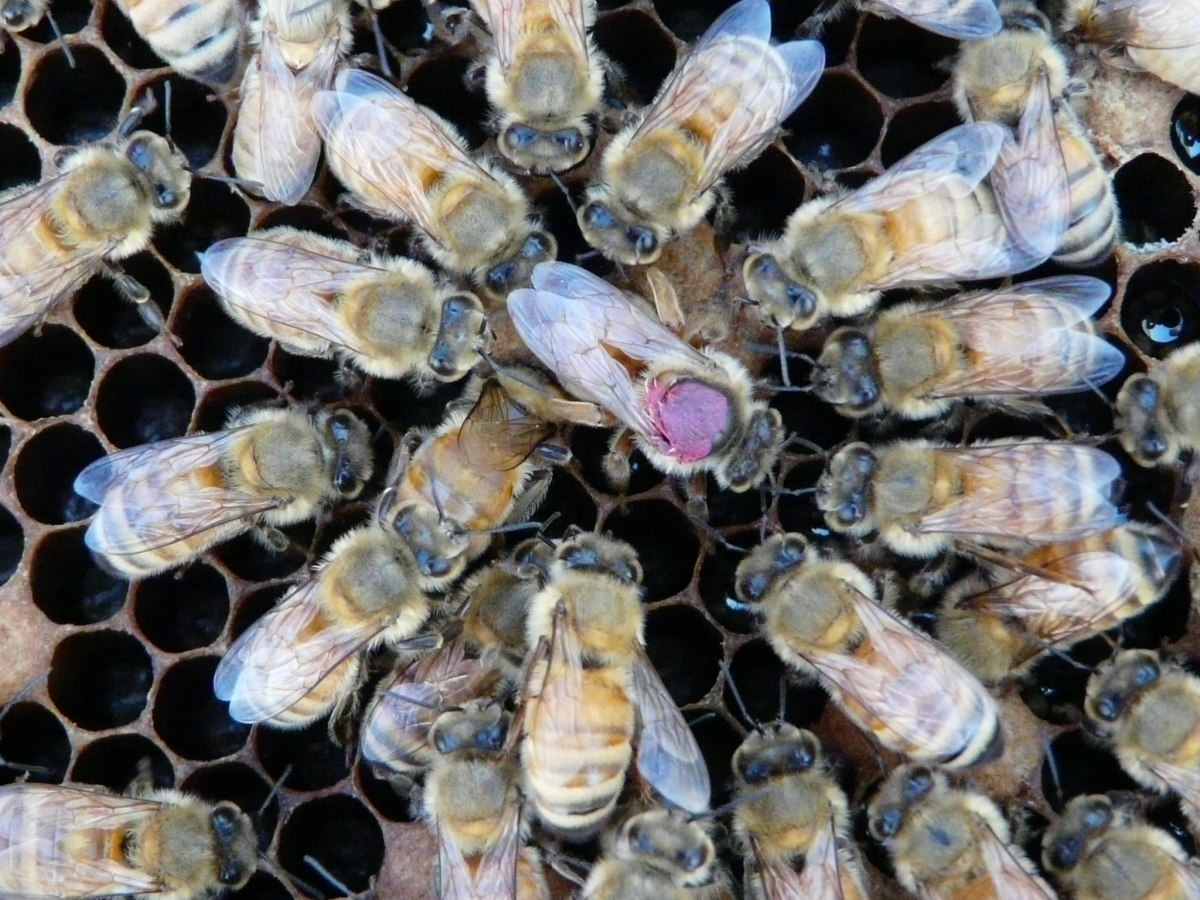
Honeybees are important pollinators worldwide, but their numbers are declining, partly due to harmful pesticides. For the first time, scientists have examined the impact these chemicals have on the entire colony, and the role the queen bee plays in removing them. Laura Verdina reports…
Worker bees are usually the first to tackle contamination in honeybee colonies, but a new study in Current Biology shows that queen bees also play a pivotal role. Previous work has shown that worker bees filter pesticides from the food given to queens, so queens are exposed to fewer pollutants. However, in the latest study, researchers tracked the pesticide methyl parathion throughout the entire colony, not just in the workers. They observed a phenomenon called ‘maternal offloading,’ which had not been documented in social insects before. This process occurs when pesticides or other contaminants accumulate in reproductive tissue and are then passed on to developing offspring.
The team used biological accelerator mass spectrometry (BioAMS) to track the movement of the pesticide through the colony, and found that worker bees could remove some of it, as expected. However, over 10 days, they also saw the pesticide building up in the queen bee’s ovaries and eggs, showing there is a limit to how much worker bees can protect the queen from pollutants. When that limit is reached, queens begin passing these toxic chemicals into their eggs to protect themselves. This highlights the queen’s important role in the colony’s handling of pollutants.
Indeed, in bee colonies, only the queen can lay fertilised eggs, which is vital for the colony’s survival. If her eggs contain excessive levels of toxic chemicals, they may not develop properly or may have defects, ultimately reducing colony size. The process of ‘maternal offloading’ – as this study suggests – may be a significant factor in the ongoing decline of honeybee populations, particularly in regions with heavy pesticide use.
But what might that look like? “The long-term implications could be that maternal offloading of these pesticides is actually a good thing because it helps the queen to survive and the colony to survive. So I would hope that queens are not exposed to too many chemicals at a time and also for a long time, chronically as we call it, so that they can use this mechanism to cleanse themselves, right? This is kind of a cleansing of chemicals out of their bodies”, Sascha Nicklisch, the study’s senior author and a researcher at UC Davis, told The Naked Scientists.
“But on the other hand, if there are multiple exposures to chemicals in an agricultural field over a long period of time, this could lead to saturation. So, if there are too many chemicals that the queen bee cannot handle anymore and then potentially, I say potentially because I want to be careful, it could also lead to the death of the queen bee which would collapse that colony in this case”, Nicklisch considered.
Honeybees are essential to global ecosystems because they pollinate many plants, including important crops such as oilseed rape, tomatoes, and strawberries. In the UK, honeybees pollinate about 5 to 15% of insect-pollinated crops. Unfortunately, almost a quarter of Europe’s bee species are declining, which could have a big impact on farming and the environment.
So with bee populations at risk, what can we do to make our gardens more inviting for pollinators? “You don’t need to make a whole garden to attract pollinators, but you start with a few pots of flowering plants beside your front door”, Sally Petitt, Head of Horticulture at Cambridge University Botanic Garden, told The Naked Scientists. “Pollinators are attracted to a wide range of plants, but particularly those which are nectar and pollen rich, including lavender, salvia and bergamot. White flowers, such as tobacco plants, are great for attracting pollinating moths, who are also attracted by their night-time scent. Funnel and tube-shaped flowers, like foxgloves, are also good pollinator plants. Native species are highly valued by pollinators, so plants such as cowslip, bluebells and knapweed are good examples”, she added.
Planting pollinator-friendly flowers in our gardens can help local ecosystems, but this honeybee study shows that bigger actions might be needed to protect pollinators. With that in mind, the agricultural industry should reduce pesticide use, and further research should be done to monitor their effect on the environment.