
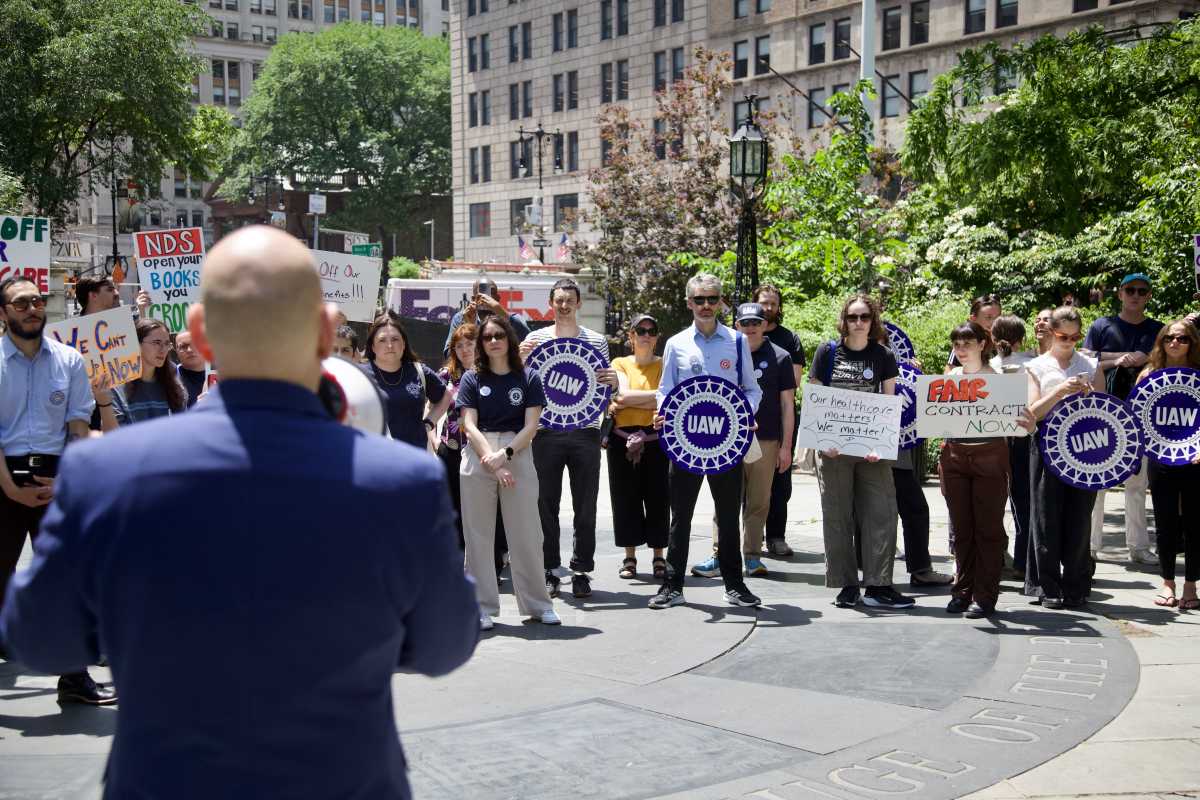
The members of Brooklyn Defender Services (BDS) say that months of negotiations had come to a standstill prior to the vote, with salary and health insurance proposals that were “patently unacceptable” and no agreement over hybrid work schedules.
“The phrase in the labor movement is ‘the boss is the best organizer,’” said Brian Holbrook, a public defender and union member. “It’s management’s inflexibility and a series of very bad proposals that have brought us to this moment where such an overwhelming majority of the office is ready to authorize a work stoppage.”
The BDS is the first to authorize a strike of five Association of Legal Advocates and Attorneys (ALAA) locals, including the Bronx Defenders, and Neighborhood Defender Service of Harlem, the Center for Family Representation, and Catholic Migration Services, whose contracts expired at the end of June.
The day after the July 6 strike vote, union members held a bargaining session where they shared the vote tally with management, who in turn unveiled a new economic offer with proposals on salaries and health insurance, according to union members.
The union declined to comment on the new proposal. The BDS declined to share details of its contents.
“We are proud of the strong economic offer that we made to the union yesterday, which reflects the value of the work our staff does every day,” wrote the legal provider’s executive director, Lisa Schreibersdorf, in a statement. “We will continue bargaining and hope to reach a resolution without a strike, which will enable Brooklyn Defenders to continue to serve New Yorkers in need of exceptional legal services.”
The strike authorization marks an escalation during the first opportunity that the ALAA’s local unions have to negotiate under Mayor Zohran Mamdani, with whom they forged a strong relationship during his election campaign. Holbrook said that there was a significant allocation of new unrestricted baseline funds to BDS, which gets a majority of its funding from the city government.
“Our focus at this point is ensuring that as much of that as possible is going into the compensation for the staff that keep our office running,” Holbrook said. “The value of this organization is in the highly trained, capable, and experienced staff, and so we feel strongly that when new money is flowing to the organization, that is wonderful, and it should flow primarily to the workers who keep our office a world-class organization.”
The bargaining builds on a tense bout of negotiations from ALAA’s unions last year under former Mayor Eric Adams, during which attorneys and staff at several other New York City legal services organizations went on strike, not counting the Brooklyn Defender Services union.
At this point, the union has not set any strike deadline and expressed its desire to settle its core demands without resorting to a work stoppage. But the BDS local — which represents over 700 workers, including 280 attorneys — is coordinating with the four other providers whose contracts have also expired.
Holbrook said that the BDS union members are certainly paying close attention to bargaining at the other providers because they don’t want to be shortchanged.
Until their most recent offer, management had been offering a $58,000 wage floor for general administrative staff, whereas Bronx Defenders, which went on strike last summer, established a $68,500 wage floor for administrative staff, even though the two organizations have similar funding models.
“It’s a tool that is obviously now on the table, and that was the point of holding the strike authorization vote and sharing the results during bargaining,” Holbrook said.