
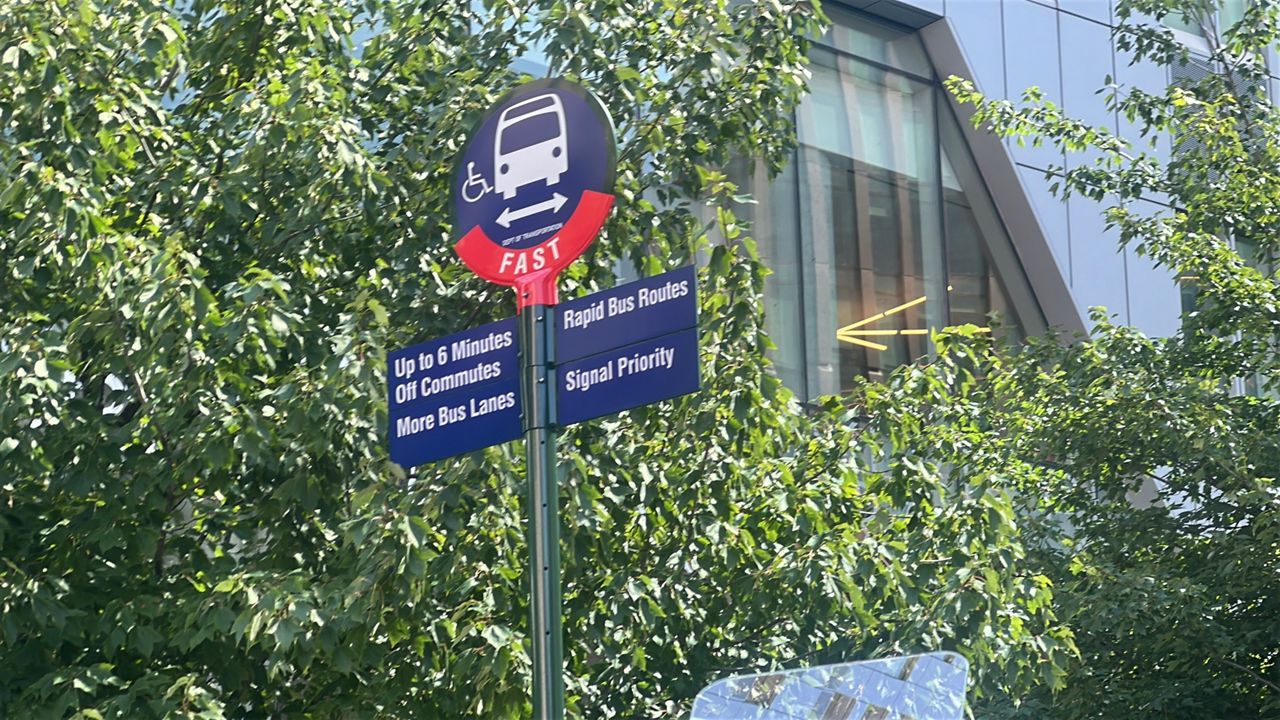
Mayor Zohran Mamdani and Gov. Kathy Hochul unveiled a new plan Wednesday aimed at making New York City buses faster, more reliable and more accessible, a plan that aims to accomplish the “fast” part of the mayor’s campaign promise of “fast and free” buses.
The plan, called “Next Stop: Fast Buses, Better Service,” includes improvements to 50 priority bus corridors across the five boroughs, expanded bus lane enforcement, upgraded bus stops and a major investment in new buses.
The plan calls for increasing bus speeds by 20% on those priority bus corridors, reducing trips by as much as six minutes on each trip.
What You Need To Know
Mayor Zohran Mamdani and Gov. Kathy Hochul unveiled a bus action plan aimed at making New York City buses faster, more reliable and more accessible
The plan targets a 20% increase in bus speeds on 50 priority corridors through new bus lanes, traffic signals and expanded rapid bus service
The MTA plans to purchase 2,500 new buses through 2029 and implement systemwide all-door boarding by next year
The city will expand bus lane enforcement with more automated cameras, additional bus lane cameras and increased NYPD enforcement
“For working New Yorkers, every minute matters. But for too long, our buses have been stuck in traffic instead of keeping pace with the city that never sleeps,” Mamdani said in a statement.
According to city data, New Yorkers take around 2.75 million bus trips per day, but some routes are among the slowest of any major U.S. city, averaging 8 miles per hour.
Five corridors – Tremont/Cross Bronx in the Bronx, Northern Boulevard in Queens, Flatbush Avenue and Utica Avenue in Brooklyn, and Kensington/JFK in Brooklyn and Queens – will be among the first to see rapid bus improvements.
The city’s Department of Transportation and the MTA will work in tandem to advance projects with dedicated, protected bus lanes, more frequent service and upgraded bus stops, according to City Hall.
Under the plan, the DOT will install or improve bus-only signals — signals that allow buses to move ahead of other traffic at intersections — on 35 routes each year.
The MTA also plans to purchase 2,500 new buses through 2029, replacing 40% of its current fleet, while also implementing all-door boarding systemwide by next year.
The transit plan calls for installing 300 new bus shelters by 2028, adding seating at 875 stops annually and increasing the number of real-time information displays.
Under the plan, bus-mounted automated camera enforcement will expand to 25 additional routes both this year and in 2027. The DOT will also install 200 additional stationary bus lane cameras by 2027.
Additionally, the NYPD is being directed to expand targeted bus lane enforcement from 14 to 20 corridors.