
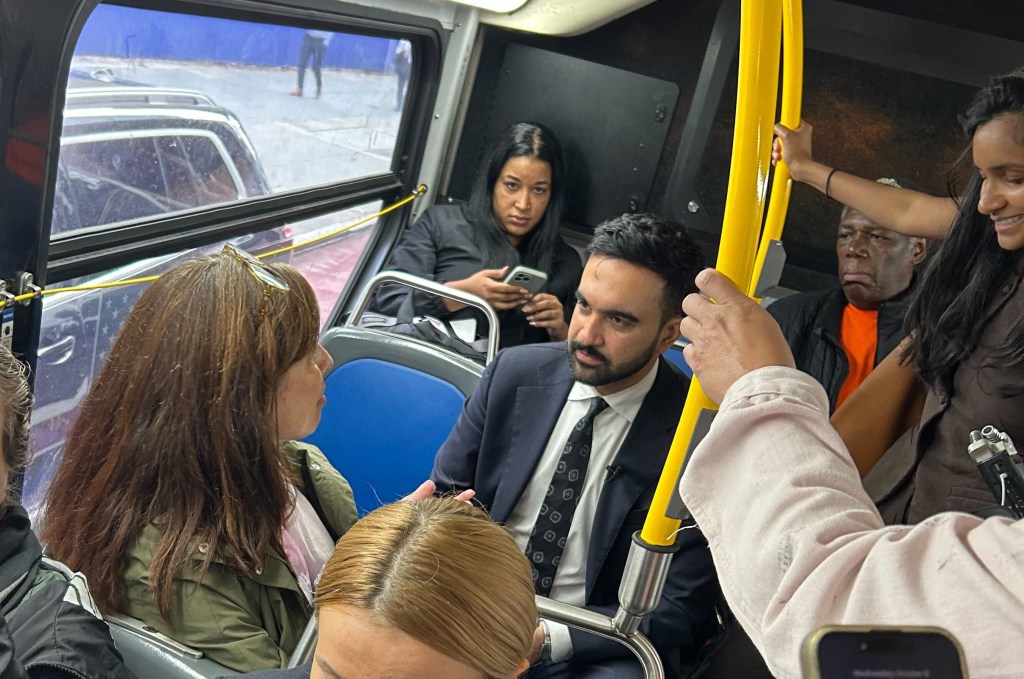
Mayor Mamdani may not get his wrongheaded wish of making city buses free, but an agreement with Gov. Hochul promises that he and the city he leads will get something even better: improved and faster-moving buses, which will move New Yorkers around at above the glacial current 8 miles an hour that city buses average.
In the 51-page report issued under the aegis of the mayor, governor and MTA, the word “fare” doesn’t appear once and “free” only shows up a single time: “Without obstructions, buses are free to keep moving.” That is something worth doing that won’t slam the MTA’s budget by eliminating the farebox.
Just as it owns the subway system, the city also owns the bus fleet, but both networks are run by the MTA. But the city does control the streets and so by working together, City Hall and the MTA can make buses better.
There will be ambitious investments to construct dozens of additional bus lanes, adding bus shelters and other infrastructure and increasing enforcement of bus lane violations, among other things. All are relatively obvious solutions that were just waiting for our leaders to have the drive to enact them. For that, we applaud the mayor and the governor, though we assure them that we’ll be keeping a close eye on how the plan is panning out.
As such an admirer of European-style social democracies, Mamdani is no doubt aware that their innovation isn’t necessarily that everything is subsidized to the point of being free; having people pay even nominal fees to keep the system running makes them feel bought in and frees up capital for improvement such as these. In any case, the budget deal he recently reached with the City Council features an expansion of the Fair Fares program, helping ensure that the subway and buses remain affordable even to very low-income New Yorkers.
We can guarantee that if you ask average bus riders whether they would prefer their commute to be free or far more efficient, the bulk of them would say the latter. It is the same principle at play with congestion pricing: for the most part, people are happy to pay a little bit if it means that they will have quicker and easier trips and better service. Slow buses can and do have costs far greater than the price of a fare. In macro terms, any urban economist worth their salt will tell you that the money that goes into providing better transit service multiplies throughout the local economy.
And speaking of fares, while activating the rear door OMNY readers will provide for somewhat faster boarding, the MTA made a big mistake in getting rid of the off-board fare payments that were used for Select Bus Service. One of the best elements of bus rapid transit (BRT) is that passengers pay before the vehicle arrives and then just flow unimpeded into the bus. Now we have to wait for each person to successfully tap OMNY (and it doesn’t always work on the first attempt).
The bus improvements will be particularly welcome in the stretches of the city where the subway is not an option. Conversations about subway expansions and the BQX are worth having, but in the meantime, we have at least one solution already viable, which is better bus service between these points. It won’t solve all commuters’ problems, but buses that come quickly and move fast would vastly improve hundreds of thousands of lives around the city with no real downside.