
A Manhattan Supreme Court judge dismissed a lawsuit that could have derailed construction on a Lower Manhattan climate resiliency project, ruling that the government entity spearheading the project had properly carried out the required environmental and public review processes for the construction to be permitted.
State Supreme Court Judge Phaedra Perry-Bond ruled last week that the north/west portion of the $2 billion Battery Park City resiliency project — which will establish new flood protection systems like flood walls and drainage infrastructure around the park on over 3 miles of Lower Manhattan’s edge and was developed to protect the area after Hurricane Sandy — is allowed to move forward without issue.
Perry-Bond’s decision caps off nearly a year of litigation from community groups Battery Park Alliance and Battery Park City Neighborhood Association. Those groups argued that Battery Park City Authority (BPCA), the state government entity carrying out the resiliency project, should pause and redo the construction’s environmental impact assessment because it was incomplete the first time and the work will negatively impact nearby residents.
“Petitioners have failed to establish BPCA’s environmental review of the North/West Project was arbitrary, capricious or affected by an error of law,” the judge wrote. “The record reflects that BPCA spent years engaging with residents, elected officials, the community board and commercial tenants as part of its design and review of the North/West Project.”
Bond-Perry also said the community groups’ claim that the BPCA was wrong to assess the North/West portion of the project separately from the project’s southern portion was incorrect, as though they were related, they were independent projects with independent benefits, and therefore there’s “no need” for an additional cumulative review.
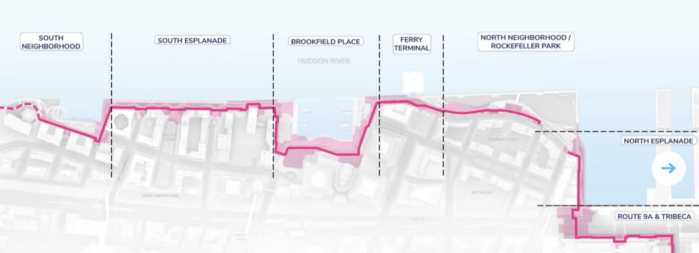 The northwest portion of Battery Park City Authority’s flood resiliency project.Battery City Park Authority
Raju Mann, the BPCA’s president and CEO, said the group appreciated the court’s “thoughtful dismissal” of the lawsuit and was ready to continue pushing the project forward.
“The North/West Battery Park City Resiliency Project was informed by years of extensive community engagement and approved in full accordance with the law,” Mann said. “We remain focused on advancing this critical work to protect Lower Manhattan residents, property, and infrastructure from the escalating threats of climate change.”
However, the legal battle will continue, said Jack Lester, the attorney representing the community groups suing. Lester said his clients disagree with Bond-Perry’s ruling and have already appealed the decision.
“The failure of the environmental review process to account for the consequences of the undisclosed easement is a violation of law that will be reviewed by the Appellate Division,” Lester told amNewYork in a statement.
The community groups Lester represents have also emphasized that the BPCA’s plans include work on a resident’s property and that the construction will result in the temporary closure of the park and the cutting down of trees, which they claim is a “non-park use” and therefore not allowed.
Bond-Perry said those arguments were unconvincing to her.
“While parts of the Esplanade will be temporarily closed during construction, it will ultimately be reopened and restored, and the erection of anti-flood systems to protect the park does not constitute alienation of land for a non-park purpose,” the judge wrote, adding that there will be an “even greater” amount of trees and biodiversity at the construction’s conclusion.
The project has faced unsuccessful lawsuits from the community groups in the past. In 2023, the group’s suit against the southern portion of the project was dismissed, with State Supreme Court Judge Sabrina Kraus ruling that the public good of climate resiliency outweighed the residents’ concerns over the inconvenience of park construction. That judge also disagreed with the group’s arguments that BPCA had improperly carried out the required environmental review.
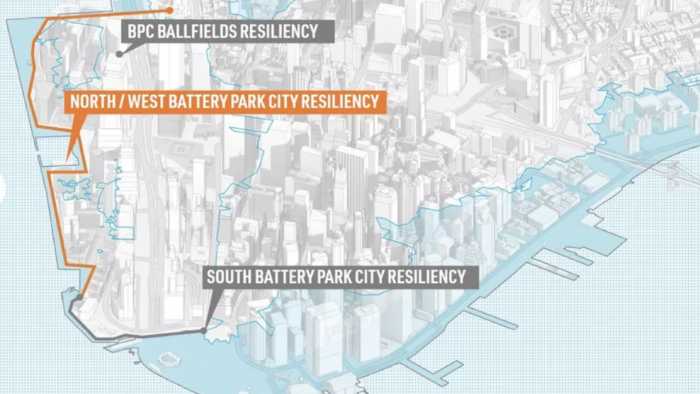 The North/West and South portions of the Battery Park City climate resiliency project on a map.
The entire project is expected to be completed in the early 2030s and is intended to keep Lower Manhattan and its residents intact as flooding in the area intensifies.