
This story originally appeared in New York Focus, a nonprofit news publication investigating power in New York. Sign up for their newsletter here.
If Hunter College manages to reduce the roughly one ton of trash it produces each day — as required by a state order directing all public entities to cut their waste — it will likely be thanks to a new, highly democratic decision-making body known as a citizens assembly.
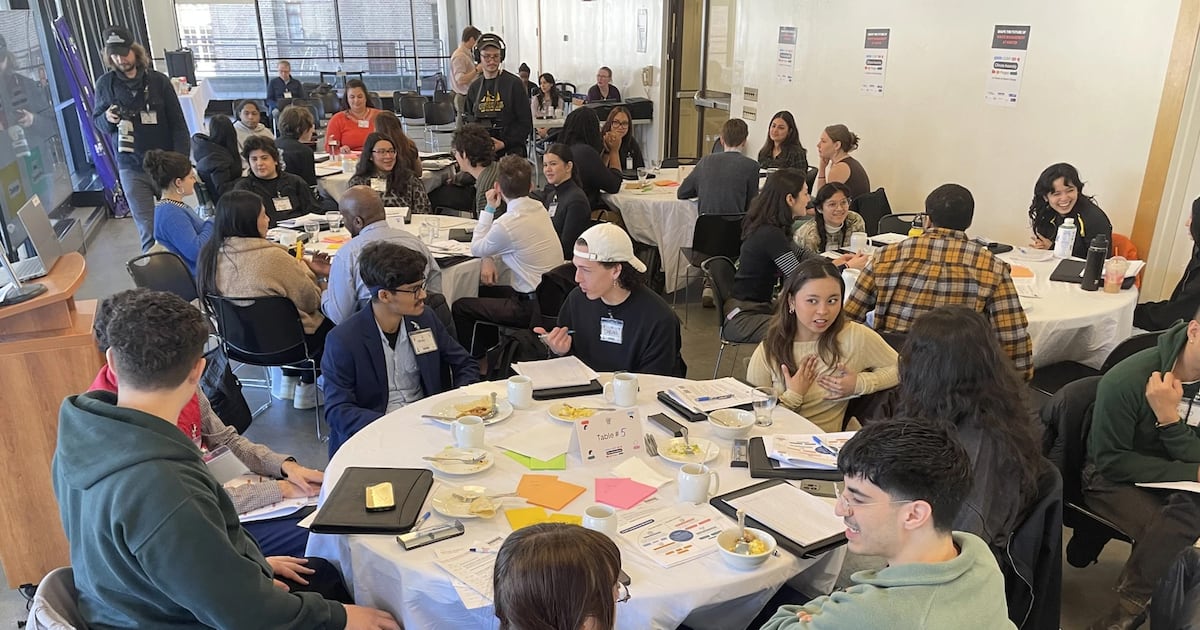
Over two months, some three dozen Hunter undergraduates met weekly to research the topic, grill the college’s waste managers and outside experts, tour the campus trash trail, and ultimately come to consensus on seven actions aimed at sending less garbage to recycling and landfills.
The CUNY Climate Assembly Project at Hunter, or CCAP, is one of the first citizens assemblies in New York state. The approach involves selecting participants at random, ensuring their demographics accurately reflect the community, and giving their recommendations real weight in decision-making. Also known as civic assembly, popular assembly, lottocracy, or citizen jury, it has been used in Europe for decades and is gaining traction in the United States and around the world.
Some of the Hunter College climate assembly participants were drawn by the $750 stipend. Others had nothing planned for spring break, when the assembly began. And some seized the opportunity to collaborate with others and achieve a tangible good.
“I’ve been in a phase of climate nihilism,” said Luisa Pellettieri, a senior in sociology. “I’m trying to say yes to more things. I’m hoping to get hope back.”
Over the summer, the group will present its recommendations to Hunter College leadership, which promised to review and respond to them. While college leaders did not commit to more binding language, they have been involved and supportive of the effort.
We’re on a need-to-know basis.
Every weekday morning, Chalkbeat New York is bringing thousands of subscribers the news on public schools and education policy that they need to start their day. Sign up for our free newsletter to join them.
Assembly organizer Forrest Sparks said the project connects people in new ways. “The group that comes together looks like the larger public of Hunter,” he said, addressing the crowd gathered in the West Building’s eighth-floor conference room on a rainy Friday in February, waiting for participants to be drawn from a lottery spinner. Over 23,000 students received an email invitation to opt in to the lottery; 570 accepted the invitation, and 42 were selected by lottery.
“It really expands who decides and who designs within our democracy,” Sparks said to the group. “In our current political system, unfortunately, we don’t have too many pathways to do that. But y’all are leading the way.”
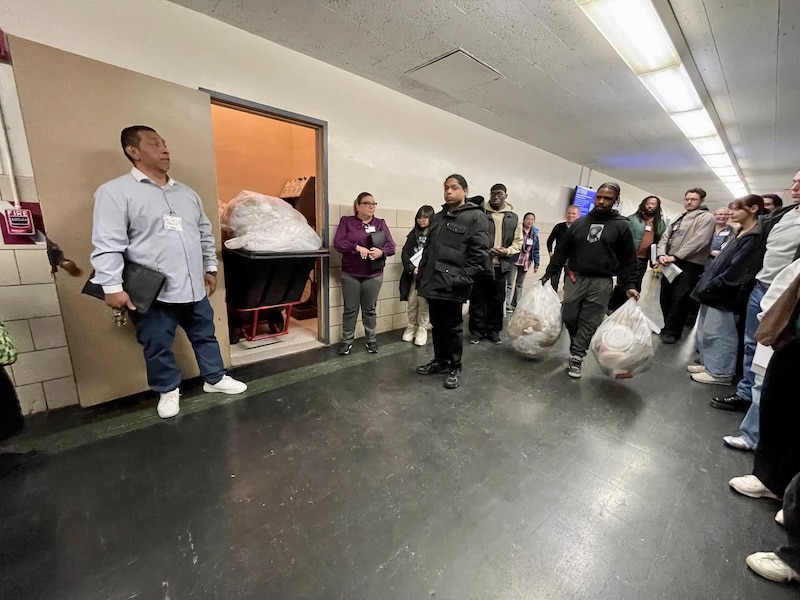 A custodial supervisor leads delegates on a tour of waste management on the Hunter campus as a custodian walks through carrying bags of trash. (Karen Loew / New York Focus) A democratic innovation
Central to any citizens assembly is the selection of participants by lottery. In a given city, an invitation might be mailed to as many as 10,000 to 20,000 people. Of those who respond, several dozen participants are usually chosen with tools that select for both randomness and demographic representativeness.
Running a successful assembly is labor-intensive. Organizers must secure funding, get buy-in from decision-makers who have the power to act on the assembly’s consensus, and recruit a qualified team to plan and lead the process over weeks or months. CCAP was funded by a Mellon Foundation grant to the CUNY Center for the Humanities and led by professional facilitators and trained graduate students.
But the payoffs can be significant. Proponents say citizens assemblies surface genuine public opinion and generate creative solutions that politicians — constrained by loyalties and conflicts — might never reach. They build trust in public policymaking, and participants often report feeling more engaged in democracy, sometimes for the first time.
Former New York City comptroller and council member Brad Lander called for a citizens assembly on housing while campaigning for mayor last year. “At a time of catastrophically low trust in our democracy, I believe citizens assemblies can help to renew it,” Lander, who is now a candidate for Congress, told New York Focus.
The model also forges unusual bonds: Because a citizen assembly’s “mini-public” mirrors the demographics of its community, participants collaborate with people unlike them politically and socioeconomically, and elected officials get policy options with democratic legitimacy already built in.
Local leaders
The Hunter College climate project isn’t the city’s only citizens assembly.
Last month, New York City residents over the age of 11 voted on local projects in a city-sponsored deliberative process called The People’s Money. The five boroughs have $4 million total to spend on priorities selected through borough-level citizens assemblies.
Now in its fourth cycle, The People’s Money unfolds in four phases: open idea submission, a citizens assembly in each borough to choose finalist ideas, a public vote, and then implementation. Projects have included swim lessons for children in NYCHA housing, food-growing and cooking programs, and housing education for older adults.
The program is run by the Civic Engagement Commission, which was created by a 2018 referendum to initiate a citywide participatory budgeting process (in addition to the participatory budgeting programs run by many City Council members in their own districts).
“People themselves do know what is best, and they can arrive at conclusions that work for the community and that are legislatively feasible,” said Benjamin Solotaire, senior adviser at the Civic Engagement Commission, who helped to integrate the assembly component into The People’s Money process. “It is really the lived experience that makes it feasible.”
New York and beyond
The climax of the Hunter College assembly’s campus “garbage tour” was a visit to the trash compactor on East 67th Street, where delegates watched as custodians on a high platform emptied trash from the entire campus into a massive metal container before it was carted away by the Sanitation Department. The goal was to see the problem up close.
Rozen Kapadia, a junior studying psychology, said her role on the assembly was already changing her mindset. “I do feel responsible,” she said. “I feel expected to bring about change.”
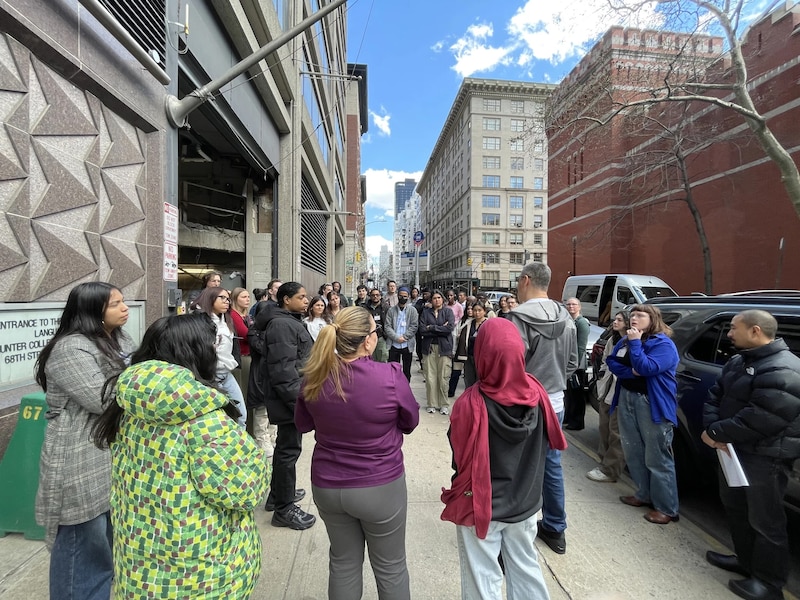 A staff custodial supervisor answers assembly members’ questions outside the compactor on East 67th Street. (Karen Loew / New York Focus)
Over the two months that followed, the delegates worked to achieve it. They sought information from outside experts. They met every Friday to learn, deliberate and ideate. A public forum on May 15 included the broader campus community. In early June, the assembly developed and voted on nine recommendations, passing seven with a strong consensus. Those include expanding the compost program, barring on-campus vendors from distributing styrofoam and single-use plastics, and redesigning and relocating trash receptacles to encourage recycling.
The results will be discussed with the administration over the summer. Then nine students will serve as post-assembly fellows, working with campus leadership to implement the proposals.
“This was a great experience,” said Hunter junior Tariq Bradshaw after the vote. “I think I’ll always look back on this time, because I never thought I would do anything like this before. It was great being part of something bigger.”
It’s unclear whether supporting citizens assemblies is a priority for Mayor Zohran Mamdani’s administration; neither the mayor nor his new Office of Mass Engagement answered questions about it. (OME’s first initiative is quite different: a campaign to recruit tenants to testify at upcoming rent stabilization hearings.)
Across the country, meanwhile, citizens assemblies are proliferating. This spring, Los Angeles used one as part of a city charter review, as did Lexington, Kentucky. Akron, Ohio, just conducted a citizens assembly on housing; Raleigh, North Carolina, held one focused on urban planning. Beginning in July, Connecticut will hold a statewide citizens assembly on property taxes.
Abroad, notable examples include the standing assemblies of Paris and East Belgium — whose recommendations have been adopted into law — and the 2016 Irish assembly that led the country to legalize abortion two years later.
Citizens assemblies are not infallible. French President Emmanuel Macron, for example, overpromised and underdelivered on implementing the French Citizens Convention on Climate six years ago.
Still, the model may prove well suited to society’s emerging problems. Two western communities have already launched assemblies on artificial intelligence: the Central Oregon Community Solutions Assembly on AI and the Snohomish County, Washington Civic Assembly.
If elected, Lander said, he’d love to do the same in New York. A citizens assembly could “transform an extractive, profit-driven model of artificial intelligence by using a democratic model for amplifying our collective intelligence,” he said.