
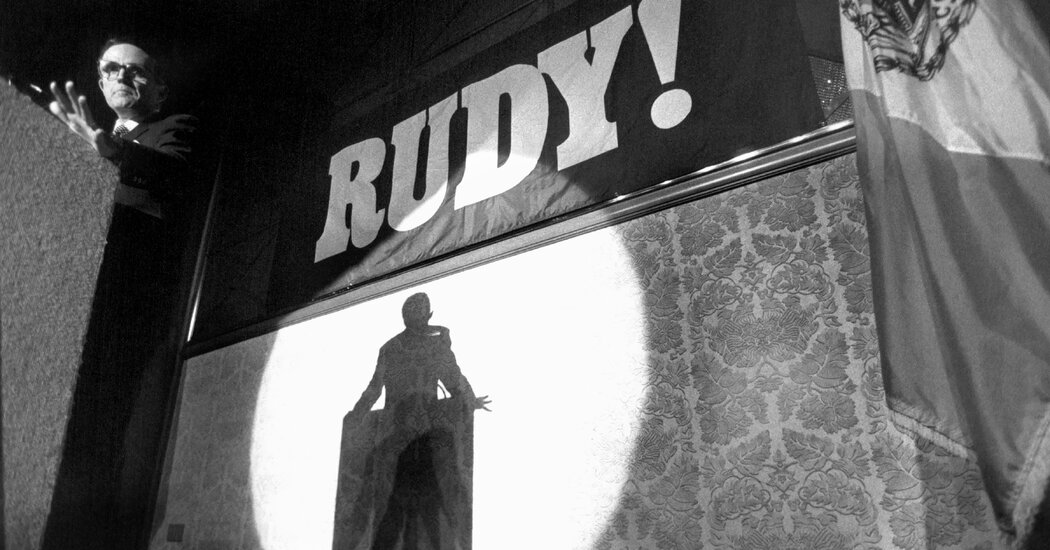
He did. With Manhattan Institute advisers by his side, Giuliani sought to make New York great again. The results were a mixed bag. Though the New York Police Department “reasserted an image of competence after three long decades of consistently high crime rates,” Williams writes, “its legitimacy in neighborhoods of color, always in question, had been deeply damaged by the rash of abuse and violence in Giuliani’s second term.”
In 1995, with the inauguration of George Pataki as governor, New York experienced what Williams deems a Republican moment. To be sure, he stipulates that “the Republican renaissance would fail to signal the full triumph of neoconservatism,” since conservatives were forced to compromise with Democrats on some issues. But even so, Pataki enacted sweeping measures curbing the rights of renters and promoting school choice.
Michael Bloomberg, who switched from the Democratic to the Republican Party to run for mayor in 2001, a job he held onto for three terms, “positioned himself as an apolitical problem-solver,” Williams writes, “who brought a businessman’s managerial approach to major urban issues.” But efforts at school reform by Bloomberg and his schools chancellor, Joel Klein, centered on small schools and the incessant testing of students, had iffy results: “For all the headlines about the system’s aggregate performance — in test scores, attendance figures, graduation rates — the story beneath the surface remained its ever-growing inequality.”
By 2011, the median New York rental household was paying over 30 percent of its income in rent, and a third paid over half. The housing crisis of the 1970s — arson and capital flight — had been replaced by a fresh one: overcrowding and homelessness. The poverty rate soared, reaching 25 percent in 2025. Meanwhile, the city became home to the highest concentration of billionaires in the world.
It’s hard to avoid the conclusion that the proponents of Gotham’s reconstruction into a glittering mecca of global wealth have overperformed at the expense of just about everyone else. Williams completed his excellent book before the election of Mayor Zohran Mamdani, but it does much to explain the mounting backlash against the city’s conversion into an ostentatious playground for the wealthy.
CITY OF FORTUNE: Inequality and the Making of Contemporary New York | By Mason B. Williams | Norton | 372 pp. | $38.99