
Whether New Yorkers support the city’s four-borough jail program, now under its third mayor and priced at $16 billion, the project has seemed too far along to change course. But a 558-page geotechnical report from Langan, an engineering and environmental consulting firm, produced in the final months of the Adams administration, dated Sept. 26, 2025, describes a foreseeable danger to neighboring buildings in Chinatown.
Another foundation crisis on this block appears foreseeable. The question is what Mayor Mamdani intends to do about it.
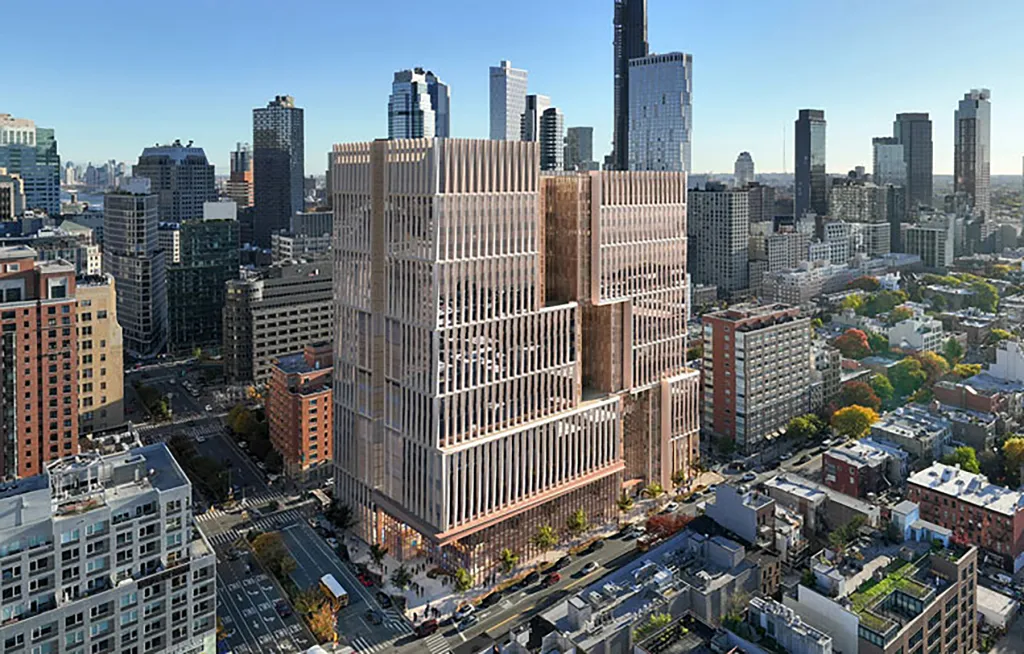
The Borough-Based Jails program began under Mayor Bill de Blasio in 2017 to replace Rikers Island. Eight years later, it is years behind schedule and on a 2027 deadline almost no one believes will be met. The Manhattan jail at 124-125 White St. is its largest and most contested facility: a 295-foot, 16-story tower (the tallest jail in the world upon completion) in the Chinatown and Little Italy Historic District.
As an architect who has practiced in Lower Manhattan for more than 35 years and worked on many complex foundation projects, I was alarmed when I read the Langan report. I was more alarmed that it has received almost no public attention.
The Manhattan jail sits directly in the historic footprint of the Collect Pond, Lower Manhattan’s first fresh water source, later filled with whatever was at hand. Beneath the site lie layers of fill, organic pond mud (445% moisture content), soft clay, sand and gravel, with bedrock 100 feet down.
Groundwater sits essentially at the surface. Contractors first install a continuous wall of overlapping concrete piles, socketed to bedrock around the perimeter, creating what engineers call a fully enclosed bathtub. Excavation then proceeds inside the wall, roughly 27 feet below the water table, with continuous pumping to remove seepage. Only then is the permanent waterproof inner structure built inside.
Building deep into Lower Manhattan is not inherently risky. The World Trade Center has been doing it successfully for more than half a century. With enough money, labor, and machines, almost anything can be built. But the WTC perimeter wall bears against firm Manhattan schist, exposed at the surface in places. The Manhattan jail site does not. It sits in 100 feet of saturated, compressible pond fill above bedrock, and the same engineering approach that holds back the Hudson at the WTC will be doing something quite different here.
The difference is plain in this block’s historical record. The original Tombs prison of 1838 was so structurally unstable that it was demolished. The 80 Centre St. office building one block south halted construction in 1928 when crews hit the swampy remnants of the Collect Pond, forcing a foundation redesign.
The Manhattan Detention Complex of 1939, the building demolished to make way for the proposed jail, ran into the same trouble: contractor litigation, delays, and a foundation of hundreds of caissons to bedrock, with continuous pumping for 87 years. Three previous attempts. Three foundation crises. Now the city is preparing the fourth, deeper than any of the previous three.
Contemporary engineering has not resolved these old risks, and the report does not pretend otherwise. Langan writes that, on similar projects, “groundwater eventually leaks through the numerous pile-to-pile cold joints,” and that water will also rise into the excavation through fractures in the bedrock below the wall.
Pumping during excavation draws down the water table outside the wall as well. The report is unusually candid about what follows: soils compress, adjacent structures settle, and older buildings on timber piles are particularly vulnerable, because removing the water exposes wood piles to air within the soil and begins their decay. In organic pond mud, settlement can amount to inches and is essentially permanent.
The report also catalogues what contractors should expect to encounter underground: buried foundations and abandoned piles, demolition debris, boulders, cobbles, and rock fractures that may create flow paths between foundation elements. The city’s own engineer cautions repeatedly that these conditions will affect schedule and construction methods.
The report also contains a contradiction that deserves public explanation. It permits up to two inches of lateral movement in the excavation wall during construction. City policy limits movement of adjacent historic structures to one-quarter inch.
All retaining walls bow inward, as the report acknowledges, and the ground behind them settles. That settlement extends roughly 90 feet behind the wall; the exact zone the city’s policy is supposed to protect. The buildings in that zone include the Chinatown and Little Italy Historic District, the Criminal Courts Building, and other landmarks such as Firehouse Engine Company 31. The city has not publicly explained how it will reconcile the wall’s permitted deflection with the policy protections for these structures.
Reasonable people can disagree about closing Rikers Island, about criminal justice policy, and about where replacement facilities belong. The issue is not preservation alone: damage to neighboring buildings would mean years of litigation, repair costs, and delays on a project already billions over budget.
Mamdani can still pause the project and ask the Council to reexamine its 2019 decision in light of the engineering report. The pause does not require abandoning the goal of closing Rikers. It requires acknowledging that this site, on this block, at this depth, is the wrong place to honor that goal.
The honest conclusion is not to dig less here. It is to stop altogether and reconsider before this generation repeats, at greater depth and greater cost, a mistake the city has already made three times on this block.
Bialosky is senior principal of Bialosky New York Architects in SoHo. He has practiced architecture in Lower Manhattan for more than 35 years.