
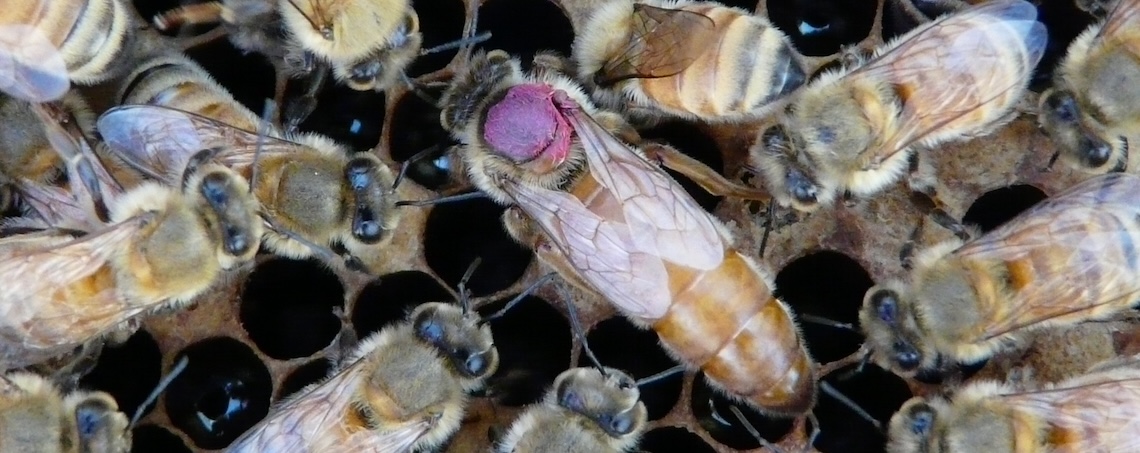
A honey bee queen surrounded by her retinue, which is an ever-changing group of worker bees charged with her care, feeding and protection. The fuchsia spot is applied to queen bees to make her easier to identify. (Sascha Nicklisch/UC Davis)
published on July 13, 2026 – 4:19 PM
Written by Frank Lopez
A new University of California, Davis study has found that honeybee queens chronically exposed to pesticides can transfer those contaminants to their eggs, a process researchers call maternal offloading.
The discovery offers new insight into how pesticide exposure may continue affecting colonies long after the initial contamination.
The research, published in the journal Current Biology, is the first to document maternal offloading in honeybees, according to the researchers.
The findings suggest pesticide residues may persist within a colony even after worker bees are no longer able to filter contaminants, creating potential long-term impacts on hive health.
Researchers say the information could help beekeepers, growers and integrated pest management professionals better understand pesticide exposure during key periods such as foraging and colony expansion.
California, particularly the Central Valley, depends on managed honeybee colonies to support the world’s largest annual commercial pollination event — the almond bloom.
The state relies on approximately 2.5 million to 2.8 million honeybee colonies each almond season, representing roughly 70% to 80% of all managed honeybee colonies in the United States.
According to data cited from the Honey Bee Health Coalition and the American Bee Federation, commercial U.S. beekeepers lost an average of 62% of their colonies between June 2024 and March 2025, the highest level recorded.
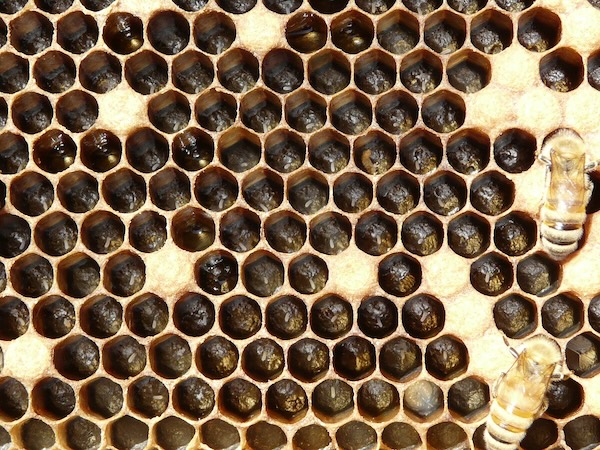 Honey bee eggs in hive comb cells. (Sascha Nicklisch/UC Davis)
Ben Zentner, CEO of 559 Honey, said he has observed queens transferring contaminants to eggs during his years of beekeeping.
Based in Kingsburg, Zentner provides pollination, hive management and honey production services throughout California.
A queen bee can lay up to 1,500 eggs each day, he said.
Zentner said pesticide exposure from neighboring farms remains a concern because bees can forage up to about 1.5 miles from their hives, increasing the possibility of exposure across property lines.
“There are a whole bunch of people that don’t deal in ag and don’t understand and there is also a whole lot of people who don’t understand all that comes out of this valley,” Zentner said.
He said greater public awareness of the role honeybees play in California agriculture is essential because healthy pollinator populations are critical to crop production and the state’s