
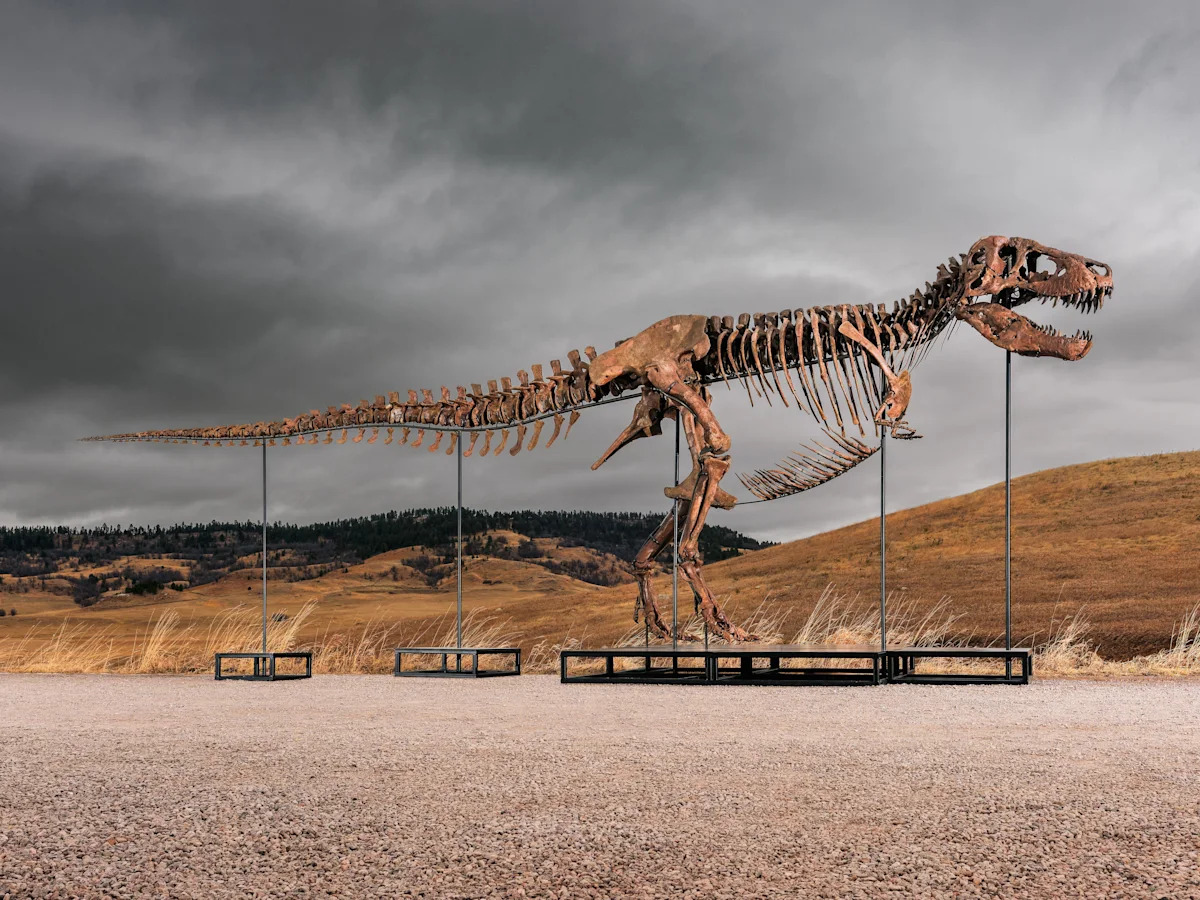
One of the most complete Tyrannosaurus rex fossils ever discovered was sold for over $50 million, making it the most expensive fossil ever sold.
On Tuesday, July 14, the fossil, known as Gus, was auctioned off by Sotheby’s, according to the auction house’s Facebook page.
The fossil is around 67 million years old and is not only the most complete, but also one of the largest T. rex fossils ever discovered, according to a news release from Sotheby’s.
“This result has been years in the making, and I’m thrilled to see that the hard work and dedication of Thomas Heitkamp and his team has been recognized,” Cassandra Hatton, Sotheby’s vice chairman and Worldwide Head of Science and Natural History, said in a statement to USA TODAY. “Gus is not only an exceptional find, but a specimen that’s been excavated, documented, prepared, and cared for with real excellence. The market responds when great specimens are taken care of in the right way.”
Ahead of the auction, the fossil was estimated to go between $20 million and $30 million and was “set to become the most valuable dinosaur offered at auction,” according to the Facebook post.
The fossil sold for a whopping $50.1 million, breaking the previous record of $44.6 million, according to Science.org. The record was held by a Stegosaurus fossil named Apex, which measures at around 27 feet in length.
The fossil was auctioned off at Sotheby’s Natural History live auction. The bidding for Gus began on July 14 at just after 10:30 a.m. ET, according to Sotheby’s website. It was auctioned alongside other prized fossils, including an Allosaurus jaw, a fossilized nest with the skeletons of two nestling dinosaurs and more.
Massive Pokémon sculptures meet real fossils at Field Museum exhibit
1 of 22
The Pokémon Fossil Museum at Field Museum in Chicago opens on May 22, 2026. The exhibit features nearly 30 Pokémon fossil sculptures, including Bastiodon, Kabutops, Tyrunt and Lileep, each paired alongside a real fossil or cast from Field’s collection. The exhibit is open at Field Museum through April 11, 2027.
(Greta Cross, USA TODAY)7 bidders tried to win over the magnificent fossil
For 10 minutes, seven bidders battled it out for their chance to win the fossil, according to Sotheby’s. It was an interesting start to the auction house’s “Geek Week,” when it will continue to auction scientific and historical artifacts, like an Apollo-Era glove.
The next auctions, called Space Exploration and History of Science and Technology, will take place on Wednesday, July 15.
Gus on display for the public
Gus was assembled and put on display at one of Sotheby’s New York City galleries in the lead-up to the auction, according to the auction house’s Facebook page. The gallery was open and free to the public throughout the weekend.
When and where was Gus discovered?
Gus was first discovered in Harding County, South Dakota, by Thomas Heitkamp and his team, according to Sotheby’s. It was discovered on land owned by his namesake, Gary “Gus” Licking, a cattle rancher. Excavation to uncover the fossil took place from 2021-2023.
For years, Licking found teeth and bone fragments on his ranch and thought there might be something bigger buried deep in the land. So, when he created a partnership with Thomas Heitkamp, the president of Theropoda Expeditions and the discoverer and excavator of the fossil, he suggested Heitkamp and his team search a 6,500-acre parcel of land.
That’s where the T. rex fossil was discovered. Licking died just one year into the excavation, according to Sotheby’s.

The largest and most completed T. rex fossil, according to Sotheby’s, went to auction in New York City on Feb. 14.
Gus is one of three T. rex fossils over 60% complete
Gus is believed to be the fossil of an adult T. rex. It is around 61% complete, according to Sotheby’s. It stands at 12.5 feet tall, its body measures 38 feet long and its skull is 54 inches long.
One of the most famous T. Rex specimens, Sue, is located around 800 miles west of where Gus was auctioned, at the Field Museum in Chicago.
Sue and Stan, another T. rex fossil located at the Natural History Museum in Abu Dhabi in the United Arab Emirates, are the only other T. rex fossils that are confirmed to be over 60% complete, per Sotheby’s.
When did the T. rex roam the Earth?
T. rex is believed to have been the largest two-legged predator in its ecosystem. It lived during the Cretaceous Period, around 66 to 68 million years ago, according to the Smithsonian. The dinosaur roamed across what is now Montana and Wyoming, and across the western United States, which most likely looked like the Louisiana floodplain all those millions of years ago.
The dinosaur is believed to have been a carnivore, or a meat-eater, and would have eaten whatever it could catch or scavenge.
This story has been updated to add new information.
Julia Gomez is a Trending reporter for USA TODAY and covers invasive species, space phenomena, scientific studies, natural disasters and trending news. Connect with her on LinkedIn, X, Instagram, and TikTok: @juliamariegz, or email her at jgomez@gannett.com.
This article originally appeared on USA TODAY: T. rex fossil sells for a monster price tag at NYC auction