
Pioneer of Minimal Art
Kunstsammlung Nordrhein-Westfalen (K20)
March 28–August 2, 2026
Düsseldorf, Germany
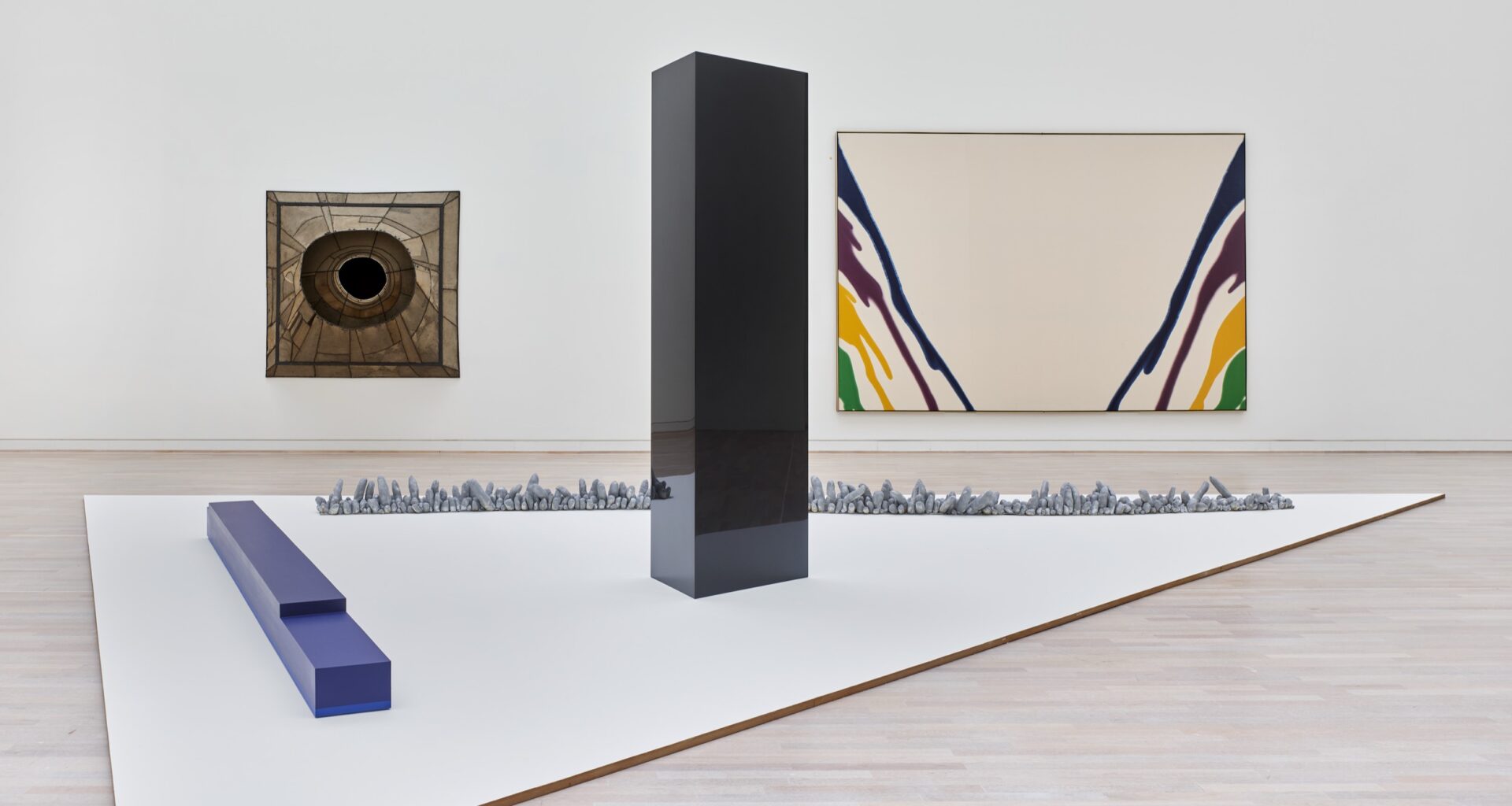
If you would picture the exhibition Anne Truitt: Pioneer of Minimal Art as a small town, the main square would be marked by a group of nine erect sculptures. Two such works, Toth (1983) and Evensong (2004), are rectangular columns in a minimal style. As a group, they are the most eye-catching works in the show. Similar in volume, most of them are slightly larger than life, and together they make a vivid impression, as though they are figures gathered on a square. Each has its own character, thanks to the way color is applied. The colors, and this is significant, do not just follow the form of the column, but create subdivisions, sometimes crossing over a corner and in other cases marking a horizontal band at the foot of the sculpture. Truitt used color to counterbalance the plastic form, and in her work it seems to have its own agenda.
In a short movie that is projected in the exhibition, Truitt can be seen noting that color can make things heavy, give them gravity, but it can also lift them up, and this was a quality she was particularly interested in—to lift things, to set them free through color. In order for that to happen, you need to take into account aspects such as saturation, value, and hue. The combination of these formal elements, and the amount that is used, will define if a color is going to sing, how it will vibrate, or if it will drop dead. It may sound as if Truitt approached color in a theoretical way, but the opposite is true. She learned through practice and experience, and strove for a certain effect, such as making material turn immaterial. She could achieve this by sanding the surface very smooth after priming it with gesso and applying many layers of colors. Truitt worked with precision, and this is something which can be felt throughout the exhibition, however her use of intuitive color joins this precision in form and scale.
In the early years, Truitt made some works that are quite solid in appearance. Hardcastle (1962) is a piece that simply consists of an upright, dark plane and two red wedges propped up behind it to hold it up. The whole thing rests on a pedestal. This sculpture is nothing but itself: a plank being supported and displaying proudly what is necessary to keep it upright as an object. Then, around the corner, there is again an example of Truitt’s lightness. In the painting Truitt ’69 (1969), a field of light yellow is layered next to pink, but between them is a divide, an open zip of raw canvas underneath. The proximity of these two works creates a dynamic contrast in atmosphere, establishing a matter-of-fact sensibility on the one hand, and her ability to make ethereal, airy works on the other.