
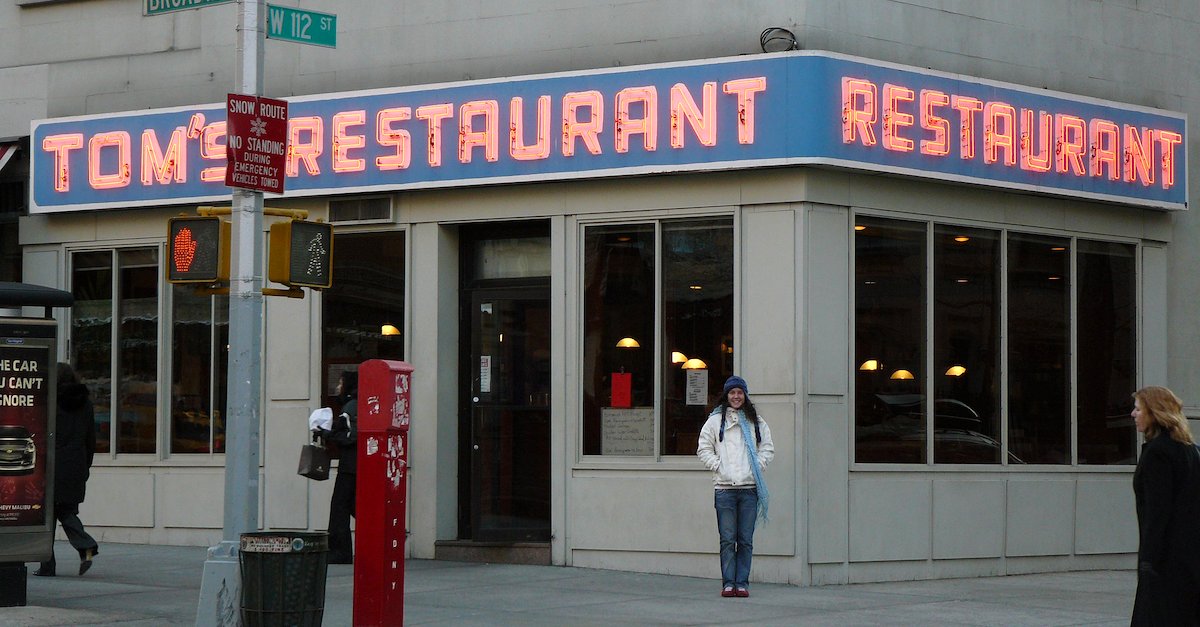
“Seinfeld’s Restaurant” by mertxe is licensed under CC BY-NC 2.0 

 .
.
Today’s guest post is by author Jennifer Keishin Armstrong.
I have what many people consider a dream job: I write books about some of the most popular TV shows in history. I’ve even become a New York Times bestseller doing so. My nine traditionally published books include Seinfeldia, Mary and Lou and Rhoda and Ted, Sex and the City and Us, and, most recently, Parks and Rec.
I first started writing books like this, with Mary and Lou and Rhoda and Ted, which is about The Mary Tyler Moore Show, in 2013. At that time, very few books went deep on TV shows. I wrote the proposal two years earlier using mostly movie-related comparative titles such as Sam Wasson’s Fifth Avenue, 5 A.M., about Breakfast at Tiffany’s, and Peter Biskind’s Easy Riders, Raging Bulls, about the 1970s film auteur revolution. Only Tom Shales’ and James Andrew Miller’s Live from New York: An Uncensored History of Saturday Night Live had succeeded in the television space, and it seemed like an outlier as a massive oral history of a decades-running show.
Mary and Lou got good reviews, including in The New York Times, but failed to take off in a major way. But Jon Karp, my publisher at Simon & Schuster, and I decided my next book should go as populist as possible by tackling one of the last true monoculture TV hits, Seinfeld. It worked, and when Seinfeldia was released ten years ago this summer, it became an instant and lasting New York Times bestseller. It also became the go-to comp that ushered in a flood of TV books since, about everything from The Office to Star Trek to Jeopardy!
No one thought Seinfeldia would be a hit when it was in the works, which is a fact I realized only after it broke through. Suddenly, there were more meetings unlocking higher levels of promotion, like a collaboration with the Hulu streaming service to co-promote the book and Hulu’s new acquisition of Seinfeld streaming rights. My publisher later explained during a panel discussion we did together that behind the scenes, books are generally categorized as long shots that will get little promotion, medium shots that will get a little push, and major priorities. With hitting the list, Seinfeldia moved from the medium category to the big time.
In the ten years since then, however, the subgenre that it forged, and the outlook for books like it, has evolved.
Even for me, someone with extensive experience and a track record, these kinds of books have become a much harder sell. The proliferation of rewatch podcasts, often hosted by famous people involved in the shows, and of books written by cast members has pushed journalist authors to the margins. In one particularly dark turn, from my perspective, Gilmore Girls creator Amy Sherman-Palladino and star Lauren Graham recently announced plans for a book about the series. Even though they have access, we’re often better equipped to provide—if I do say so myself—more context, critical analysis, and objectivity, but publishers are hungry for anyone with name recognition in an increasingly fractured media landscape.
And while stars have gotten more reluctant to participate in journalists’ books as they often hope to write their own or sell a podcast, publishers have begun to require authors to secure major sources before signing a deal. I sold my Mary Tyler Moore, Seinfeld, and Sex and the City books all without buy-in from sources, which I honestly find a little shocking in retrospect. In fact, I prefer the buy-in, too, to save me the stress of pursuing sources under the pressure of a book contract. I had co-creator Mike Schur and stars Nick Offerman and Amy Poehler on board for Parks and Rec at the proposal stage, and it was a much calmer experience.
With all of that said, I find that my agent and editors are still open to TV book pitches if they’re done right. Here are some of my additional tips—besides the crucial clinching of major sources—for assembling a TV book proposal:
Choose the right show
Obviously. But there’s a lot to consider beyond whether it’s a show you like. (It should definitely be not only a show you not only like, but one you can imagine immersing yourself in and talking about for years to come.) The first question is whether there are already any books on the topic. If there are, that doesn’t immediately disqualify yours. There are at least three major books on The Office, and star Jim O’Heir published a Parks and Rec book before I did. This can even be good, since it shows evidence of public interest, as long as you’re bringing a different perspective to the material. I also look for a genuine feeling of longevity and cultural significance: Will people want this book on their shelves ten and twenty years from now? Has the show made a genuine difference in television as well as in people’s lives? Is there a discernable fan base?
Find a story arc
You’re going to have to fill 300 or so pages on this show. Is there enough of a story to tell? What were the struggles and triumphs along the way, what was the aftermath of the show, and how does it still linger in culture today? All of this will need to sustain a lengthy narrative.
Have a take
What is the point of your book, besides behind-the-scenes stories? You can see my theses most clearly in my subtitles (which are the subject of much scrutiny from my agent and editors):
Mary and Lou and Rhoda and Ted: And All the Brilliant Minds Who Made The Mary Tyler Moore Show a Classic
Seinfeldia: How a Show About Nothing Changed Everything
Sex and the City and Us: How Four Single Women Changed the Way We Think, Live, and Love
Parks and Rec: The Underdog Show That Lit’rally Gave Us a Vision for a Better America.
Have (or build) the right platform
You’ll need this for securing your sources, honestly—stars are not going to sign on to talk to someone with no standing in journalism, books, or the show’s fan community. You’ll also need this to answer the question of why you, specifically, should be the one to write this book. I was an established journalist, having been on staff at Entertainment Weekly for ten years, when I sold my first books. Now there are other possibilities, such as being an entertainment news influencer with a large following, or a major figure in the fan community. If you don’t have those qualifications yet, it’s time to fire up a Substack or podcast on the show of your choice, and/or to pitch stories to major outlets about it.
And speaking of the fan community, it’s time to befriend them, too, regardless of your platform. Find the fan accounts online and follow them, listen to the podcasts, and join the Reddit threads.
Emphasize your personal connection to the subject
This goes along with your platform to demonstrate why you’re the perfect person for this job. I’ve had varying degrees of personal connections to my shows, but when I’ve had particularly juicy ones, I have emphasized them. The Mary Tyler Moore Show helped to inspire me to be a journalist; Sex and the City gave me the courage to end my engagement and embark on my single New York City life; Parks and Rec made me nostalgic for my early newspaper reporter days covering small-town government. In the cases of both Sex and the City and Us and Parks and Rec, I included some very personal reflections in the introductions, which I think assures readers that I care about my topic as much as they do. And that, in the end, is what we’re there to do—connect over a show that meant something special to all of us.

Jennifer Keishin Armstrong’s writing takes readers behind the scenes of major moments in pop culture history and examines the lasting impact that our favorite TV shows, music, and movies have on our society and psyches. She investigates why pop culture matters deeply, from The Mary Tyler Moore Show and Seinfeld, to Sex and the City and Mean Girls, to Beyoncé, Taylor, Olivia, and Sabrina. She has written nine books, including the New York Times bestseller Seinfeldia, When Women Invented Television, Sex and the City and Us, and Parks and Rec. Learn more at jenniferkarmstrong.com.