
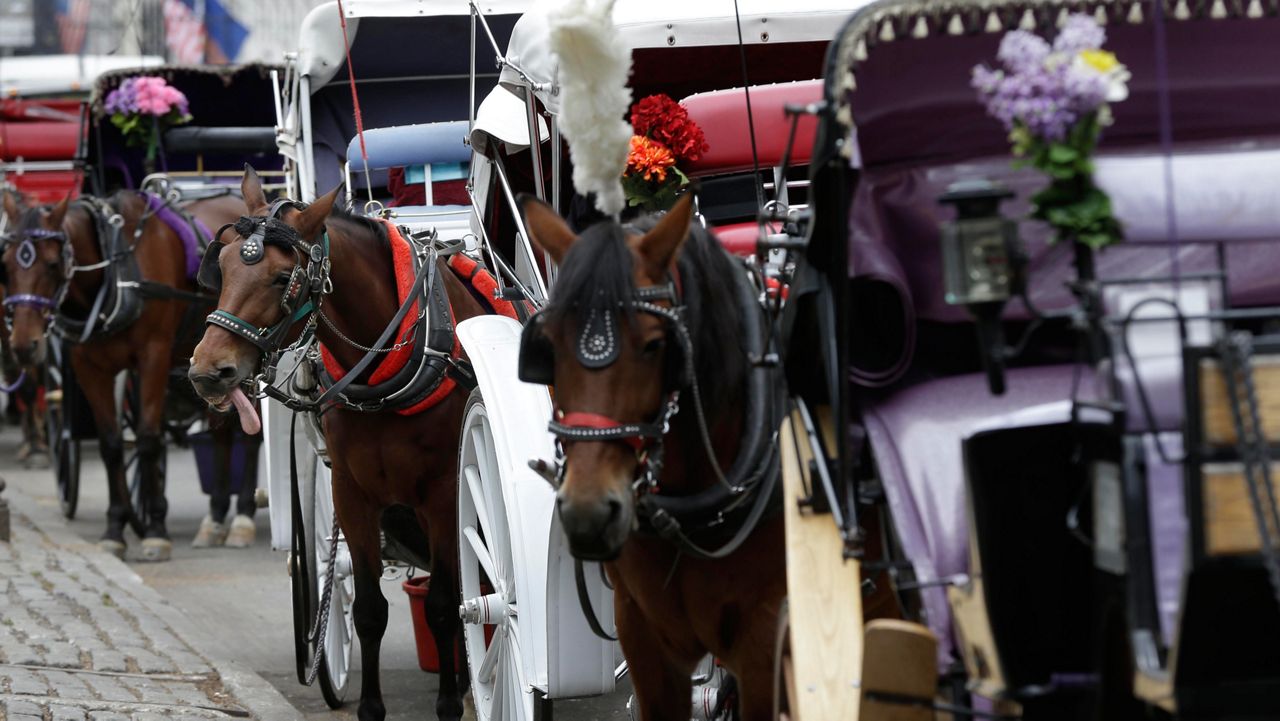
The City Council is considering a bill Wednesday that would ban horse carriages in the city.
The legislation would begin phasing out carriages before a total ban by June 2028 and create a program to support carriage drivers while they transition to new jobs.
The bill, formerly known as Ryder’s Law, was renamed Romanch’s Law after an 18-year-old tourist was killed last month in an incident involving a runaway horse in Central Park.
What You Need To Know
The City Council is considering a bill Wednesday that would ban horse carriages in the city
The legislation would begin phasing out carriages before a total ban by June 2028 and create a program to support carriage drivers while they transition to new jobs
The bill was renamed Romanch’s Law after an 18-year-old tourist was killed last month in an incident involving a runaway horse in Central Park
The council’s Committee on Health began discussing the bill at 10 a.m. Wednesday.
In a video statement on Tuesday, City Council Speaker Julie Menin declared her support for the legislation.
“The day has come for our city to begin the transition away from horse-drawn carriages as a tourist attraction in Central Park, for the safety of our residents, the safety of visitors from all across the globe, and the safety of the animals here at home,” Menin said.
Romanch Mahajan and his family, visiting from India, were sitting in a horse-drawn carriage in Central Park when cellphone video shows the carriage driver chasing the horse after it took off running with the family still inside.
At some point after the horse took off, police say the 18-year-old fell from the horse carriage and was taken to a local hospital, where he later died from his injuries.
His family has been advocating for a ban since his death.
Mahajan’s death came just over a week after a carriage horse died in the park after eating a poisonous plant, which had already reignited calls for a ban.
But the fatal accident has signified a turning point in the debate. For the first time last summer, the Central Park Conservancy came out in support of a ban, and has echoed that support since.
The horse-drawn carriage industry is more than 150 years old. For decades, the industry’s future has been debated in city politics.
In recent years, there have been several high-profile incidents involving carriage horses.
The union representing the carriage horse workers has pushed back against the ban, saying it takes the livelihood away from working-class New Yorkers.
In the weeks since Mahajan’s death, the union has argued that while it is a tragedy, it is an extreme outlier.
“There are dynamics to this industry that we represent, that no one is speaking to, because the truth is is that, then they would have to acknowledge that their interest is to get rid of the livelihoods of these workers,” Alexander Kemp, administrative vice president at TWU Local 100, said.