
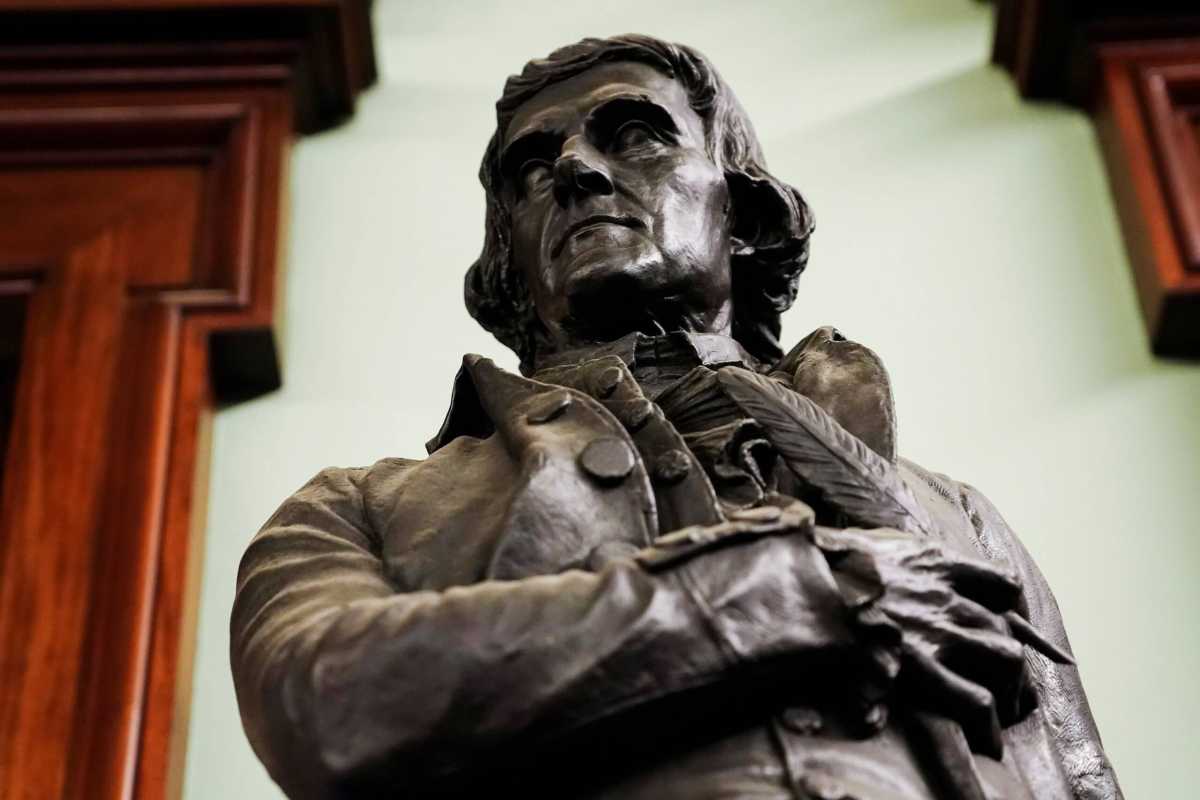
In an unexpected twist and turn in the journey of a famous Thomas Jefferson statue, the quill has been broken – and put back together again.
Amid celebrations of the 250th year of the signing of the Declaration of Independence, a well-known New York City statue of its principal author, Thomas Jefferson, was recently damaged.
A piece of the quill on the statue of Jefferson, which in 2021 was moved from the New York City Council chambers to New York Historical, broke off while it was moved to the Klingenstein Gallery in a new wing.
While the Statue of Liberty is a famous French gift, this painted plaster statue by French sculptor Pierre-Jean David d’Angers is a second famed statue with a French heritage linked to American history.
The somewhat towering, nearly 900-pound plaster statue, done in 1833, was moved from the Council amid concerns related to Jefferson’s history as the owner of a plantation with enslaved people.
A bronze version stands in the Capitol rotunda in Washington DC, while this plaster version has remained in New York City.
The slightly more than 7-foot-tall statue, on a 10-year loan to the New York Historical, was recently moved from a reading room to a more prominent place in the newly constructed wing.
“The Jefferson statue is a fragile work made of plaster not bronze,” a New York Historical spokesperson said. “In the recent moving of the statue from the research library to our new gallery, the quill was slightly damaged.”
It’s a “huge deal:” Todd Fine, historian
While the New York Historical describes the damage to the statue of the third president of the United States as minor, some historians believe any damage to such a historic work is significant.
“From my perspective as a historian, it’s a huge deal,” said Todd Fine, a historian and president of The Washington Street Advocacy Group, which focuses on public art. “Everybody knew this was one of the most fragile, valuable statues in the country.”
New York Historical in its description to the Public Design Commission, said a brace was moved higher on the shoulder to “avoid a previous stress fracture.”
“While shifting its position, the brace slipped and knocked the tip of the quill off,” according to the May 29 letter, from New York Historical Director of Conservation Kenneth Be. “The broken piece fits perfectly with the surface of the piece from which it was separated.”
Fine said multiple moves to and within the New York Historical could expose the statue to risk.
The New York Historical said they “informed the city, developed a conservation plan that was approved by the Public Design Commission, and Jefferson, with his restored quill, is now on prominent display in the Democracy Matters exhibition.”
Fine said it’s important to remember this statue is the property of New York City, questioning the wisdom of a long-term loan to a private institution, even a nonprofit.
“This was given explicitly as a gift to the people of New York City,” Fine said. “To give it to a private institution that uses it to promote an exhibit is objectionable.”
He said any damage “arguably bolsters claims that such an important statue should remain in public hands.”
The New York Historical attracts thousands of visitors who see and stand near the prominently displayed statue that they otherwise might never see.
“We are grateful for the city’s loan of this work,” the New York Historical spokesperson said, “and will continue to provide all conservation resources necessary for its care.”