
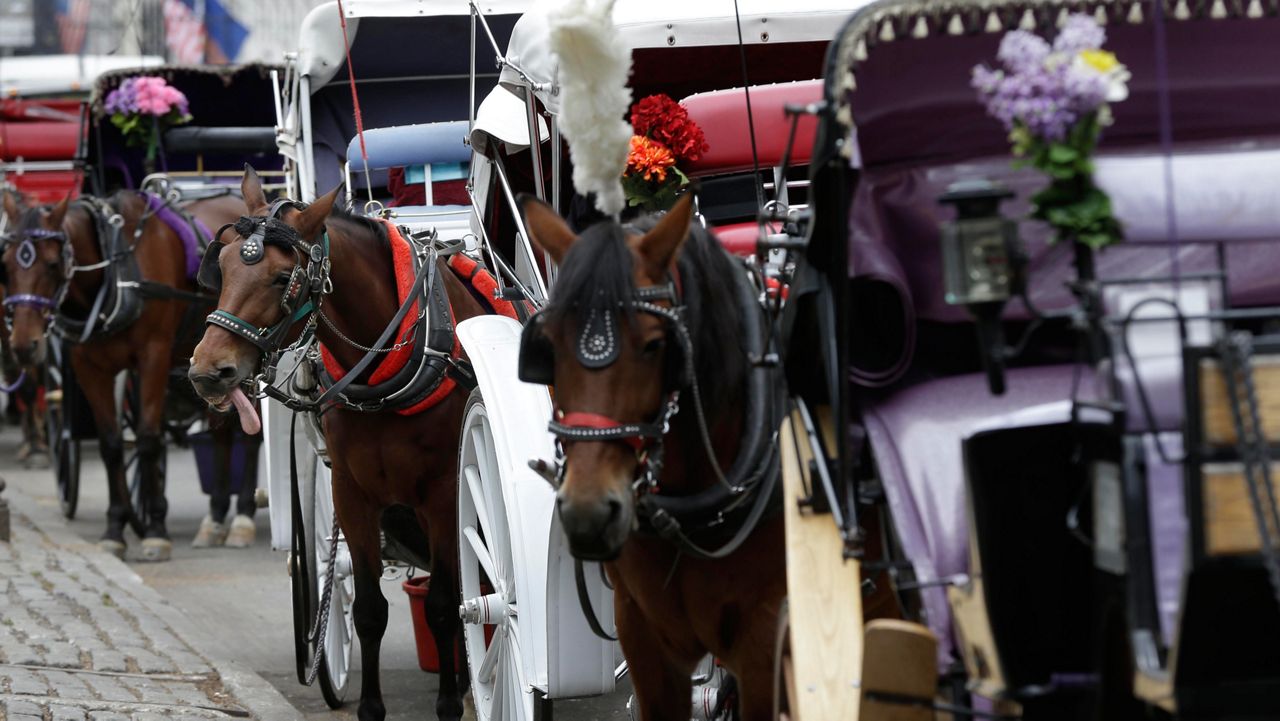
The City Council held a hearing Wednesday to consider a bill, known as Romanch’s Law, that would phase out and eventually ban horse-drawn carriages.
The bill is named after the 18-year-old tourist from India who was killed last month when he was thrown from a runaway carriage in Central Park after the horse was spooked.
What You Need To Know
The City Council held a hearing Wednesday to consider a bill, known as Romanch’s Law, that would phase out and eventually ban horse-drawn carriages
The bill is named after the 18-year-old tourist from India who was killed last month when he was thrown from a runaway carriage in Central Park after the horse was spooked
The bill would provide training to transition drivers into new jobs before a total ban in 2028, as well as retire the horses to sanctuaries
The earliest the bill could be voted on is August
If adopted, the legislation would begin phasing out carriages before a total ban by June 2028.
“He took his last breath in his mother’s arm, while his 11-year-old brother and I stood watching,” Deepak Mahajan, Romanch Mahajan’s father, said.
Deepak Mahajan testified before the City Council over Zoom from India in support of the bill named after his son.
Romanch’s aunt also pleaded to the Council to ensure that her nephew is the last person to die from the industry.
Emotions were high all around — from animal rights activists who support a ban to carriage drivers who are against it.
The bill would provide training to transition drivers into new jobs before the 2028 total ban, as well as retire the horses to sanctuaries.
The bill was formerly named Ryder’s Law after a horse that was caught on video in 2022 collapsing in Hell’s Kitchen and ultimately died.
“My original bill would have banned horse-drawn carriages in New York City June 1 of this year. Romanch died on June 17,” former City Council Member Robert Holden, original sponsor of the bill, said.
Former City Council Speaker Adrienne Adams would not bring the bill for a vote. This time, however, Council Speaker Julie Menin says she supports the legislation.
“Today, when you combine a public space teeming with tens of millions of people and animals that weigh more than 1,000 pounds and possess an instinct to flee, accidents and collisions become inevitable,” Menin said.
According to the city, the horse carriage industry is made up of 160 horses, 68 carriages and 208 licensed drivers, who are represented by the Transport Workers Union.
“It’s [been going for] more than 200 years,” John Chiarello, president of TWU Local 100, said. “We’re all sad for the family, but think of all these immigrant laborers who have a job, but won’t have a job anymore.”
“I am a horse person. I grew up in Lexington, Kentucky. Horse capital of the world. I own a horse. His name is Sherman Oaks, but he’s 12 years old. I expect him to live for another 20 years. And this bill is telling me that I can’t go work with my horse in another place to pull a horse and carriage,” Christina Hansen, a carriage driver, said.
Drivers say they need to be made whole. Many owners took out loans to buy their carriage medallions, and they’re basically small businesses. Menin said all of that is under discussion.
“The path forward must protect the workers. We have to address the medallion owners. All of that has to be negotiated, and I’m deeply committed to negotiate that,” Menin said.
The Mahjan family has retained a lawyer who says they plan to take action against the city.
There are over 20 cosponsors of Romanch’s Law, and the Council needs 26 votes to pass legislation. The mayor says he supports the law but is also concerned about having more worker protections in the bill.
The earliest the bill could be voted on is August.