
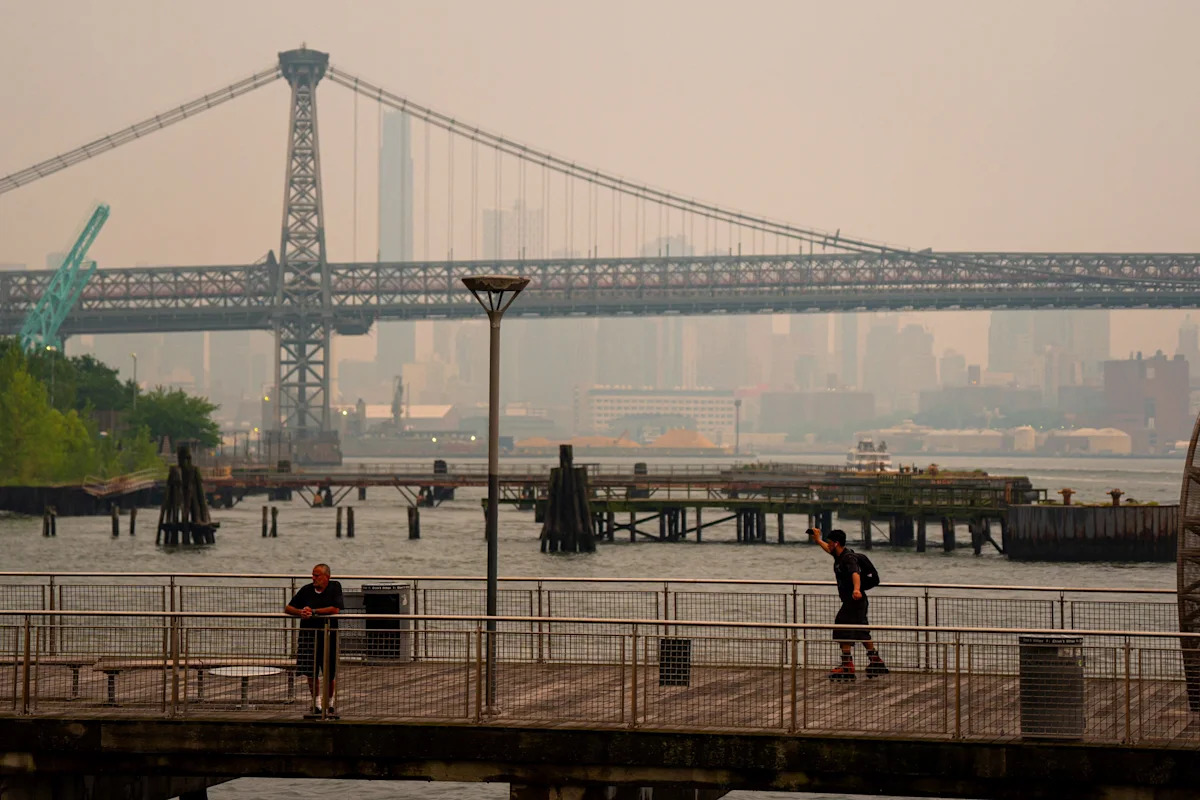
Smoke from Canadian wildfires continues to blanket parts of the Midwest, Great Lakes and Northeast, triggering air quality alerts and turning skies hazy from Chicago to New York City.
More than 830 wildfires are burning across Canada, with at least 100 considered out of control, as smoke from the fires drifts south into the U.S. Millions of Americans are under air quality alerts through the end of the week, with some areas reaching unhealthy levels and officials urging residents to limit prolonged outdoor activity.
While the 2026 wildfire season has been less active overall than the record-breaking seasons of 2023 and 2025, Canadian officials warn fire danger could increase as summer continues.
Forecasters say a shift in the weather pattern next week should gradually improve air quality across much of the eastern U.S.
Americans suffer poor air quality, hazy skies from Canadian wildfires
1 of 17
Wildfire smoke from Canada and Minnesota is causing poor air quality across the northern U.S. See the impact of wildfire and smoke across North America.
Smoke rises from the Lussier River Wildfire (N20809), north of Cranbrook, British Columbia, Canada July 11, 2026 in an aerial photograph.
(BC Wildfire Service, via REUTERS)When will wildfire smoke clear in Chicago?
Smoke is reducing visibility across the Chicago area Thursday, July 16, with the thickest concentrations generally along and northeast of Interstate 90. The National Weather Service in Chicago said smoke moved in along a lake-enhanced boundary, with webcams showing haze spreading across the city and visibility dropping near Lake Michigan.
Conditions should gradually improve Thursday night into Friday, July 17, as winds turn southwest and push near-surface smoke back toward the lake. Forecasters say lighter winds could slow the cleanup, but a stronger cold front moving through the Great Lakes early next week will bring a more widespread return of cleaner air.
More: Unhealthy air quality in Chicago amid wildfires. Check AQI near you
When will wildfire smoke clear in Detroit?
Southeast Michigan is seeing some of the densest smoke impacts, with air quality alerts in place as fine particles from Canadian wildfires reach the surface. The National Weather Service in Detroit/Pontiac said northwest winds are continuing to funnel smoke south from Ontario, reducing visibility and even limiting daytime temperatures by blocking sunlight.
Hazy conditions are expected to persist into Friday, July 17, before a wind shift helps gradually improve air quality. Cleaner air is expected after a cold front crosses the Great Lakes this weekend.

A screenshot of the Mackinac Bridge Authority’s live cameras shows haze over the bridge Wednesday morning, July 15, 2026, as wildfire smoke makes its way through Michigan.
When will wildfire smoke clear in Cleveland?
Smoke is expected to remain a problem across northeast Ohio through Friday, July 17, with reduced visibility and unhealthy air quality possible. The National Weather Service in Cleveland said north and northwest winds are carrying smoke into the region, with the worst conditions expected Thursday, July 16.
Gradual improvement is possible Friday as winds turn south and begin moving smoke away from the surface, though forecasters say it may take time for the haze to fully clear. A cold front this weekend will bring cooler, cleaner air.
When will wildfire smoke clear in Milwaukee?
Southern Wisconsin is seeing unhealthy air quality as smoke from wildfires in northern Minnesota and northwestern Ontario settles across the region. The National Weather Service in Milwaukee/Sullivan said visibility could fall to 1 to 3 miles at times, with the thickest smoke expected Thursday, July 16.
Southwest winds developing Friday should help improve conditions, though smoke near Lake Michigan may linger longer. A weekend cold front will bring additional relief.
When will wildfire smoke clear in New York City?
Hazy skies and reduced air quality are expected across the New York City area through Thursday evening as smoke from Ontario continues moving into the region. The National Weather Service in New York said visibility could fall to 2 to 5 miles as smoke mixes down toward the surface.
Smoke concentrations should peak Thursday afternoon and evening before winds shift Friday, July 17, and push the thickest part of the plume away. Forecasters expect improvement Friday, though smoke forecasts remain uncertain because of changing wind patterns.

A cover of wildfire smoke clouds the New York City skyline in New York City, U.S., July 15, 2026. REUTERS/Angelina Katsanis
When will wildfire smoke clear in Boston?
Smoke from wildfires in Ontario and northern Minnesota is spreading into New England Thursday, creating hazy skies and reducing air quality across the region. The National Weather Service in Boston/Norton said northwest winds are transporting the smoke plume into Massachusetts, Connecticut and Rhode Island, with visibility potentially dropping to 3 to 6 miles in some areas.
The worst of the smoke is expected Thursday afternoon and evening before conditions improve overnight. A cold front moving through the region will help push the smoke plume south and west by Friday, bringing less smoky skies and better visibility. Cleaner, cooler air is expected early next week after another weather system moves through.
Where are the Canada wildfires? Are they in Ontario?
Many of the wildfires affecting air quality concerns in the Northeast are burning in Ontario, Canada, as well as Minnesota and nearby regions, according to AccuWeather and Canadian wildfire maps. Smoke from those fires has spread across the Great Lakes and is forecasted to move toward New Jersey and the Northeast.

A satellite view of smoke from Canadian wildfires as it descends across the U.S. East Coast, North America, July 14, 2026.

Smoke rises from the Lussier River Wildfire (N20809), north of Cranbrook, British Columbia, Canada July 11, 2026 in an aerial photograph.
US air quality mapAir quality index levels
0–50 – Good: Air quality is considered satisfactory, and air pollution poses little or no risk.
51–100 – Moderate: Air quality is acceptable; however, there may be a concern for some people who are unusually sensitive to air pollution.
101–150 – Unhealthy for Sensitive Groups: Members of sensitive groups (e.g., children, elderly, people with asthma or heart/lung conditions) may experience health effects. The general public is less likely to be affected.
151–200 – Unhealthy: Everyone may begin to experience health effects; sensitive groups may experience more serious effects.
201–300 – Very Unhealthy: Health warnings of emergency conditions. The entire population is more likely to be affected.
301–500 – Hazardous: Health alert: everyone may experience more serious health effects. Avoid all outdoor activity.
Why does Canada have so many wildfires?
Canada’s wildfire problem is being driven by a combination of geography and climate. The country’s massive boreal forests provide abundant fuel, while hotter temperatures and drought are drying those forests faster.
U.S. weather watches and warningsStay informed. Get weather alerts via text
Brandi D. Addison covers weather across the nation as the Weather Connect reporter for the USA TODAY Network and contributes to Texas Connect coverage across the state. She can be reached at baddison@usatodayco.com. Follow her on Facebook here.
This article originally appeared on USA TODAY: When will wildfire smoke clear? Skies are hazy from Chicago to NYC