
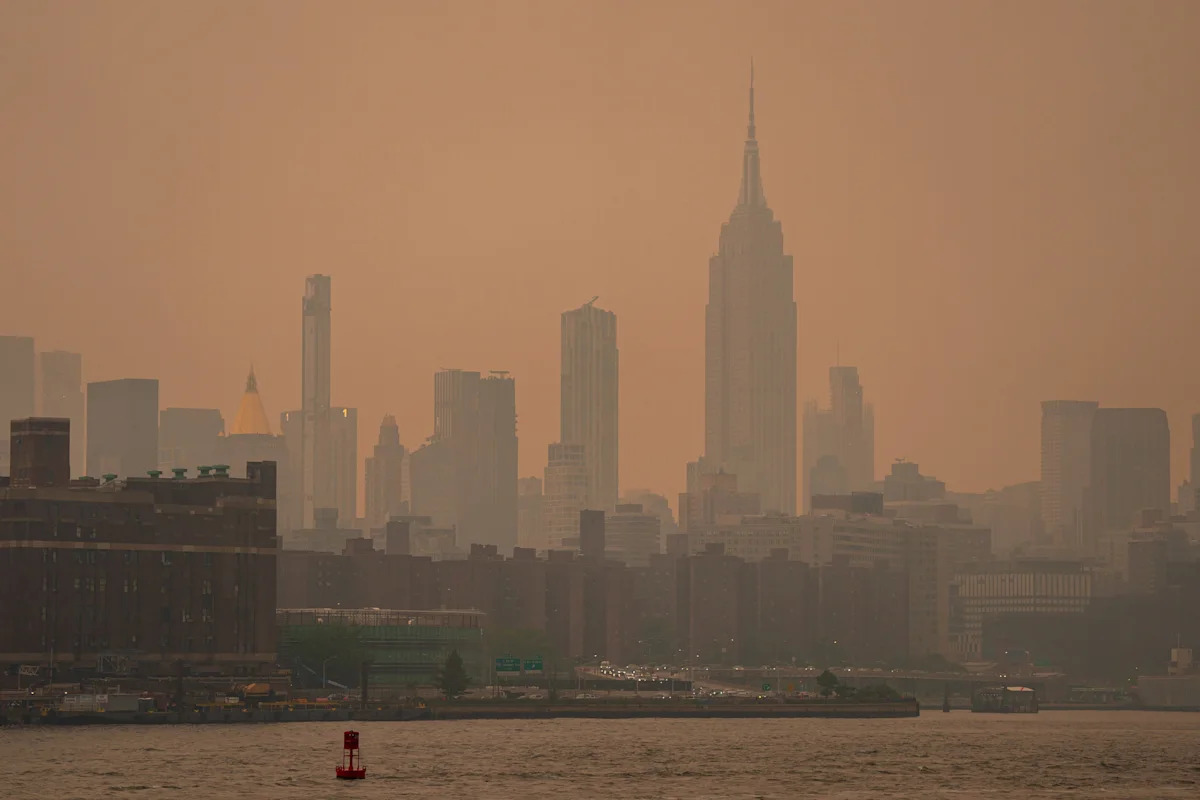
Hazy skies from Canadian wildfire smoke will continue across parts of New York on Thursday, July 16, as fine particulate pollution keeps air quality levels elevated across the region.
The National Weather Service in Upton issued an air quality alert for parts of the New York City metro area because of smoke-related fine particulate matter in the air.
The alert remains in effect until midnight for Rockland, Orange, Putnam, Dutchess and Westchester counties, as well as Manhattan, the Bronx, Staten Island, Brooklyn and Queens.
When will New York air quality improve?
Smoke is expected to linger across parts of New York through the end of the week, with patchy wildfire smoke possible through Saturday.
While skies may remain hazy at times, National Weather Service meteorologists said conditions in New York are not expected to be as severe as they were in 2023, when smoke from Canadian wildfires caused some of the worst air quality levels recorded across the region.
Air quality conditions can change throughout the day depending on wind patterns, temperatures and the movement of wildfire smoke.
Residents can check current conditions through the Environmental Protection Agency’s AirNow website.
Why are New York skies hazy?Canada wildfires smoke fills NYC area skies. See photos
1 of 10
Canada wildfires smoke is effecting the Lower Hudson Valley as seen looking westbound on Interstate 84 in the Town of Southeast July 15, 2026.
(Frank Becerra Jr./The Journal News)
Smoke from more than 830 wildfires burning in Ontario, Canada, and parts of Minnesota is being carried south by wind patterns into the Northeast.
The smoke contains fine particulate matter, known as PM2.5, which consists of tiny particles that can travel deep into the lungs and worsen asthma, heart disease and other respiratory conditions.
Smoke has created hazy skies across parts of the Northeast and Mid-Atlantic since Wednesday, July 15.
What are current air quality levels in New York?
The New York State Department of Environmental Conservation issued an Air Quality Health Advisory after forecasting Air Quality Index (AQI) levels above 100 because of elevated fine particulate matter.
An AQI above 100 is considered unhealthy for sensitive groups, including children, older adults and people with asthma, heart disease or other respiratory conditions.
The U.S. Environmental Protection Agency reported:
Lower Hudson Valley: AQI of 71 as of 6:45 a.m. Thursday, indicating moderate air quality.
New York City: AQI of 110, considered unhealthy for sensitive groups.
State health officials recommend limiting strenuous outdoor activity and wearing a well-fitting N95 mask if exposure to wildfire smoke cannot be avoided.
Who is most at risk from wildfire smoke?
Wildfire smoke can irritate the eyes, nose and throat and worsen existing health conditions.
People most vulnerable include:
People with asthma or other lung conditions
People with heart disease
Anyone experiencing breathing problems, chest pain or worsening symptoms should contact a health care provider.
How can you protect yourself from poor air quality?
The Environmental Protection Agency recommends limiting time outdoors when the AQI exceeds 100, especially for people in sensitive groups.
Additional steps to reduce exposure include:
Keep windows and doors closed.
Use an indoor air purifier if available.
Run air conditioning on the recirculate setting with a high-efficiency filter.
Avoid activities that increase indoor air pollution, such as vacuuming, burning candles, frying food or using gas appliances.
Clean dust with a damp cloth instead of dry dusting.
Wear a well-fitting N95 mask if you must spend extended time outdoors during periods of poor air quality.
What the Air Quality Index means
The AQI measures air pollution on a scale from 0 to 500. Higher numbers indicate greater health risks.
0-50 (Good): Air quality is satisfactory with little or no health risk.
51-100 (Moderate): Air quality is acceptable, though unusually sensitive people may experience effects.
101-150 (Unhealthy for sensitive groups): Children, older adults and people with heart or lung conditions may experience health effects.
151-200 (Unhealthy): Everyone may begin experiencing health effects, with greater risks for sensitive groups.
201-300 (Very unhealthy): Health alert; everyone may experience more serious effects.
301-500 (Hazardous): Emergency conditions; everyone should avoid outdoor activity.
This article originally appeared on Rockland/Westchester Journal News: Wildfire smoke in NY: How long will hazy skies and poor air quality last?