
In 2024, the New York Mets selected Carson Benge with their first-round pick. In 2025, he embarked on his first full season of professional baseball. In 2026, he was the Mets’ Opening Day right fielder.
It was a quick and uncommon rise through the minor leagues for Benge, and one that perhaps put too high expectations on the organization’s subsequent first-round pick, Mitch Voit. The No. 38 pick out of the University of Michigan, Voit didn’t enjoy the immediate success Benge did. In his pro debut in his draft year, Voit hit .235 with a .637 OPS in 22 games. Then, to start his first full season in 2026, he posted back-to-back months with an OPS under .700.
First impressions are important, and Voit’s wasn’t great. As a result, though, his resurgence has flown a bit under the radar. It started midway through his second month, too.

The statistical breakdown of Mitch Voit’s turnaround
Voit’s struggles in 2026 are mainly confined to his first 25 games. In that stretch from April 3 to May 10, Voit hit .208/.286/.347/.632 with a 25.9% strikeout rate and 6.3% walk rate. His wRC+ in that span was 71, making him 29% worse than the average High-A hitter. He was striking out way too much, and when he was making contact, he wasn’t doing much damage with it.
In 13 games to finish May, Voit’s production ticked up, hitting .244/.368/.467/.835 with three home runs, the same number he hit in his previous 25. He was still striking out too much at 26.3%, but crucially, his walk rate more than doubled to 14%.
June was a breakthrough. In 21 games, Voit hit .305/.426/.476/.901 with three more homers, five doubles and dueling 12.9% strikeout and walk rates. His wRC+ for the month was 144. He also stole 12 bases in the month after stealing 14 in his first 38 games.
This is who Voit is when he’s at his best. If Voit is striking out over 25% of the time, he doesn’t have enough thump in his bat to offset it. His profile was billed as a solid all-around hitter who would make good swing decisions, paired with being a plus runner and a potentially plus glove up the middle. If he’s making more contact and drawing more walks, then his average power will play better, and he can take advantage of his speed more often on the basepaths. He’s up to 31 stolen bases in 36 tries on the season. That’s significant.
That brings us to July. Through the first nine games, Voit is hitting .176/.326/.353/.679. It might appear to be a regression on the surface, but I don’t think it is. When Voit struggled earlier in the year, he was striking out a lot while drawing few walks. In this nine-game stretch, both his strikeout rate and walk rate sit at 16.3%. He’s still walking, and he’s still limiting strikeouts. He’s also still hitting for power, smacking two home runs in the nine games. Odds are, it’s likely just batted-ball variance that will correct itself with a larger sample size.
Voit might be the most interesting Mets minor leaguer to watch in the second half. Some might be having better years, but seeing if the organization’s first-round pick from a year ago can maintain what he’s done over his last 43 games and not slip back into his first 25 is a compelling storyline. If he can maintain, he’ll cement himself as a no-doubt top-10 organizational prospect.
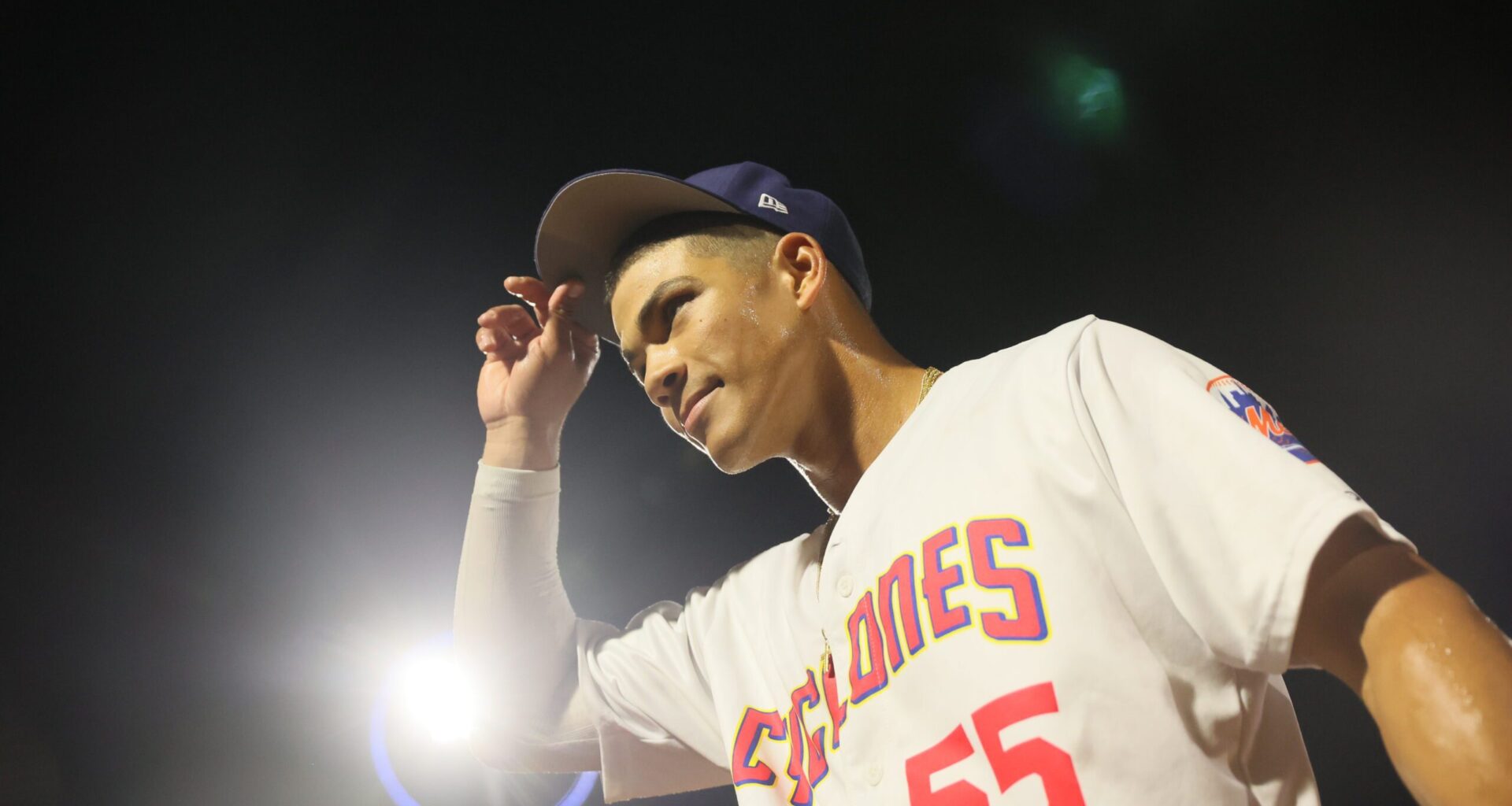
Prospect Mitch Voit is hitting well in Brooklyn. Photo by Matt Kipp / Brooklyn Cyclones