
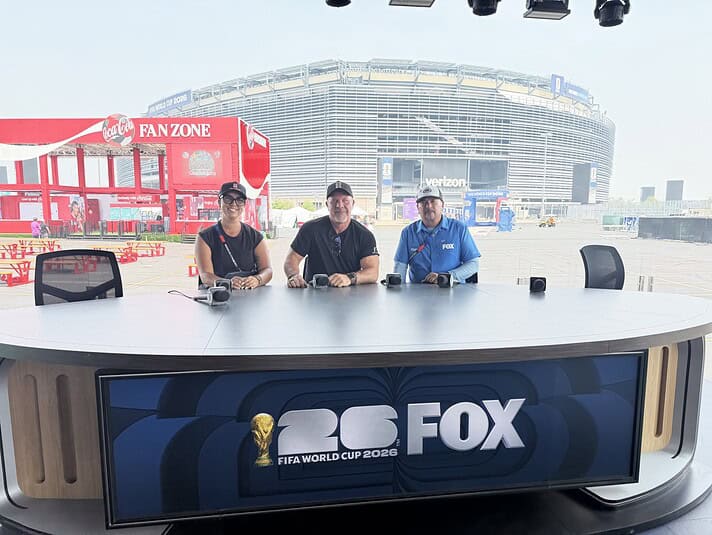
The broadcaster’s massive effort covering 104 matches across North America was led by a small team in Los Angeles
When FOX Sports SVP, Remote Studio Operations, Rod Conti talks about choosing a backdrop for a broadcast set, he thinks like a painter — or at least like the people who used to commission painters.
“In the old days before mass media, paintings were commissioned to tell a story,” he says. “If Napoleon won a battle, the painter who was commissioned would represent him however the story needed to be told. That was like your press. And that’s essentially how I look at our backdrops for sets.”
For the start of Sunday’s FIFA World Cup Final pre-match show, that backdrop is the Manhattan skyline as seen from Brooklyn Bridge Park — the Brooklyn Bridge and Freedom Tower framed in the distance, a sprawling Adidas-sponsored fan fest humming behind the set. It is, by Conti’s assessment, one of the best shots his team has ever had.
“When you see this backdrop, you’re seeing Manhattan, you’re looking at the Brooklyn Bridge, you’ve got the Freedom Tower in the frame,” he says. “We all felt like this was gold.”
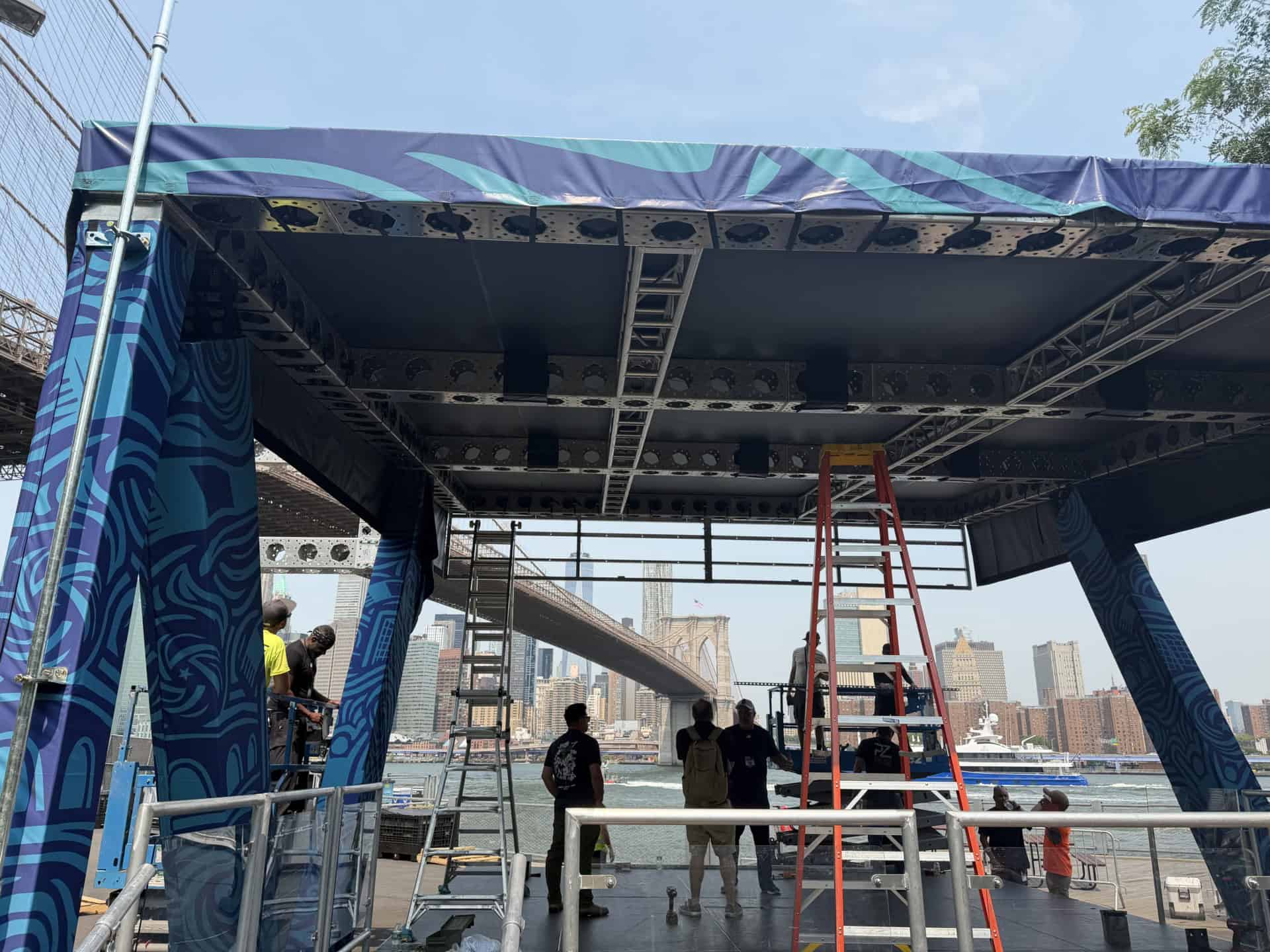 For FIFA World Cup Final pre-match show, FOX Sports built a studio set at Brooklyn Bridge Park with a backdrop featuring the Manhattan skyline.
It is also, in nearly every other respect, one of the most complicated productions FOX Sports’ remote-studio–operations team has ever attempted.
Ferry, Helicopter, Escort: Two Sets, One Day, 40 Minutes
Sunday’s pregame coverage will unfold in two acts. The first begins at Brooklyn Bridge Park, where FOX’s main talent will host for roughly an hour against that Manhattan backdrop before departing — by ferry across the river, helicopter around the Statue of Liberty, and ground escort from Teterboro Airport — to MetLife Stadium in New Jersey, where the second act picks up outside the stadium ahead of kickoff and then continues inside.
“Much like our Super Bowl model, it’s all about following the fans,” Conti says. “We’re coming from New York with the backdrop of the city and then heading over to Jersey, where the match will take place.”
Getting to this point required a full location survey of New York City — Times Square, Central Park, and Bryant Park among the sites considered — before landing at Brooklyn Bridge Park through a partnership with Adidas, which has operated a fan fest there throughout the tournament. Working within the Adidas footprint simplified the regulatory path considerably.
“They did a lot of that pre-work for us,” Conti says. “We were just looking at placements in the park, egress, and so on.”
Notes FOX Sports EVP, Technical and Field Operations, Michael Davies, “Match 104 of 104 caps years of work by thousands of people, the biggest sporting event ever produced. Our mantra is making the technically complex look effortless on screen, and nothing has been more complex than this. The sets are just the framing for the talent we’ve assembled one last time: a fan’s journey from Brooklyn Bridge Park with our partners at Adidas, to the Fan Experience, to our platform inside.”
Construction pushed the set closer to the waterfront than originally planned, which Conti now counts as a happy accident. “We’re getting an unobstructed view from the drone looking at us at the foot of the bridge. It’s magnificent.”
A 45-ft. Technocrane will be deployed alongside drone coverage to bring the fan fest into the broadcast. The Brooklyn set will also serve as the host location for the third-place match, which takes place Saturday in Miami.
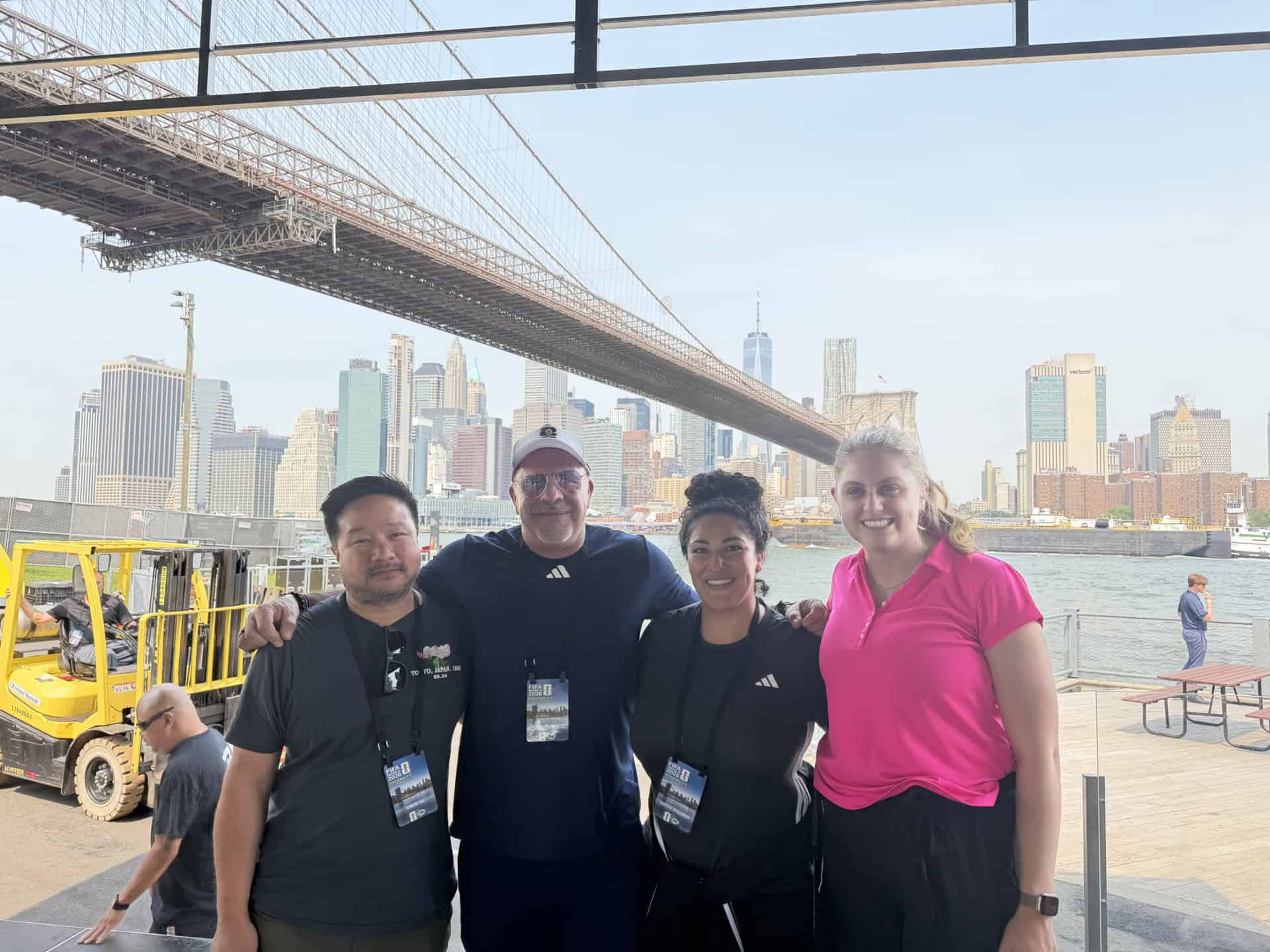 FOX Sports’ crew at the Brooklyn Bridge Park set: (from left) Johnny Chou, Rod Conti, Senior Operations Manager Patricia Fisher, Tara Schumal
In a last-minute wrinkle, a transmission issue forced the team to bring in a full production truck — the MTVG truck is parked on Water Street — instead of the BRISK (Broadcast Remote IP Studio Kit) unit that has supported nearly all the remote studio shows throughout the tournament. The truck is serving the same field-acquisition role that a BRISK kit would, shipping feeds to the primary control room in Los Angeles, where the broadcast will be produced.
Tying Brooklyn, MetLife, team hotels, and several other live positions together on Sunday falls to FOX Sports Studio and Coordinating Remote Director Courtney Stockmal, working from FOX’s Pico facility in L.A.
“The bigger obstacle is in L.A.,” Conti says. “Courtney is directing all our spots — not only MetLife but our team hotels, all the remotes coming from all over the city. It’s quite the endeavor to have all those things set up technically and work in line and in timing with everything else.”
At MetLife Stadium, Lead Operations Tech Daniel “Pineapple” James and his crew ran 4,000 ft. of fiber to support the exterior set, extending the infrastructure provided by host-broadcast partner HBS. For redundancy, backup gear — including the BRISK system previously used in Doha and Sydney — is staged onsite in a tent.
BRISK Tournament: IP Infrastructure Powers Remote Sets
The Brooklyn exception aside, the technical backbone of FOX’s World Cup remote-studio operation has been its six BRISK systems: ST 2110–based flypacks designed to extend the broadcaster’s Pico production environment into the field without requiring a full truck or standalone production operation at each location.
Each BRISK system functions as a field extension of Pico: cameras and sources from remote locations feed into the main production as additional sources, folded into the same environment as if they were onsite. Graphics, replay, media workflows, and production control remain centralized in Los Angeles.
The systems were designed specifically to move fast, allowing FOX Sports’ remote-studio team to set, shoot, and strike quickly with minimal fuss. James and his team have that process down to a science: each system is deployed on match day minus two, and full technical setup is completed by minus one.
“We can get it powered and interconnected in an hour and a half,” James says. “We also went to a lot of repeat venues where infrastructure was already in place, so we weren’t running fresh fiber to the interconnect room each time. It has been working really well.”
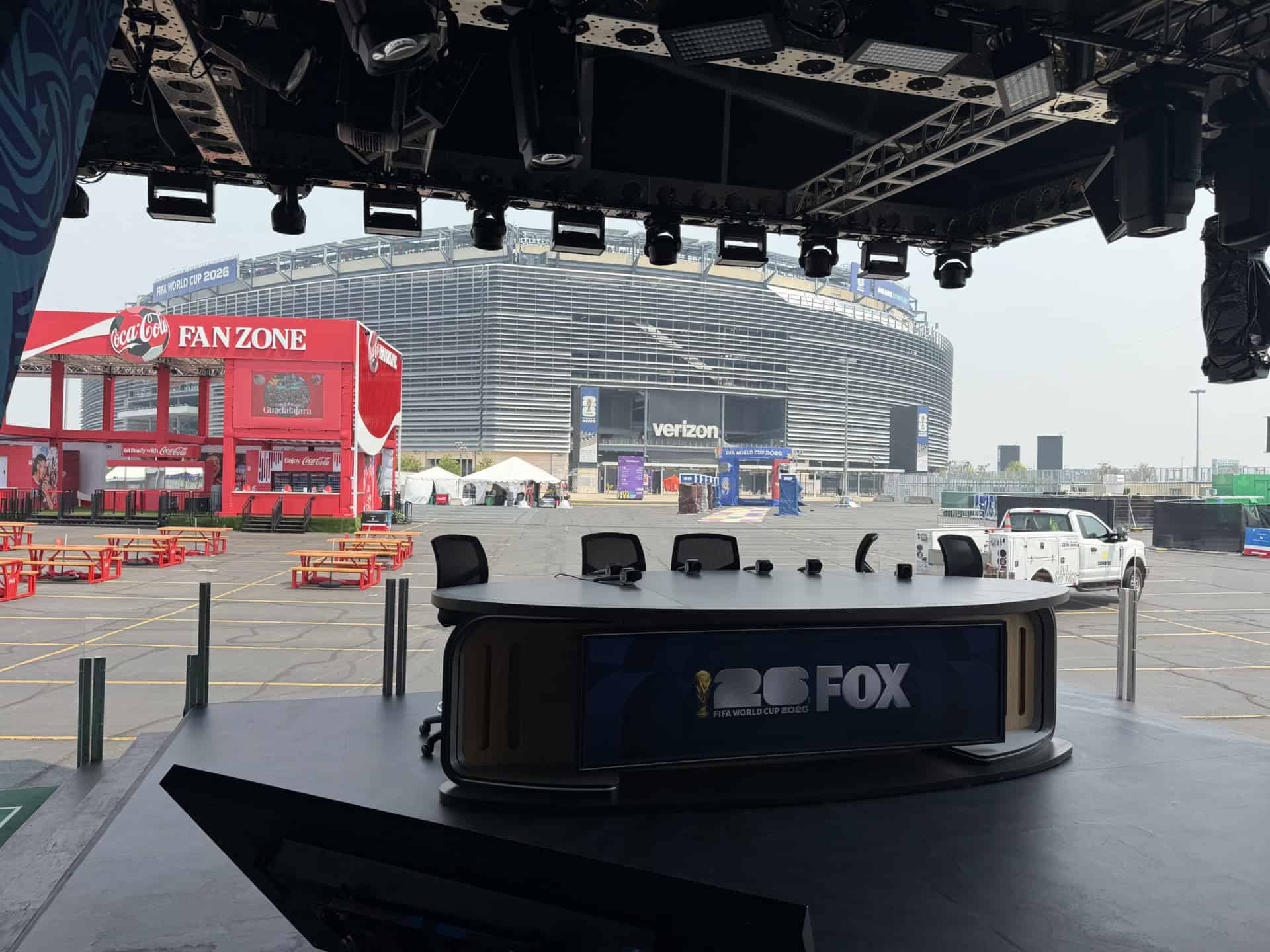 FOX Sports caps off the FIFA World Cup with the Final at MetLife Stadium.
The systems are also built for vendor pre-positioning. Instead of lighting racks and LED boards being shipped with each kit, partners like LMG have staged duplicate equipment at each location.
“If you went to L.A.,” James points out, “there’d be another lighting rack there; one in Boston, one in San Francisco. As long as those were pre-positioned, everything is self-sufficient.” Power infrastructure was similarly staged through partners Aggreko and Sunbelt.
Overseen by Tech Engineer Noah Johnson, BRISK 2, the system based mainly on the West Coast and primarily following the U.S. Men’s National Team (USMNT) until it was eliminated, is on hand at MetLife Stadium.
Built on Motion: Six BRISK Kits Run by One Small Team
For the first six weeks of the tournament, FOX Sports’ remote-studio operation was unlike anything the team had built before. Instead of anchoring in one host city with a signature set, the broadcaster constructed seven outdoor presentation platforms across North America — at SoFi Stadium in Los Angeles, Lumen Field in Seattle, AT&T Stadium in Dallas, Mercedes-Benz Stadium in Atlanta, GEHA Field at Arrowhead Stadium in Kansas City, MetLife Stadium in New Jersey, and Hard Rock Stadium in Miami — with smaller setups in Boston, Philadelphia, Mexico, and Canada. When the USMNT advanced to a match at Levi’s Stadium in San Francisco, an eighth full set was added on the fly.
The team managing it all — Conti; Senior Manager, Operations, Patty Fischer; and Executive Director, Remote Engineering and Operations, Greg Pfeiffer — did so for the first time entirely from Pico instead of traveling the circuit.
“We were essentially serving as air-traffic control, guiding things all over North America from one central location,” says Conti, noting, “There had to be a lot of trust in the great crews we have. We were like outside cats stuck in a windowless room, which was weird for this whole group. It was very successful and was definitely the right call, but we’re glad to be back in our natural habitat doing what we probably do best, which is having our hands on things onsite.”
Fischer describes the adjustment as both difficult and ultimately effective: “At first, it was a little hard to accept not being out on the road. But it was very beneficial to be at HQ managing all the sites. It has been a 24-hour operation when it comes to crew travel, logistics, and getting into site.”
To provide flexibility in the field, Set Designer Johnny Chou deliberately over-engineered the inventory of sets and podiums: seven desks and 12 podiums built across the country, including a floater desk that could be repositioned on short notice.
“It was about getting ahead of any situation,” he explains, “having enough foresight to see something coming.”
That foresight proved essential when the USMNT’s run required construction at Levi’s Stadium on short notice. Chou and James flew from L.A. to San Francisco to conduct a site survey — with roughly 50 FIFA, HBS, and FOX venue staffers waiting on their assessment — and then flew back within hours to make that day’s show.
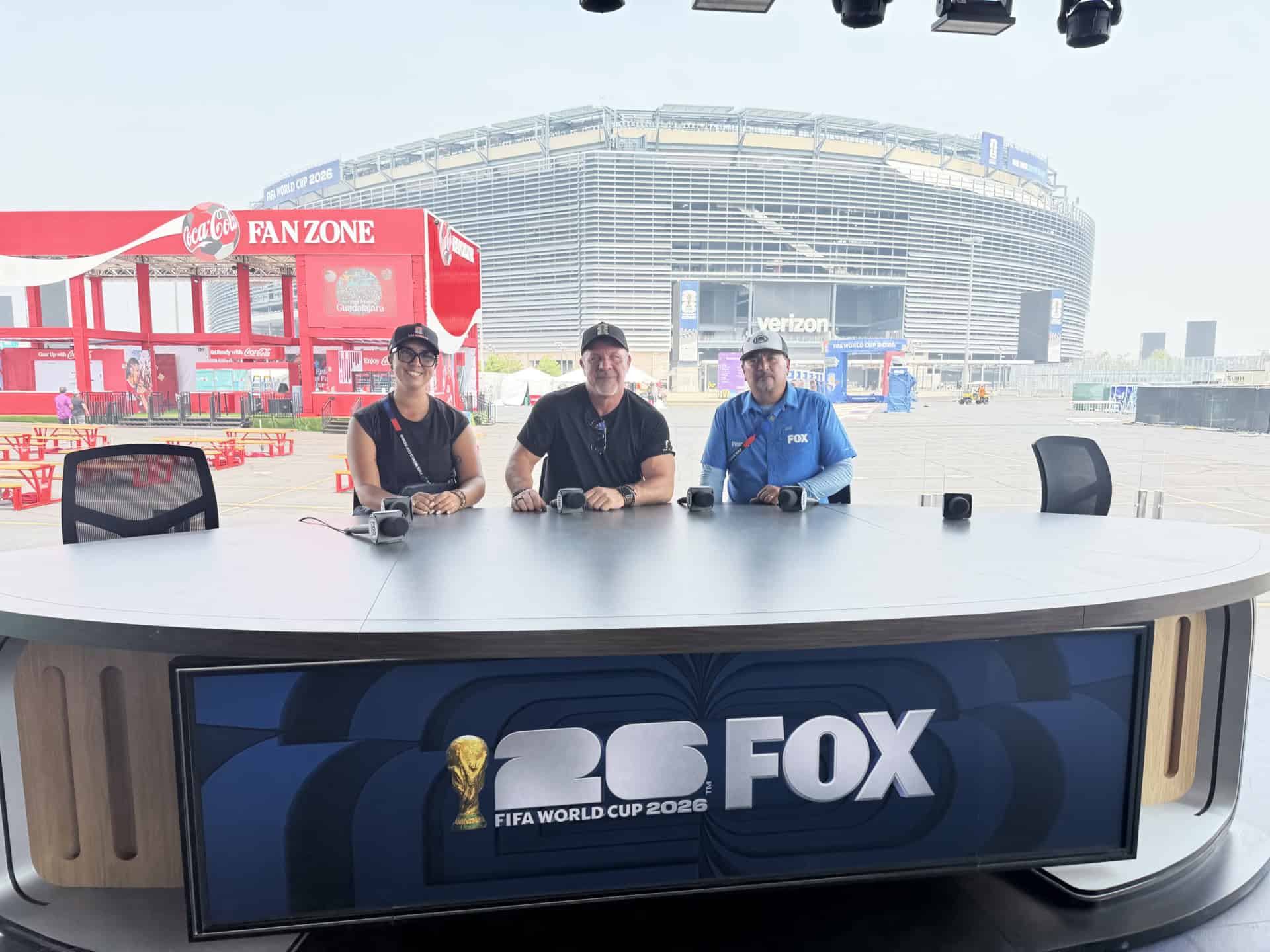 On the set at MetLife Stadium: (from left) Operations Manager Vanessa Wiater, Rod Conti, and Dan “Pineapple” James
Manager, Remote Engineering and Operations, Tara Schumal coordinated crew movements and credentialing across all cities, often managing rotations mid-tournament as the U.S. team’s path forced last-minute decisions.
“This was one of those puzzles on top of a puzzle, and the pieces kept moving,” she says. “There were times when we thought we’d end up in New York but ended up in Dallas. It required us to be prepared for every possible scenario.”
Goosebumps on the Road: What It All Means to the Crew
The scale of the operation — more than 300 crew members across all locations, 40-50 per site plus local hires — was managed by what Conti calls a surprisingly small leadership group.
“It’d be shocking to another network that the nucleus of our team is just a handful of people,” he says. “We were able to find key people who could take the ball and run with it. It was an eye-opener just how much this team is capable of despite its small size.”
For James and the crew that followed the USMNT and then moved on to the Quarterfinals and now the Final, the tournament has meant something larger than a production challenge. The crowds at FOX’s sets have been massive throughout, and the atmosphere — filled with chants of “USA, USA” — has moved even the most seasoned members of the crew, some of the talent among them, to tears.
“It makes you step away from the production for 30 seconds and just be a fan,” James says. “It’s cool to look around and see our techs smiling and laughing and enjoying it as fans. It has been an honor for all of us to be a part of this. And now we’re ready to kick this last show off.”