
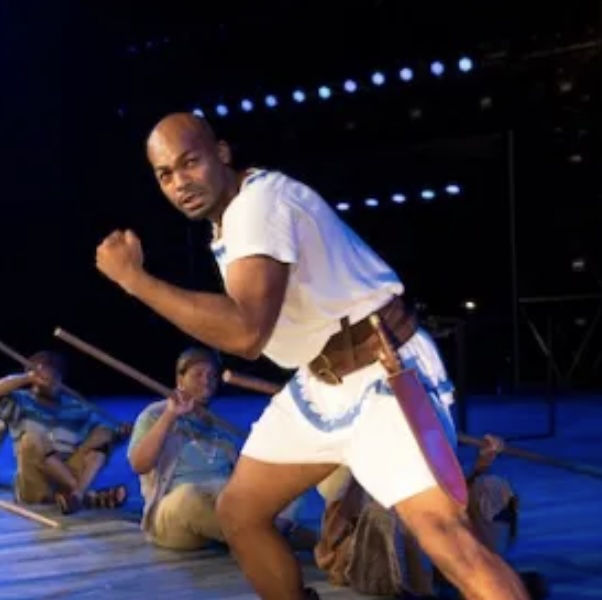
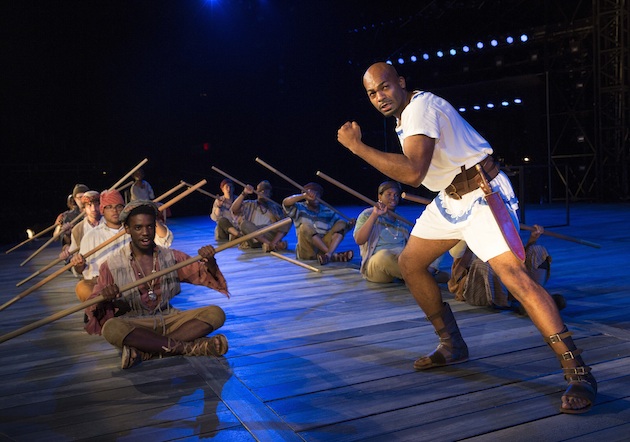
Given the raves for the new movie “The Odyssey,” a three-hour adaptation of Homer’s poem, it seems the right time to remind theatergoers of a stage adaptation — a spectacular musical! — that starred Brandon Victor Dixon as Odysseus (portrayed in the new movie by Matt Damon), and Karen Olivo as his wife Penelope (Anne Hathaway on screen), and featured a cast of hundreds (not the thousands in the new movie, but nevertheless impressive for being live on stage.)
Below are photographs from the production at the Delacorte Theater in Central Park, along with an abbreviated version of my September 7, 2015 review, which argues for having turned the poem into a musical: After all, Homer himself sung it.
At the end of the tuneful, rousing, and spectacular modern musical adaptation of Homer’s three thousand year old epic poem about a ten-year journey home, everybody from the cast is on stage or in the aisles, dancing and singing “Welcome home.” Yes, that includes the terrific leads, Brandon Victor Dixon as the warrior and wanderer Odysseus and Karen Olivo as his long-suffering wife Penelope, as well as the handful of other professional cast members certified by Actors Equity.
But it also means:
the Marching Cobras marching band
the D.R.E.A.M. Ring hip-hop dancer-contortionists
the gospel singers from The Bobby Lewis Ensemble
the dancers from Flamenco Vivo Carlota Santana II
the riders from the Old Bones Motorcycle Club, N.Y.C. Fire Riders, and W.L.C. Crew,
members of Tada! Youth Theater, New York Youth Symphony, Brownsville Recreation Center, the Children’s Aid Society, Dreamyard Project, Domestic Workers United, and the Fortune Society
There are, in short, hundreds of New Yorkers who perform in The Odyssey, from all five boroughs, and their performances erase the line between amateur and professional, in good and clever ways. This is surely thanks in large measure to the direction of Lear deBessonet, who conceived The Odyssey and developed the department within the Public Theater that produced it, Public Works.
Todd Almond wrote both the script and the songs for The Odyssey, and performs as The Singer, who functions as both a narrator and MC. The Odyssey is a loose, vernacular, and condensed adaptation, running little more than 100 minutes with no intermission. Such liberties can be easily justified: The original is in Ancient Greek after all, and Homer is believed to have sung it. One can appreciate many of Almond’s modern-day jokes and shtick; the rest can be forgiven, because of his impressively varied score – soul, folk, rap, country, tango, pop ballads, even a lovely symphonic arrangement performed by the New York Youth Symphony accompanied by Almond’s narration
Almond’s Odyssey keeps the basic structure of the poem. In the first half hour, we are in Ithaca, whose citizens are feeling the 20-year absence of their king no less than does their queen Penelope. Most assume Odysseus has died, either in the 10-year war (the subject of Homer’s Iliad) or in the 10-year journey home. That is why Penelope has a mob of coarse suitors (that’s where the members of the motorcycle clubs come in, and the just-as-gruff Lucas Caleb Rooney as Antinous.) They push for Penelope to wed one of them, and meanwhile are “eating all the king’s pizza and corn dogs.” Athena (“portrayed” by the Bobby Lewis Ensemble, standing on a second tier overlooking the stage) watches over Telemachus (Jabari Johnson), Odysseus’s vulnerable son who has never met his father.
It’s about a third of the way through the show that we meet Odysseus, who has washed ashore in Phaeacia at the very moment they are celebrating Odysseus Day (cue the terrific D.R.E.A.M. Ring dance crew.) Rescued by the royalty of Phaeacia, Odysseus eventually reveals his identity, delighting the Prince (Travis Raeburn), who takes a selfie with him. Odysseus is asked what has happened to delay his journey home, and that’s when we get the scenes that most of us surely remember best from the poem. We see Odysseus outmaneuver the ravenous Cyclops (the amusing Andy Grotelueschen, holding up a pole with a big eye attached); resist the seduction of Circe and the Sirens (this is brilliantly set to a tango score, climaxed by the Flamenco Vivo dancers); survive the monsters Scylla and Charybdis (we see in a a kind of shadow puppetry that is the least effective staging of the challenges.) After these tests, he finally returns home disguised as a beggar and wins back his rightful place, after he aces a contest requiring super-human marksmanship (a scene wittily enhanced by the Marching Cobras.)
In all this, Brandon Victor Dixon, in heroic countenance and exquisite voice, feels like the ideal leading man, dashing and despairing.
Related