
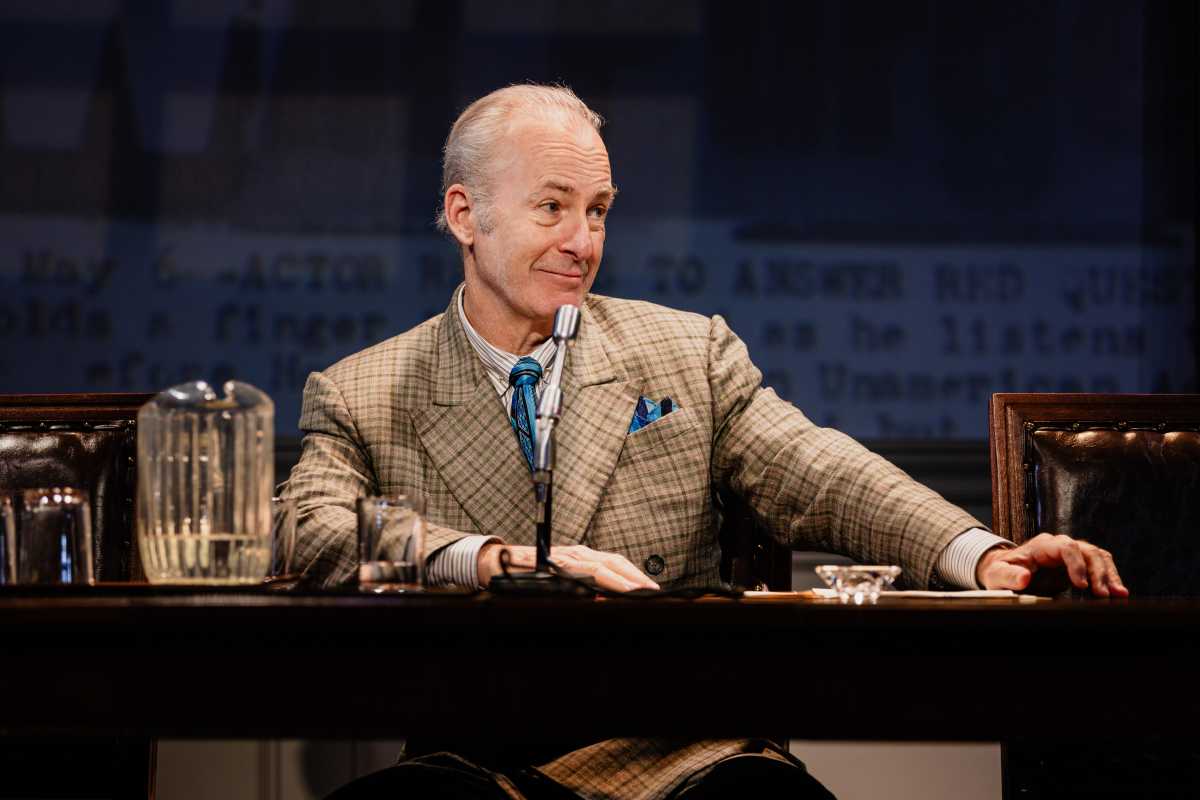
Roughly an hour and 45 minutes of congressional testimony, staged with little movement beyond one witness taking a seat and being replaced by another, hardly sounds like enticing summertime theater.
Yet Anna D. Shapiro’s revival of “Are You Now or Have You Ever Been” at New York City Center proves unexpectedly absorbing. Eric Bentley’s 1972 documentary drama is inherently static and occasionally monotonous, but strong casting and its uncomfortable resemblance to the present keep it alive.
Bentley, best known as a serious theater critic, academic and champion of Bertolt Brecht, created the play by editing and arranging material from the public record of the House Committee on Un-American Activities’ investigation of the entertainment industry. Rather than invent a plot, he culled together the words of artists questioned about their politics and pressured to identify colleagues.
The witnesses include Arthur Miller, Elia Kazan, Jerome Robbins, Lillian Hellman and Paul Robeson, along with once-prominent figures now unfamiliar to many theatergoers. Some refuse to answer. Others rely on humor or constitutional protections. Still others name names, reluctantly or enthusiastically.
The play feels newly relevant at a time when public figures and institutions facing pressure from the Trump administration must decide whether to resist, comply, self-censor or sacrifice others in the hope of protecting themselves. The circumstances are different, but the underlying calculation is familiar. The most unsettling question is not whether someone was a Communist, but what people will surrender when their livelihood is threatened.
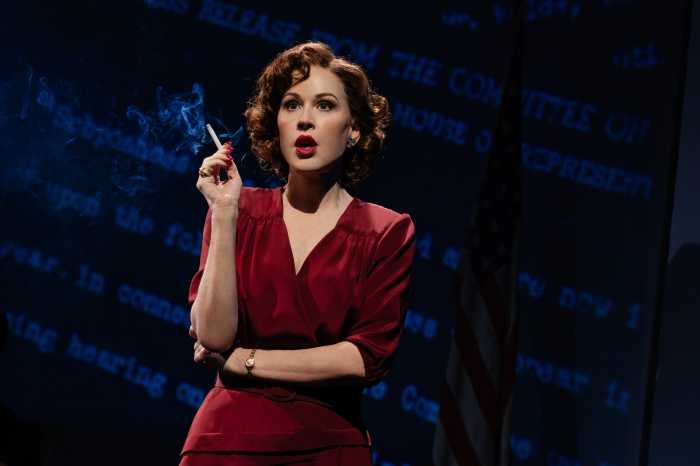 “Are You Now or Have You Ever Been”Photo by Marc J. Franklin
The rotating cast is also an effective commercial strategy. Appearing through Aug. 2 are Norbert Leo Butz, T.R. Knight, Harry Lennix, Bob Odenkirk and Molly Ringwald. They join Brooks Ashmanskas, Jason Babinsky, Steven Boyer, Adam Kantor, Frederick Weller and Michael McKean, who remain throughout the run. Santino Fontana and Steven Pasquale will join later.
Knight is especially affecting as Larry Parks, the star of “The Jolson Story,” who admits to former Communist Party membership but initially resists naming others. Boyish, resigned and helpless, Knight captures Parks’ realization that his career may have been destroyed simply by his being summoned.
Butz brings his comic instincts and flair to Abe Burrows, the “Guys and Dolls” co-author who protects himself through jokes and verbal detours. Odenkirk gives Lionel Stander the aggressive, slightly manic energy he brought to “Better Call Saul,” making him funny and volatile as he turns on his interrogators.
Ringwald displays great poise and nails her few moments as Hellman, who offers to answer questions about herself while refusing to implicate anyone else. Lennix brings gravitas to Robeson, whose testimony broadens the play beyond Hollywood careers to encompass racism, citizenship and constitutional freedom.
Among the continuing company, Boyer is memorable as Robbins, appearing mysterious, guarded and uncomfortable while providing names. Weller’s Kazan is angry and self-righteous, presenting cooperation as a principled act. McKean anchors the production as the committee chairman, wrapping intimidation in practiced courtesy.
Shapiro cannot entirely disguise the play’s documentary origins, and the evening occasionally loses momentum. Still, the accumulation of evasions, compromises and acts of defiance exerts a steady grip. What lingers is not the question in the title, but the spectacle of artists deciding, one by one, what they are willing to surrender in order to keep working.
Through Sept. 11 at New York City Center, 131 W. 55th St., nycitycenter.org.