
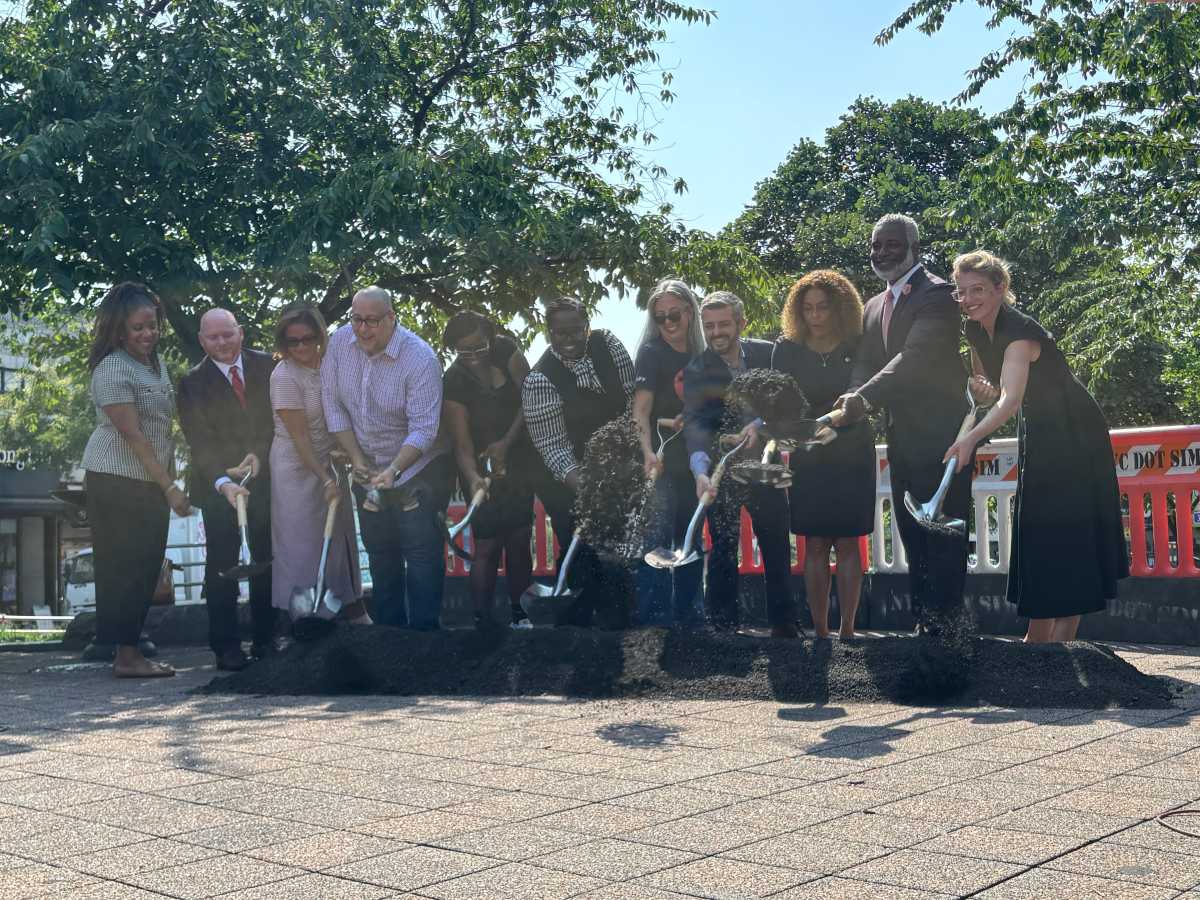
DOT Commissioner Mike Flynn, during a July 23 groundbreaking ceremony at the intersection of Fordham and Kingsbridge Roads, said the throughfare’s buses are often slowed by traffic. The slugglish speeds at which the buses on Fordham Road move make them some of the slowest in the country, he said.
While the street currently has curbside bus lanes, Flynn said that design has been ineffective at boosting speeds because the vehicles often have to contend with businesses getting deliveries and drivers making pick-ups and drop-offs at the curb.
By contrast, Flynn said the offset model, which places buses in a separate lane farther from the curb, will take buses out of the traffic around the curb space. He said introducing the design on Fordham Road is intended to shorten bus trips for the 130,000 riders who travel there each day via four bus lines: the Bx12, Bx9, Bx17, and Bx22.
“It’s about saving people time, saving money, and making commutes more comfortable and a lot less stressful,” Flynn said. “New Yorkers deserve better than the slowest buses in America. We deserve buses that are world-class, just like the people of New York City.”
Mayor Zohran Mamdani and his DOT had announced they were reviving the project earlier this year after it had been halted by former Mayor Eric Adams in 2023 amid pushback from local businesses. It is one of several bus and bike lane projects that Adams killed, shelved, or watered down and Mamdani has brought back to life.
The project, which was originally supposed to break ground in the spring, is slated to be finished by the end of the year, Flynn said.
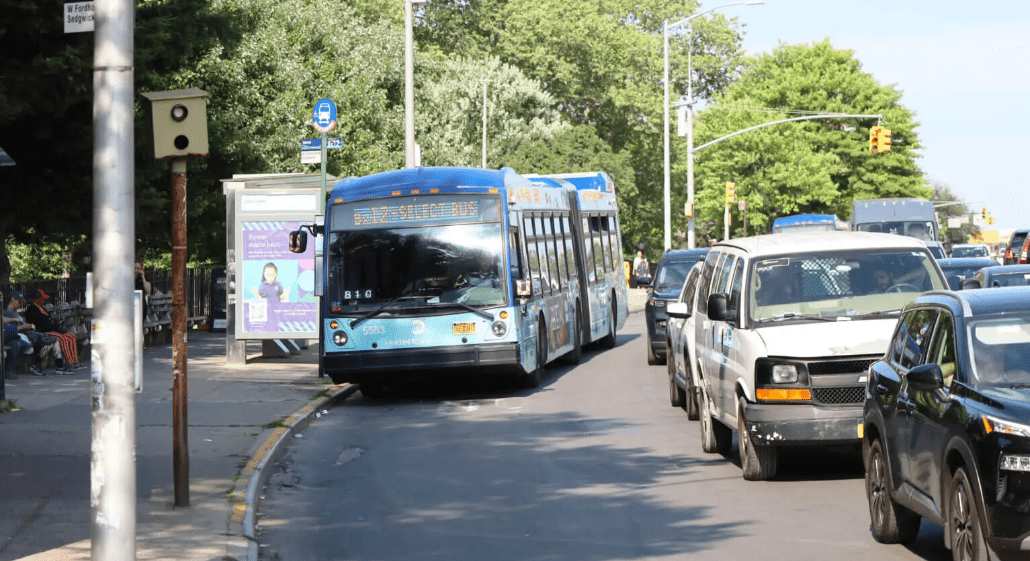 A bus on Fordham Road in the Bronx.File Photo by ET Rodriguez
Elizabeth Adams, Mamdani’s faster buses czar, noted that Bronxites rely heavily on buses like the Bx12, which runs east-west in a borough where the subways all run north-south.
“Bus riders are the majority here,” Adams said. “They are nurses getting to Montefiore, students getting to Fordham University, or heading to Arthur Avenue after school, or families heading to Fordham Plaza along the largest shopping corridor in the Bronx. Yet we have been okay with leading bus riders stuck in traffic for far too long.”
In addition to boosting bus speeds on Fordham Road, the redesign is intended to make the street, which DOT says is one of the Bronx’s most dangerous traffic crash corridors, safer.
Fordham Road is one of 50 priority corridors on which the city and state have pledged to increase bus speeds by at least 20%, cutting commutes by up to six minutes.
“While that may not sound like a lot, if you’re doing that on your commute every day over the course of a year, you get two whole days of your life back,” Flynn said.
The benchmark was set in a plan, dubbed Next Stop, released by Mayor Zohran Mamdani, Gov. Kathy Hochul, and the MTA earlier this month.
Flynn said DOT will keep tinkering with the project until it achieves its 20% speed increase goal. He said that could mean adding other features to the design or coming up with a new one altogether.
“I believe we’re going to hit the 20%, if not exceed it,” he said. “But if we find that we need to speed buses up even more, there’s definitely additional tools we could look at. Everything from tweaks to signal timing to the curb regulations to some of the way certain turns are allowed or not allowed, or to even bigger ideas further down the road, right? To just do a different approach.”
While the announcement was attended by local elected officials, including state Sen. Gustavo Rivera and Assembly Member Yudeka Tapia, one was notably absent: City Council Member Oswald Feliz.
The council member, who was a noted opponent of the project during the Adams administration, said in a statement that the project is “dissappointing” because it only offers “crumbs” in terms of additional benefits to the surrounding community.
The improvements Feliz was seeking include “paving of roads, improved street signs and spaces for pedestrians, greenification of medians, and more lighting.”
“Is this community not trendy enough to justify the kind of improvements that other communities receive, even without asking?” he asked. “If this was a trendier neighborhood, I have no doubt that a more ambitious proposal would have been on the table.”
When asked about the statement, Flynn said they heard there were “concerns” from some “local stakeholders” and that they “hear that loud and clear.”
“I don’t think one precludes the other and in fact they’re complementary,” he said. “Right now, we’re moving ahead with the toolbox that we can do through a bus project, and we’re having those conversations. And I’m excited to sit down and learn more about what else we can do. Things can be done over time.”