
Seven landlords sued Wednesday to overturn New York City’s landmark rent freeze, accusing Mayor Zohran Mamdani’s administration of steering the Rent Guidelines Board toward an outcome he promised during his campaign, according to court filings.
Hours after the case was filed, Richmond County Supreme Court Justice Ralph Porzio scheduled a virtual hearing for Sept. 2 on the challenge, including the landlords’ request to obtain internal communications involving City Hall, the Rent Guidelines Board and several mayoral offices dating back to Jan. 1.
The freeze is scheduled to take effect Oct. 1 and will set increases at 0% for both one- and two-year renewal leases through Sept. 30, 2027.
The lawsuit asks the court to throw out the June 25 vote, send the issue back to the board, and keep the increases imposed last year of 3% for one-year leases and 4.5% for two-year leases in place until the board reaches a new decision.
The seven plaintiff companies own or operate rent-stabilized buildings in Staten Island, Queens, the Bronx and Brooklyn. They are represented by Randy Mastro, Eric Adams’ former first deputy mayor, who is already battling the Mamdani administration in court as the attorney for a Charter Revision Commission that Adams created on his final day in office and Mamdani later disbanded.
City Hall has been contacted for comment on the lawsuit; amNewYork is awaiting a response.
Lawsuit claims rent board didn’t act independently of Mamdani
The central claim of the legal challenge is that the board majority appointed by Mamdani was not acting independently when it approved the freeze in June. The lawsuit alleges that Mamdani promised the result during his campaign, appointed members the lawsuit says were predisposed to support a freeze, and then used city resources to mobilize tenants around the board’s hearings.
Mamdani appointed five new members and reappointed tenant representative Adán Soltren in February, giving his selections six of the board’s nine seats. All six later voted for the freeze.
At the time, Mamdani said he continued to believe rent-stabilized tenants deserved a freeze. But he also described the RGB as an independent body and said its members would consider all the evidence before reaching a decision.
 Mayor Zohran Mamdani in a video explaining the Rent Guidelines Board process ahead of the panel’s first public meeting in March. Photo by Mayor’s Office
The lawsuit also targets Organize NYC, an Office of Mass Engagement initiative that encouraged tenants and owners to participate in the RGB process. Mamdani said the city would not tell people what position to take. The landlords portray it as an effort to build support for their preferred result.
The landlords’ lawsuit portrays that outreach as an attempt to build support for the mayor’s preferred result. The plaintiffs also point to a presentation by the Mayor’s Office of Equity and Racial Justice on New Yorkers’ “true cost of living,” arguing that the appearance of a mayoral office before the board was another sign that City Hall had inserted itself into the process.
The board initially voted in May to consider increases ranging from 0% to 2% for one-year leases and 0% to 4% for two-year leases, keeping a freeze on the table while leaving room for an increase after four public hearings.
The process took a dramatic turn hours before the final vote, when Christina Smyth, who represented property owners, resigned and accused the board of working backward from a decision that had already been made.
“This rebuilt board was required to deliver a rent freeze,” Smyth said in her resignation letter, which the lawsuit points to repeatedly. “Everything since has been theater. The hearings, the reports, the public comment, the data. None of it was ever going to change the result.”
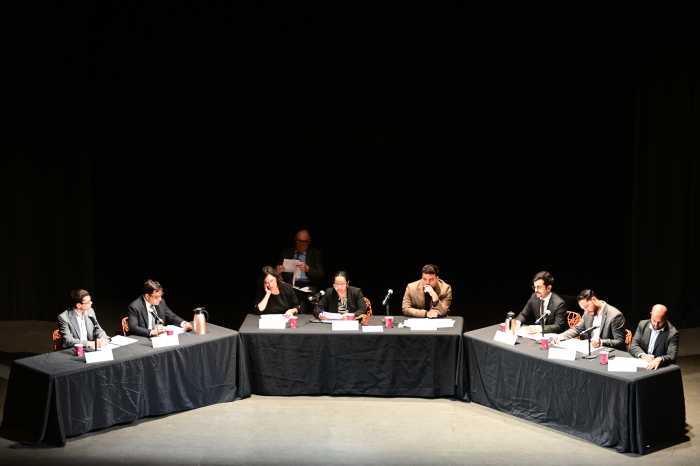 Eight members of the New York City Rent Guidelines Board sit for Thursday night’s final vote after owner representative Christina Smyth resigned hours earlier. Chair Chantella Mitchell noted at the meeting that the board still had a quorum.Photo by Lloyd Mitchell
 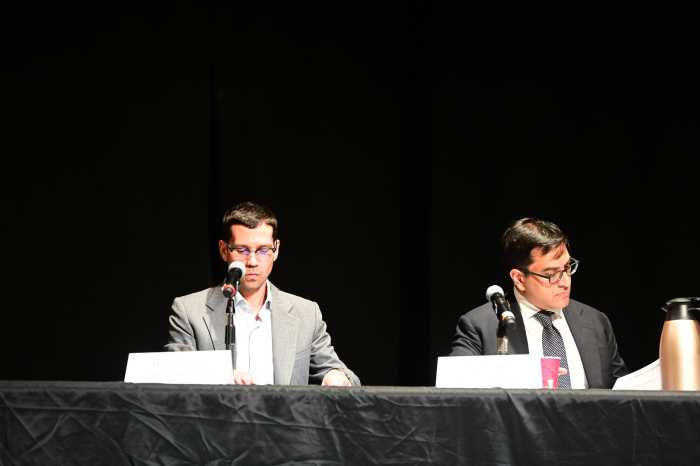 Owner representative Maksim Wynn, left, sits beside Rent Guidelines Board member Arpit Gupta during Thursday night’s final vote. Wynn supported the rent freeze, while Gupta cast the board’s lone no vote.Photo by Lloyd Mitchell
The eight remaining board members went ahead with the vote that night and approved the freeze 7-1. It marked the first time the RGB had frozen rents for two-year leases. Previous freezes under former Mayor Bill de Blasio applied only to one-year renewals.
But Arpit Gupta, a public member appointed by former Mayor Eric Adams who cast the only vote against the freeze, pushed back on part of that allegation the following day, saying he had not observed City Hall interfering with individual board members’ decisions.
“Unlike in previous years, there was no interference that I observed by the mayoral administration on decisions of individuals,” Gupta said.
Gupta nevertheless warned that repeated freezes could strain older buildings without government help to lower costs. Owner representative Maksim Wynn supported the freeze, arguing that higher legal rents could reduce collections if more tenants stopped paying.
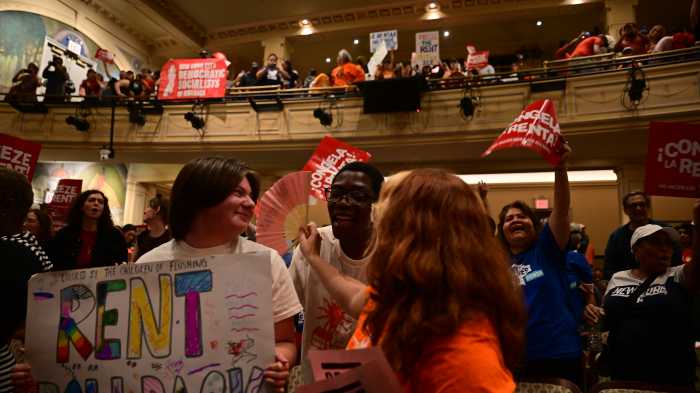 Tenant advocates cheered the Rent Guidelines Board’s decision to freeze rents for 1 million stabilized apartments.Photo by Lloyd Mitchell
The lawsuit also attacks the board’s handling of its financial data.
The RGB’s Price Index of Operating Costs found that building expenses rose 5.3%, including increases of 11% for fuel and 10.5% for insurance, and projected another 4.1% increase. The landlords cite one calculation that produced increases of 3.4% for one-year leases and 4.8% for two-year leases, though the RGB says its formulas are illustrations, not recommendations.
Supporters of the freeze cite the board’s finding that net operating income rose 6.2% among buildings with at least one stabilized apartment. The landlords say that figure is skewed by buildings with market-rate units and other income; the same study found net operating income rose 2.4% in fully stabilized buildings.
RGB Chair Chantella Mitchell said after the final vote that most owners remained able to cover rising expenses, while distressed properties needed targeted government assistance.