
Among the many highlights of Summer for the City are the performances of the Festival Orchestra of Lincoln Center under Renée and Robert Belfer Music and Artistic Director Jonathon Heyward, who has made programming contemporary works—including several commissions and premieres—a hallmark of his leadership.
This summer’s orchestra concerts feature modern works by composers ranging from Unsuk Chin (July 10-11) and Adolphus Hailstork (July 15) to Valentin Silvestrov (July 17–18), along with a world premiere by Hannah Ishizaki and New York premiere by Billy Childs (both on the August 7–8 closing night program) as well as a U.S. premiere by Jessie Montgomery, no stranger to Lincoln Center’s stages ever since she was a composition student at The Juilliard School.
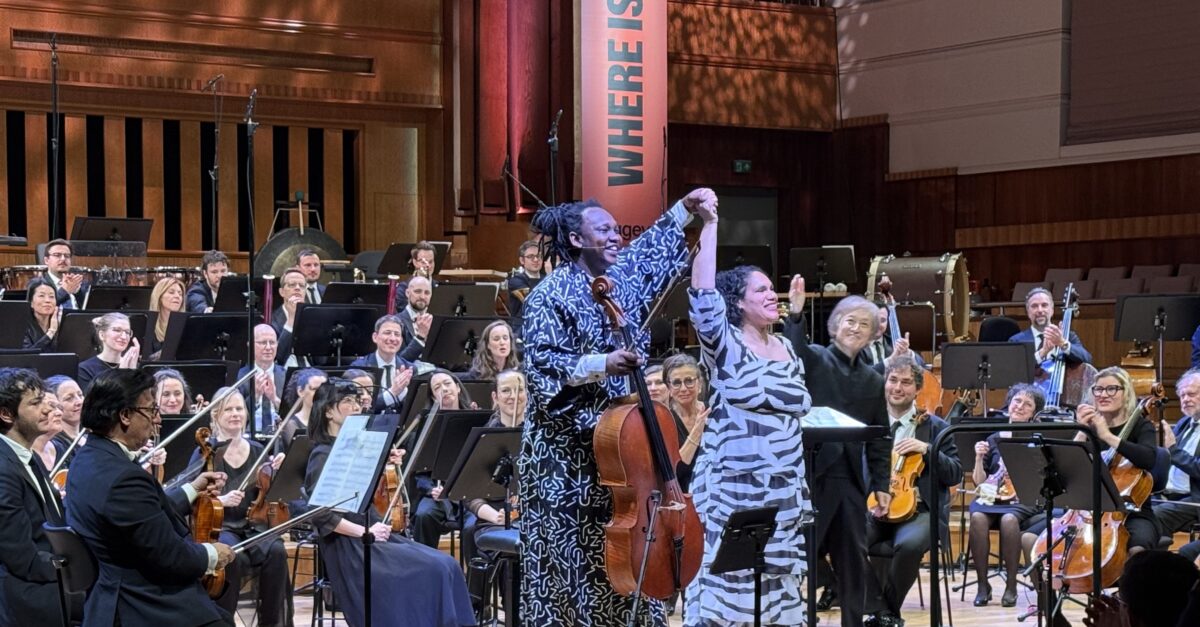
Montgomery’s These Righteous Paths (July 31–August 1), which had its world premiere in March in Berlin, is a Lincoln Center co-commission that finds the composer dealing with the death of her mother, Robbie McCauley, a leading figure in the Black theatre movement, in 2021. Although ostensibly a cello concerto—the soloist is the South African cellist, Abel Selaocoe—it’s quite unlike the usual works one hears for that instrument and orchestra.
“I knew I was going to work with Abel, so to get acquainted with his work, I went to see him perform in Norway,” Montgomery explains. “He introduced a piece he was about to play about mothers, so I became interested in that sentiment. And the song he sang was so moving and beautiful, I wanted to participate in that aspect as well.”
Hearing Selaocoe sing led Montgomery to look at McCauley’s archives to find texts that linked Selaocoe’s South African heritage with her and her mother’s Black American roots. “There’s definitely a relationship between Black Americans to the African continent, and there’s also a feeling of longing,” Montgomery says. “Abel’s cultural reflections and my personal experiences after my mother died were connected.” (Her working title for what would become These Righteous Paths was Mother Tongue, which had several connotations related to those connections.)
The three movements of These Righteous Paths —”All the Ancestors and I”; “Another Train Poem: Part 1, Georgia and the Foreman; Part 2, Up South”; and “A New Song”—all include McCauley’s words as set by Montgomery for Selaocoe to sing. The composer also gave the movements a chronological storyline. “First, there are ancestral incantations or messages; second, my mother’s childhood, which is the present day of the piece; and third, a look into the future,” she says. “I used the imagery of the poems to guide the music.”
Selaocoe’s ability to use his voice as well as his cello greatly informed the piece. “I originally thought of it as a conventional cello concerto—but how do you write a piece that multiple people can play?” she says. “Then I decided that writing it around Abel’s facility to both sing and play was more compositionally interesting and freed me up more. I abandoned the idea that it’s something that would work for any cellist.”
Indeed, Selaocoe has played all performances of the premiere cycle so far, and he will also be the soloist for the U.S. premiere at David Geffen Hall July 31 and August 1 with the Festival Orchestra of Lincoln Center and Heyward, who has paired Montgomery’s piece with two works suffused with maternal longing: William Grant Still’s touching Mother and Child and Brahms’ majestic Symphony No. 2, which includes his famous lullaby that’s heard in the opening movement. Montgomery is pleased with the program’s through-line. “I think it’s a very lovely instinct—I love those kinds of programmatic connections,” she says. “Mother and Child was the very first piece I learned by a Black composer, and I’ve been influenced a lot by Brahms.”
Montgomery has been clearly touched by the emotional reaction to These Righteous Paths, especially when the cellist first vocalizes. “It’s always a surprise to audiences when Abel starts singing in the middle of the first movement, but the response has been very positive, especially by those who are reflecting on their own loves and loss,” she says. “Hearing from listeners who also share their tears is always very healing.”
For more information on Festival Orchestra of Lincoln Center performances, visit here.