
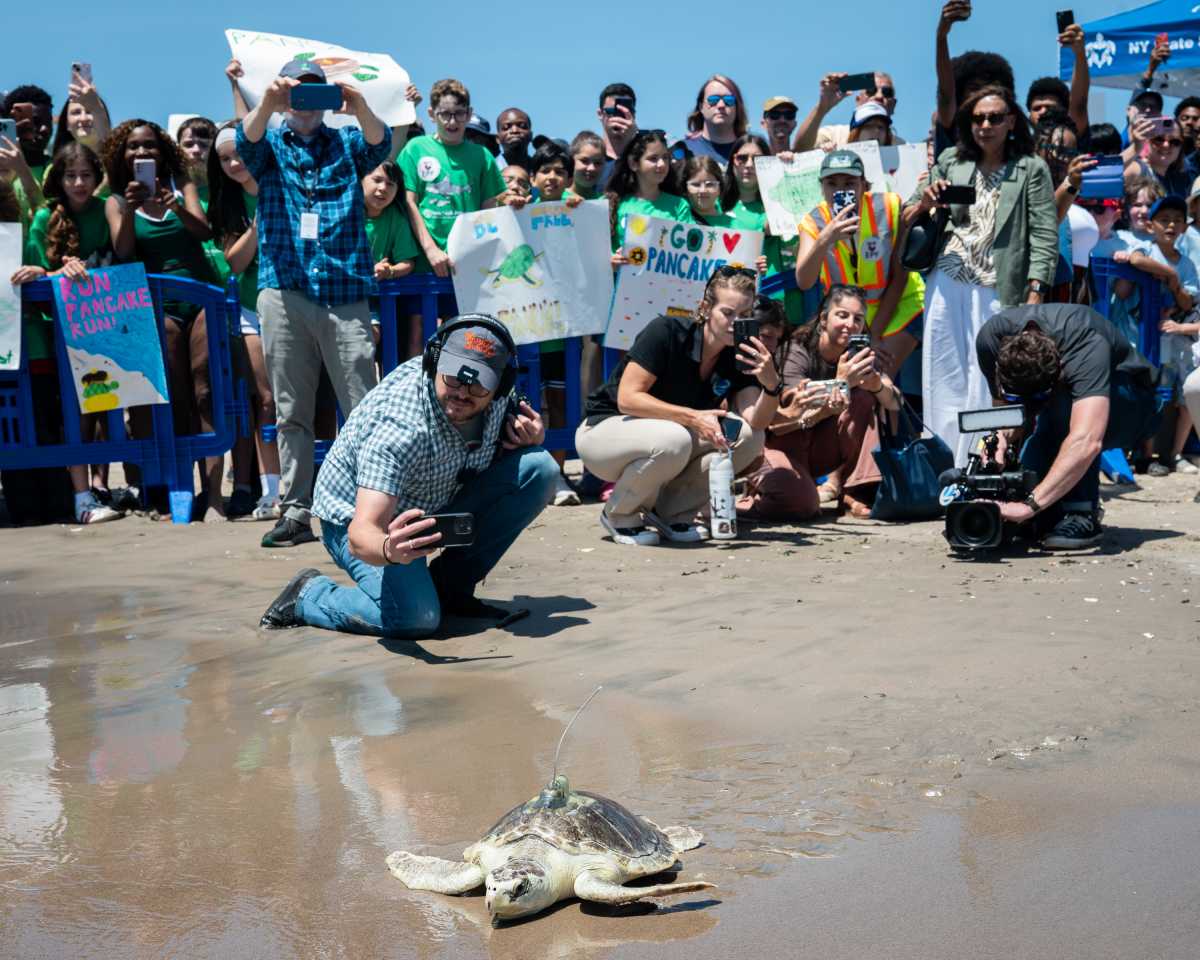
Pancake, an endangered Kemp’s ridley sea turtle, made a splash when it returned to its natural habitat on July 24 after eight months of rehabilitation at the Atlantic Marine Conservation Society’s Sea Turtle Care Center (AMSEAS) in Westhampton Beach on Long Island.
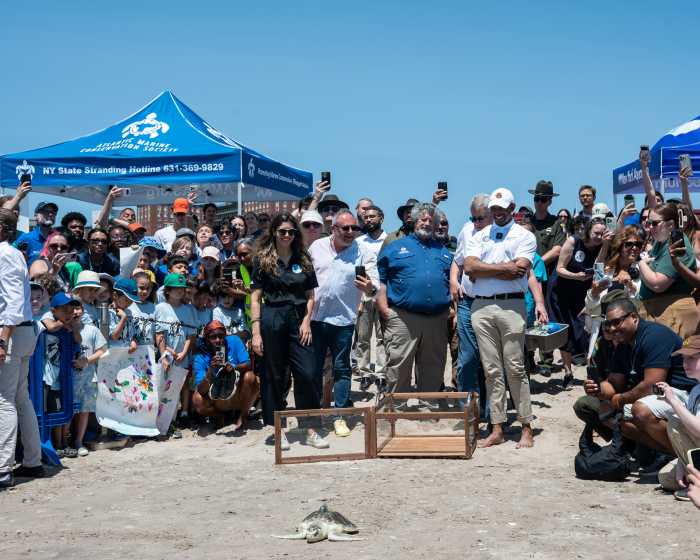
Spectators — including representatives from the New York State Department of Environmental Conservation, the New York State Department of State, the Atlantic Marine Conservation Society, the Wildlife Conservation Society, environmental organizations, elected officials, New York Aquarium camp participants and youth leaders — cheered as the chelonian crawled across Coney Island beach and into the Atlantic Ocean, paddling into freedom.
 Pancake dashes back into the ocean after eight months of rehabilitation.Photo by Gabriele Holtermann
 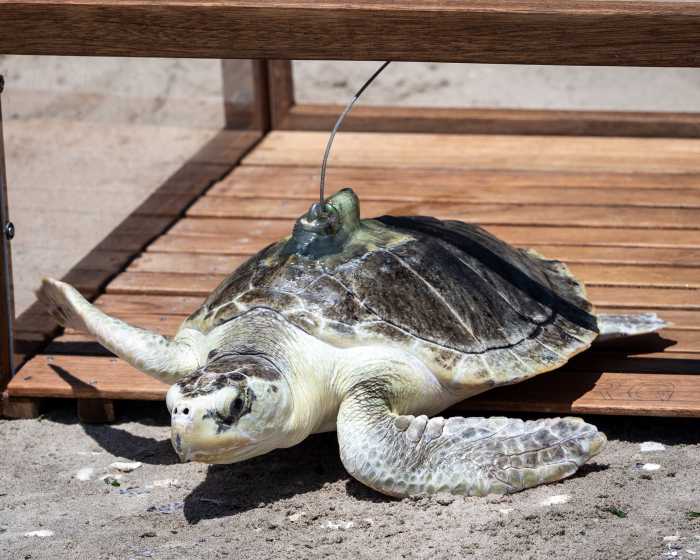 Pancake, an endangered Kemp’s ridley sea turtle, returned to its natural habitat after eight months of rehabilitation.Photo by Gabriele Holtermann
The 2- to 5-year-old turtle was found suffering from cold-stunning, a form of hypothermia that occurs when cold-blooded turtles fail to migrate south before northern waters drop below about 50 degrees Fahrenheit, affecting their ability to swim and survive. Pancake was discovered in November 2025 at Duck Harbor Beach in Wellfleet, Massachusetts. After being rescued by the Massachusetts Audubon Society and receiving emergency triage and medical treatment at the New England Aquarium, the turtle was transferred to AMSEAS’ turtle care facility in Westhampton Beach, where it underwent months of specialized rehabilitation.
The Kemp’s ridley is the smallest sea turtle species, measuring about 2 feet in carapace length, and the most critically endangered. Pancake’s sex remains unknown, as determining a turtle’s gender requires blood testing that is unnecessary during rehabilitation. Pancake was one of 25 sea turtles transferred to AMSEAS during the last cold-stunning season and one of 125 sea turtles the organization has treated since 2020.
Unlike other sea turtles, the Kemp’s ridley is the only species that nests during the day. Male Kemp’s ridleys never return to shore unless they are injured or sick, and the species is the only sea turtle with an almost perfectly circular carapace, or upper shell.
Thanks to the care of the five-member AMSEAS team and a slew of volunteers, the 11-pound turtle made a full recovery, regaining strength on a healthy diet of shrimp and clams while demonstrating strong swimming behavior.
Robert A. DiGiovanni, founder and chief scientist of AMSEAS, told Brooklyn Paper that Pancake, which now has a satellite tag attached to its shell to track its location and the surrounding water temperature, is the 113th animal the organization has returned to the wild. Last year, the organization also released another Kemp’s ridley sea turtle, Elton, at Coney Island Beach.
“We still have a couple that are at our facility, so we have about three more that are back at our facility that are up for release soon,” DiGiovanni said. “This is a success story where we’re able to release an endangered Kemp’s ridley turtle into the wild, working with our partners here, Wildlife Conservation Society, and it’s showing how you can bring people together to try and make a positive impact on the environment.”
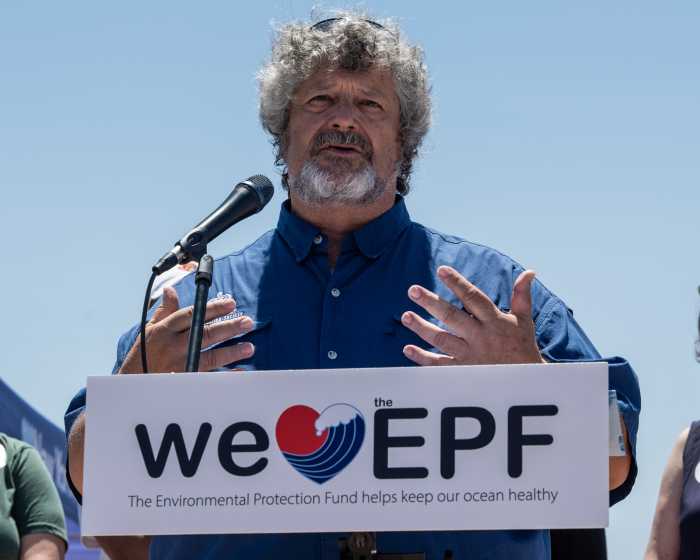 Pancake is the 113th animal Robert DiGiovanni’s organization has returned to the wild.Photo by Gabriele Holtermann
 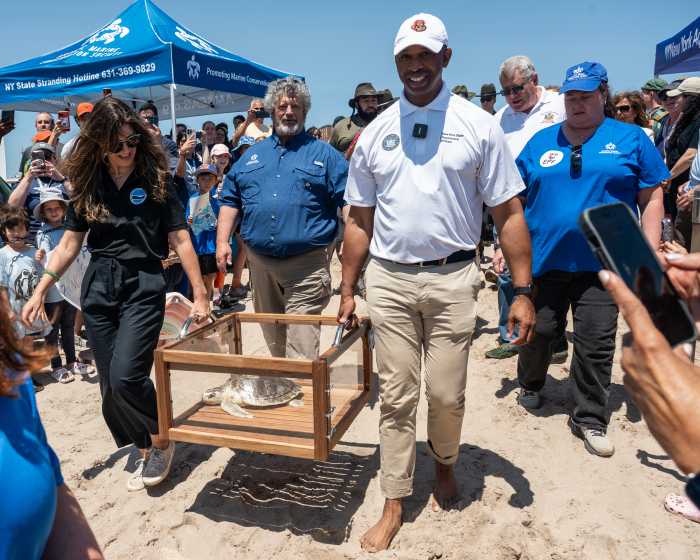 New York Secretary of State Walter Mosley (right) helped carry Pancake to the beach before its release.Photo by Gabriele Holtermann
Pancake’s release also served as a celebration of the New York State Environmental Protection Fund, which supports ocean conservation, wildlife rehabilitation, marine science and coastal restoration through its Ocean and Great Lakes Program.
The Environmental Protection Fund remains the state’s primary source of funding for projects that protect and restore New York’s marine ecosystems, highlighting the ecological importance of the New York Bight, a marine ecosystem stretching from Cape May, New Jersey, to Montauk, New York. The region provides important habitat and migration routes for endangered sea turtles, whales, dolphins, sharks, rays, seabirds and countless fish species.
New York Secretary of State Walter Mosley said Pancake’s release symbolized the collaborative effort between the state and environmental organizations to protect the environment.
“We still care about the preservation of our environment, regardless of what’s happening elsewhere in our country, and that we are still willing to put up the resources necessary to give those stewards within our conservancy groups, within our office of environmental conservation, or even within our department, the tools necessary to deal with these issues in real time,” Mosley told Brooklyn Paper, noting Gov. Kathy Hochul’s record investment in the Environmental Protection Fund because she recognized the importance of preserving the ecosystem and wildlife.
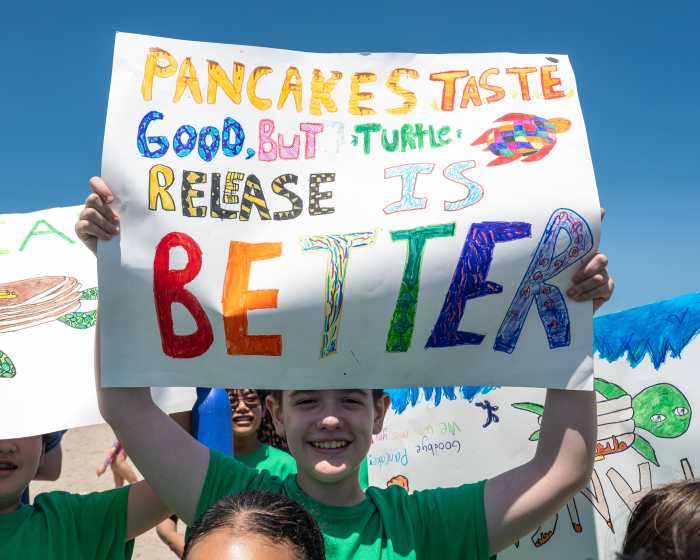 New York Aquarium camp participants cheered on Pancake as it returned to its natural habitat.Photo by Gabriele Holtermann
 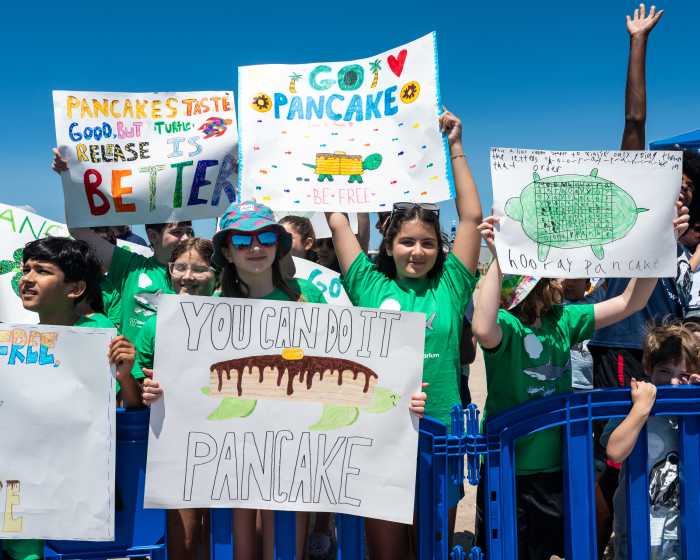 New York Aquarium camp participants cheered on Pancake as it returned to its natural habitat.Photo by Gabriele Holtermann
Shane Weeks, co-founder and director of research and education at the Metoac Indigenous Collective, and Tecumseh Ceaser, the collective’s director of education and strategic planning, sent Pancake off with an Indigenous blessing, singing a song in Algonquian, the language of the Shinnecock Nation.
“That is the way we send off relatives that are on a journey,” Weeks explained. “There are so many people that are working to help protect our relatives, and we say in our way that if something happens to our relatives, our non-human kin, it happens to us,” Weeks said. “So it’s very important for us to create awareness around the issues that are facing our relatives, our non-human relatives, and be able to step in and maintain balance within the environment where we can.”
The collective regularly collaborates with AMSEAS, educating the public about environmental water concerns and the sacred connection between Indigenous people and turtles and whales. Members also perform blessings when dead whales wash ashore.
“Usually when we do work with [AMSEAS], it’s during the necropsies. So that’s when the whales have passed. We do a ceremony for them, so it’s nice to be able to do work where it’s not a funeral, and you get to see an extension of an animal’s life that’s been rehabbed,” Ceaser said.
Caitlin Daly, senior policy adviser at The Nature Conservancy of New York, told Brooklyn Paper that Pancake’s successful rehabilitation and release were a testament to the collaborative efforts of government agencies and environmental and maritime organizations.
“There’s not often a tangible thing where you can see this is what the Environmental Protection Fund is doing and what our partners’ work is. A lot of it’s intangible. So to be able to see and actually physically celebrate something like Pancake returning to the water was really, really special,” Daly said.
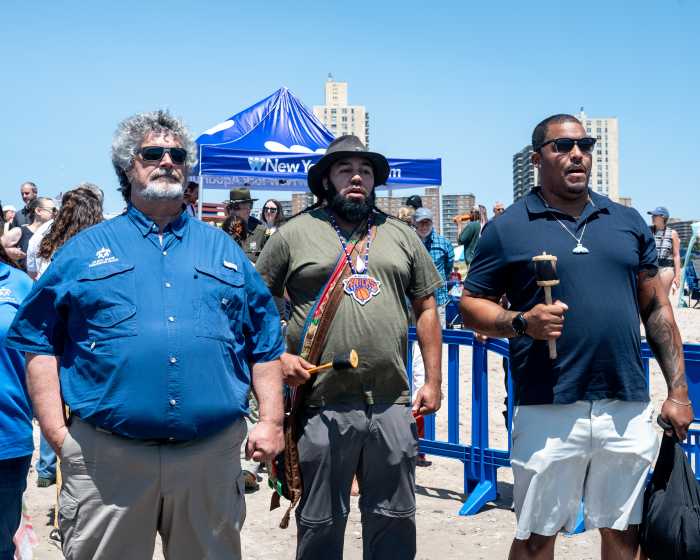 Robert A. DiGiovanni, Tecumseh Ceaser and Shane Weeks sent off Pancake with an Indigenous blessing.Photo by Gabriele Holtermann
 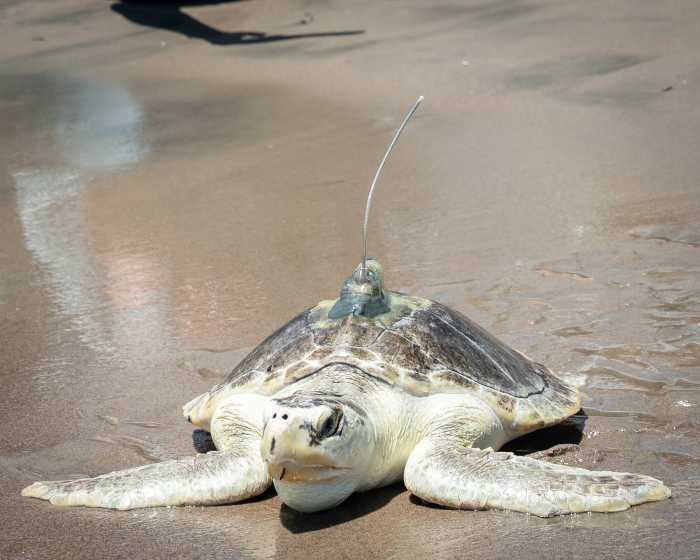 Pancake, an endangered Kemp’s ridley sea turtle, returned to its natural habitat after eight months of rehabilitation.
Glen Cove resident Michelle Massarone volunteers with AMSEAS every Thursday. She told Brooklyn Paper volunteers do not need prior experience. AMSEAS teaches them how to feed the turtles, administer supplements such as liver pills and vitamins, measure them and observe their behavior.
“I’ve learned so much about sea turtles; caring for them, and then get to see them released in the ocean,” Massarone said. “I go every Thursday; my Turtle Thursday.”
She urged beachgoers to call the New York state 24-hour stranding hotline at 631-369-9829 if they spot cold-stunned sea turtles on the beach.
“What happens is the water’s so cold, and their heart rate slows down, and then they can’t move their flippers, so they can’t swim, and then they get [washed] on the beach. [While] they look dead, they’re cold. That’s why they call it cold-stunned, because they’re frozen,” Massarone explained.
Dr. Maia Austin, a postdoctoral researcher with the New York Bight Program at the Wildlife Conservation Society, told Brooklyn Paper the event gave the public a glimpse into the offshore world of turtles, sharks, fish, whales and dolphins.
“We have a lot of cool wildlife in the area that people maybe don’t know about or don’t get to see regularly if they’re not going offshore,” Austin said, noting Pancake’s rehabilitation highlighted the importance of protecting endangered species like Kemp’s ridley sea turtles.
“If we lose any single species, it’s really upsetting for that species, but also for the whole ecosystem because each of them plays a role, so I feel like it’s really important to have species that we put extra attention into to try to protect to make sure that everything can thrive in a healthy way,” Austin said.