

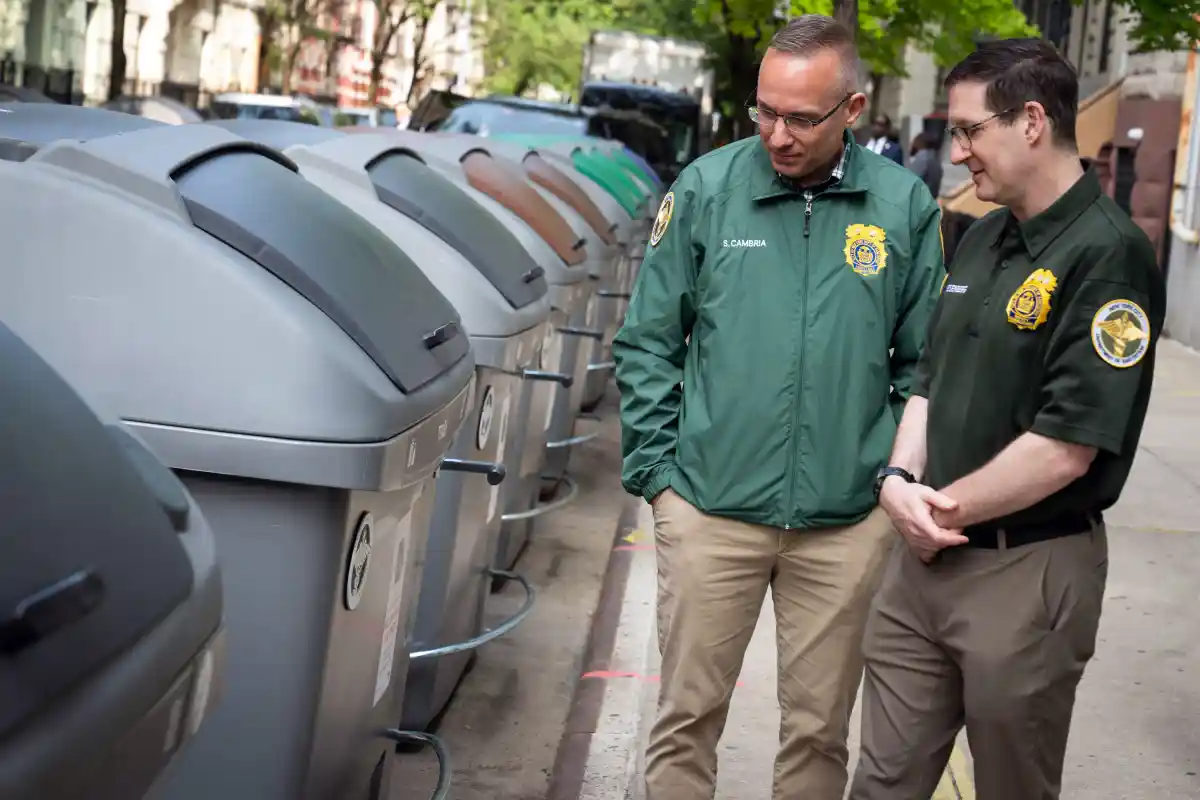
On-street Empire Bins are coming to Brooklyn Community Board 2, and registration is open until July 31. Photo by Ed Reed/Mayoral Photography Office
by Kirstyn Brendlen, Brooklyn Paper
Trash bags piled up on the sidewalk outside big apartment buildings on collection day will soon be a thing of the past for Brooklyn Community Board 2.
Curbside Empire Bins are set to arrive in Downtown Brooklyn, Boerum Hill, Brooklyn Heights, Dumbo, Vinegar Hill, Fort Greene, Clinton Hill, and the Brooklyn Navy Yard this fall as the city expands its trash containerization program. The large on-street containers will be required for every residential building with more than 30 units, while buildings with 10 to 30 units can choose either an Empire Bin or to continue using the city’s standardized “wheelie bins.”
The bins are designed to keep rats out and trash and mystery liquids in, and can only be opened with special key cards provided to building management and staff, who will be tasked with ferrying trash bags from the buildings out to the street.
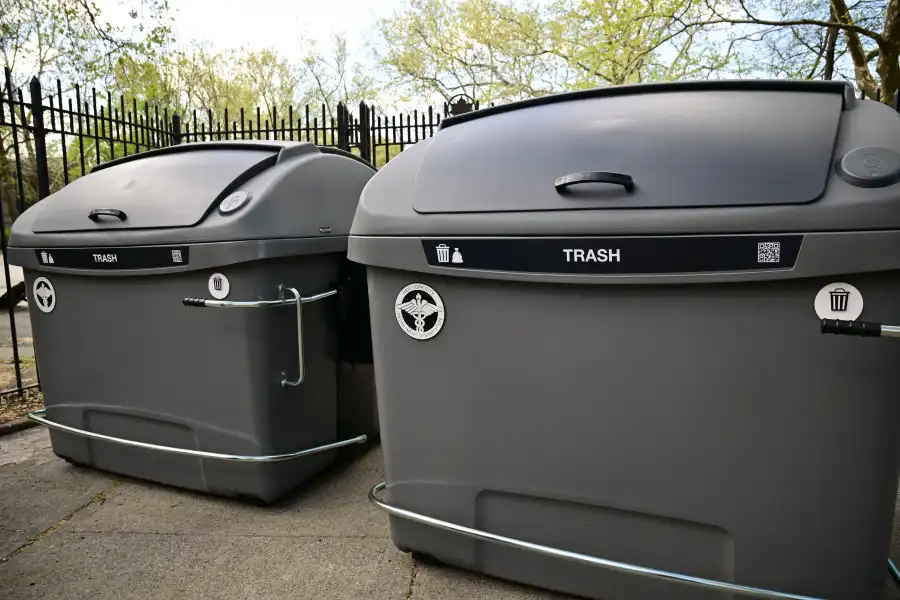 The large curbside Empire Bins are required for all buildings with more than 30 units. File photo by Lloyd Mitchell
All residential buildings with more than 30 units are required to register with the Department of Sanitation by July 31, and smaller buildings can opt in during the same period.
The rollout is part of a years-long effort to banish rats by containerizing all the refuse in the city. Smaller buildings have been composting and containerizing trash for years, but changes during Covid, including the suspension of composting, caused residential blocks in Brooklyn and beyond to be inundated by rats.
Council Member Lincoln Restler said he’s “elated” by the arrival of Empire Bins in his district, the second area of the city to get them, following Manhattan’s Community Board 9. While critics have objected to Empire Bins taking up parking spaces on city streets, the containers are next set to roll out to areas in the Bronx, Queens, and Staten Island, as well as Brooklyn Community Board 8.
“As New Yorkers we have all experienced walking by a wall of trash bags that are stacked higher than us,” Restler said. “And it’s so gross, especially in the summer when the smell is just disgusting. These are just piles of rat food that we put out on the street every day, and from larger buildings, they can be absolutely massive.”
Mandatory composting before Covid separated food waste into rat-proof containers. More recently the city introduced containerization of all trash, starting with requiring smaller buildings to make use of city-issued trash bins in 2024. The on-street containerization program was announced later that year, and Manhattan’s Community District 9 became the first New York City neighborhood with 100 percent trash containerization in June 2025.
Brooklyn Community Board 2 will be the second. Five more districts, including Brooklyn Community District 8, are set to receive Empire Bins by 2027, and Mayor Zohran Mamdani has said all trash citywide will be containerized by the end of 2031. The Empire Bins are accompanied by new side-loading DSNY trucks that automatically grab, lift, and dump the bins without sanitation workers needing to get out and pick up individual trash cans.
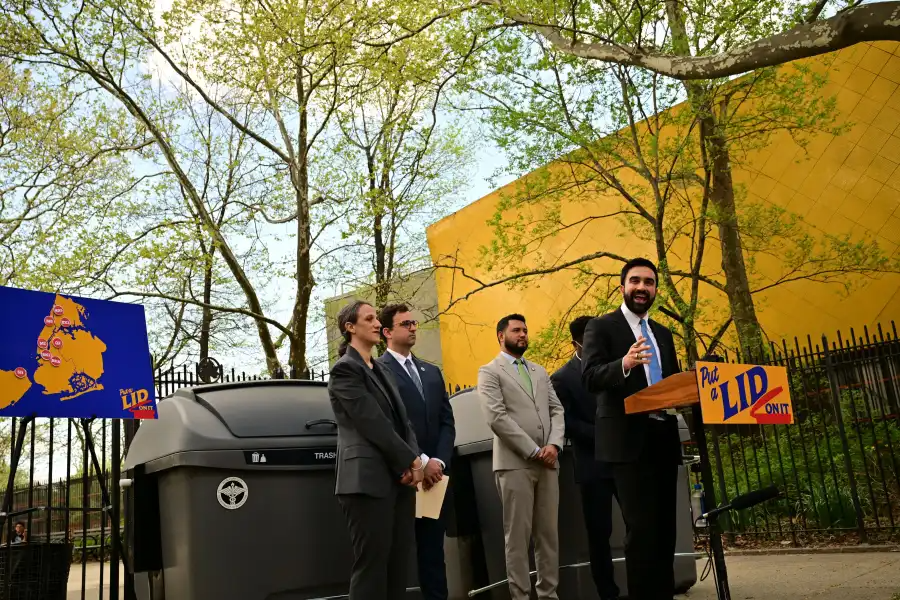 Mayor Zohran Mamdani said trash in the city will be 100 percent containerized by 2031. File photo by Lloyd Mitchell
The Department of Sanitation has conducted a “massive” outreach operation in CB2, said agency rep Vincent Gragnani, including visiting 450 mid-sized buildings with the option to choose Empire Bins or the smaller bins.
“Among these, roughly 50 buildings have opted for Empire Bins so far, but discussions with building owners and managers are ongoing,” Gragnani added. “In Manhattan District 9, we saw a lot of signups in the final days.”
The agency expects to install around 1,700 Empire Bins in CB2 starting this fall.
DSNY is also piloting shared Empire Bins in CB2, allowing smaller properties on the same block to share an Empire Bin. There has not been a lot of interest in the shared bins just yet, Gragnani said, but DSNY wanted to “gauge interest and to test the concept on a smaller scale” before the larger rollout next year.
Rat sightings in West Harlem have been on the decrease since the bins were installed, Gragnani said, and rat reports are also down citywide since the wheelie bins were rolled out at smaller buildings.
“The data shows that containerization works!” he said.
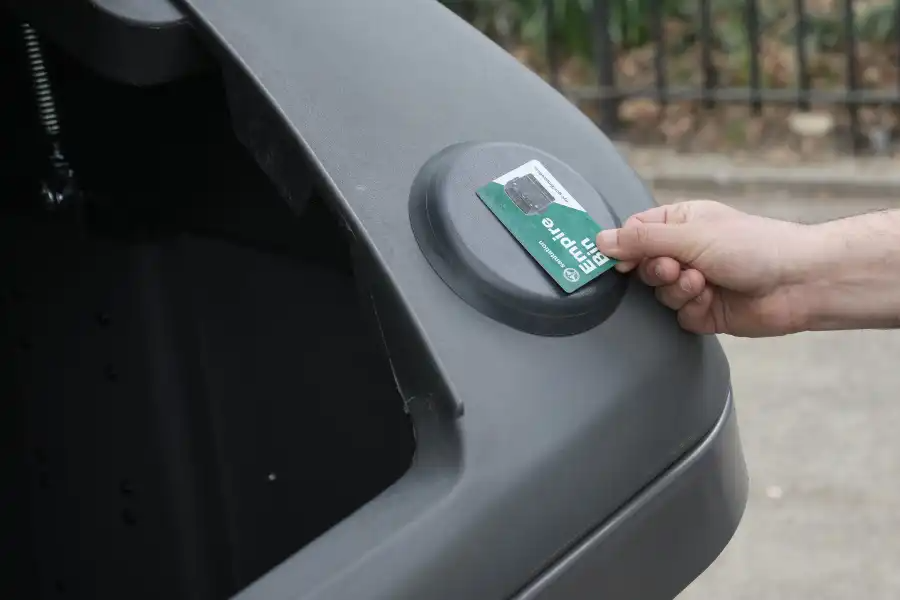 The bins can only be opened with special tap cards distributed to building owners and staff. Photo by Ed Reed/Mayoral Photography Office
In the fall of 2025, the City Council passed Brooklyn Council Member Crystal Hudson’s Intro. 1123-B, codifying and setting guidelines for the containerization program. The bill also set up a funding plan, Hudson explained, and allows DSNY to collect a $55 fee per tenant per year from larger buildings. That fee won’t be collected from the jump, but is there as a stopgap in case of future issues.
“Should there ever become a budget issue that would make it more difficult for the sanitation department to provide the service, charging the fee basically makes the program permanent … and allows people to receive the service sort of continuously, no matter what,” she said.
Hudson, whose District 35 overlaps with CB2 and will be part of the containerization rollout, said she was inspired to introduce the bill after she traveled to Barcelona and saw the on-street containers they have in place there.
“I just was like, ‘Wow, imagine a world where there are no trash bags on the street,’” she said. “I’ve passed by heaps of trash bags that are bigger than I am.”
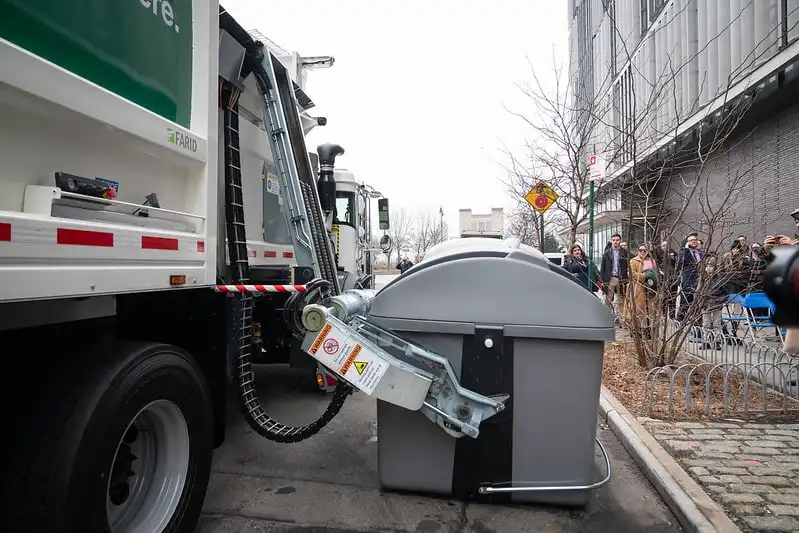 Side-loading trucks can automatically grab and dump the Empire Bins. Photo by Ed Reed/Mayoral Photography Office
Her district suffered with such severe rat problems that her office launched a community Rat Task Force that has worked to secure rat-proof bins and educate commercial businesses on containerization laws in an effort to deter the rodents.
So far, she said, reception has been positive — even among residents who are concerned about losing parking spaces to the bins. Restler has seen the same.
“There’s some concern about loss of parking, but my sense is that most neighbors see the Empire Bins and containerization of garbage as a big win for our neighborhoods,” he said.
Lara Birnback, executive director of the Brooklyn Heights Association, used to live in a suburban neighborhood in Spain where household trash was gathered in shared bins on the street. Containerization is “a positive shift,” she said.
“At the same time, I understand that people have a lot of questions, and it’s something new, and it’s a pilot so inevitably there will be things about it that work very well, and things about it that don’t necessarily work, or that need to be tweaked, or could be improved,” Birnback said.
Some neighbors have expressed concern about the way the bins look, she said. She’s sympathetic, but said “neither are rats or leaking bags of garbage particularly attractive on our streets.” The BHA will listen closely to resident experiences and liaise with elected officials and DSNY if changes need to be made once the bins arrive, she said.
Hudson said full containerization will be a “slow roll,” and it will take some time before the Empire Bins are deployed across the entire city.
“We’re going to sort of ramp up the program, and also the sanitation department will be investing in a whole new fleet of sanitation trucks that will be compatible with these bins,” she said. “I think they’ll be a little bit smaller in terms of their physical footprint … and I think it’s gonna ease the physical requirements of the sanitation workers a little bit. That’s something I’m particularly excited about.”
Editor’s note: A version of this story originally ran in Brooklyn Paper. Click here to see the original story.
Related Stories
Email tips@brownstoner.com with further comments, questions or tips. Follow Brownstoner on X and Instagram, and like us on Facebook.