
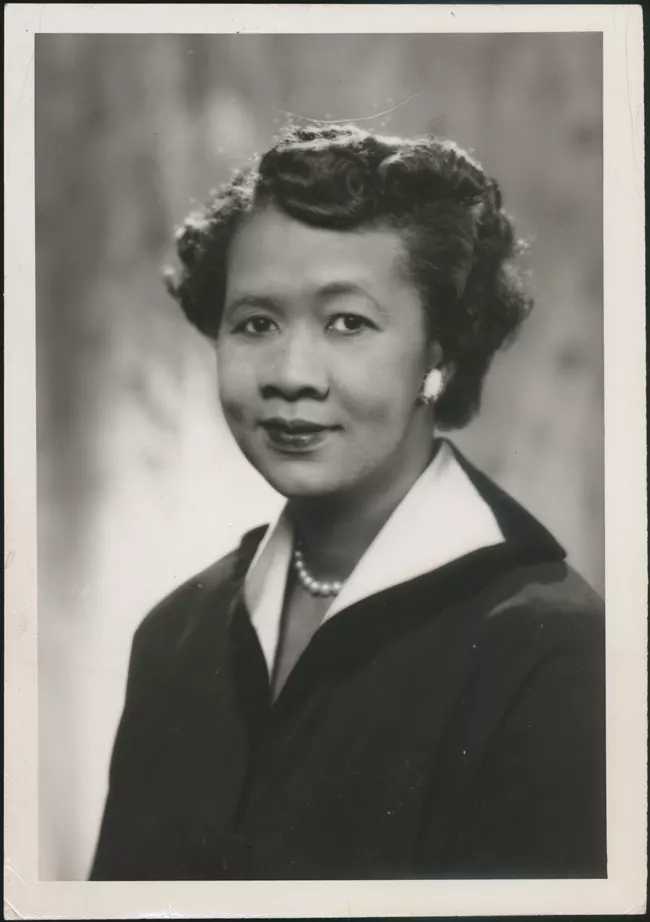
The new Women’s Professional Baseball League embraced its identity and history as the first all-female professional baseball league in the United States in more than 70 years by honoring iconic women leaders as the inspiration for the four inaugural teams.
The league announced on July 8 that the team representing NYC would be called the New York Heights in honor of Dr. Dorothy Height, sometimes referred to as the “godmother of the civil rights movement.”
The WPBL detailed the reasons for choosing their namesakes in a statement announcing the New York Heights along with the three other teams, the Los Angeles Queens, San Francisco Firebelles and the Boston Hunters.
“As we take the field, we‘re inspired by her confidence, leadership, and unwavering commitment to her goals,” WPBL said in the announcement. “Just like Dorothy Height, we’re ready to rise to the occasion and change the game.”
Height, a trailblazing leader, spent her life fighting for justice and equality, not only with the civil rights movement, but within the civil rights movement, where Black women were historically excluded from leadership positions and not credited for their work. But Height famously met her exclusion from the spotlight with a determined grace.
“I want to be remembered as someone who used herself and anything she could touch to work for justice and freedom…. I want to be remembered as one who tried,” Height said in one of her most famous quotes.
Height’s work in the civil rights movement spanned more than 50 years, beginning when she was only a teen, volunteering for anti-lynching campaigns and continuing on to become a key organizer in the historic March on Washington, longstanding president emeritus of the National Council of Negro Women (NCNW) and trusted advisor to multiple presidential administrations.
Born in Raskin Pennsylvania in 1912, Height didn’t find herself in New York City until 1929, when she moved to Harlem to live with her sister while attending college. Her initial experience in NYC was a pivotal one for Height. Having won a scholarship to pay for her education, Height applied to and was accepted at Barnard College.
But, on presenting herself at the college, the dean informed Height that the university had already met its quota of admitting two Black students per semester and turned her away. It was then that Height went downtown to Washington Square and NYU and was accepted on the spot.
Height earned both a bachelor’s degree and a master’s degree from NYU Steinhardt as well as studying at Columbia University and the New York School of Social Work.
Height would say of her time at NYU that the school gave her a base, “it felt like home,” she would say.
“It gave me a feeling of confidence in a sense that though I came out of a small school and out of a small town, that I never felt that I was less and I was constantly challenged,” Height said in an interview ahead of being awarded NYU’s Distinguished Alumni Award.
Later in Life, Height was awarded with 36 honorary doctorates from schools like Harvard University, Princeton, Harvard and Tuskeegee University as well as various medals and achievements like the Presidential Medal of Freedom and the Congressional Gold Medal. But perhaps the most significant recognition of all came from Barnard College in 1980, when they issued Height a formal apology and named her an honorary alumna.
She would go on to become a social worker, doing casework with the New York City Department of Welfare. During that time, Height was tapped to mediate the Harlem Race Riot of 1935 and manage the aftermath and she spoke out against the so-called slave markets for domestic workers in the Bronx and Brooklyn.
Height became a leader in the Young Womans’ Christian Association (WYCA) Harlem branch where in 1937 she would meet two women who would become longtime partners in Height’s work in the civil rights movement: Mary McLeod Bethune and Eleanor Roosevelt.
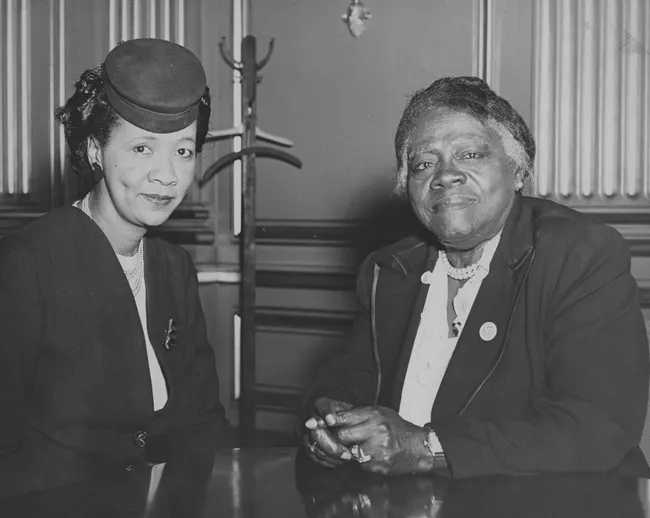 Dorothy Height (Left) sits next to Mary McLeod Bethune (Right), her longtime ally in the civil rights and women’s rights movement and partner in the National Council of Negro Women. Photo: National Parks Service/ National Archives for Black Women’s History
As Height, then the Assistant Executive Director of the Harlem YWCA, escorted Roosevelt into a National Council of Negro Women (NCNW) meeting, Bethune who was the founder and president of the organization, asked Height to join the cause and fight for equal employment, pay and education for Black women.
There began a decades-long career with both organizations. Height rose through the ranks of the YWCA to the National Board of the organization and eventually led the successful effort to fully integrate the YWCA. She joined the NCNW first as a volunteer, but was eventually voted president of the organization, a position she maintained for 40 years.
In the 1960s, Heights was a key member of the Council of the United Civil Rights Leadership organizing the historic March on Washington, the site of Martin Luther King Jr.’s famous “I Have a Dream” speech. While Height was instrumental in organizing the march and sat on the platform seats away from King, she nor any other female leaders were asked to speak at the ceremony.
Height wrote about the experience in her famous essay, “We Wanted the Voice of a Woman to be Heard.”
“The blatantly insensitive treatment of Black women leaders was a new awakening,” Height said in the essay. “We began to reflect on the importance of Black women in our community. They are the backbone of our churches. The evidence of their work can be seen everywhere. It made some of us sit up and think in new and different ways.”
Height’s contributions to the civil rights movement were not recognized by media among the infamous “Big Six” activists who were all men: King, James Farmer, John Lewis, A. Philip Randolph, Roy Wilkins and Whitney Young. In fact today, her efforts are still underrepresented in history.
For the WPBL, naming its New York franchise after Height is intended to do more than recognize a historic figure. League officials say each inaugural team was designed to reflect women whose courage and leadership reshaped American history, much in the way the inaugural cohort of pro baseball players have been fighting for recognition and breaking down barriers within the sport to make way for future generations.