
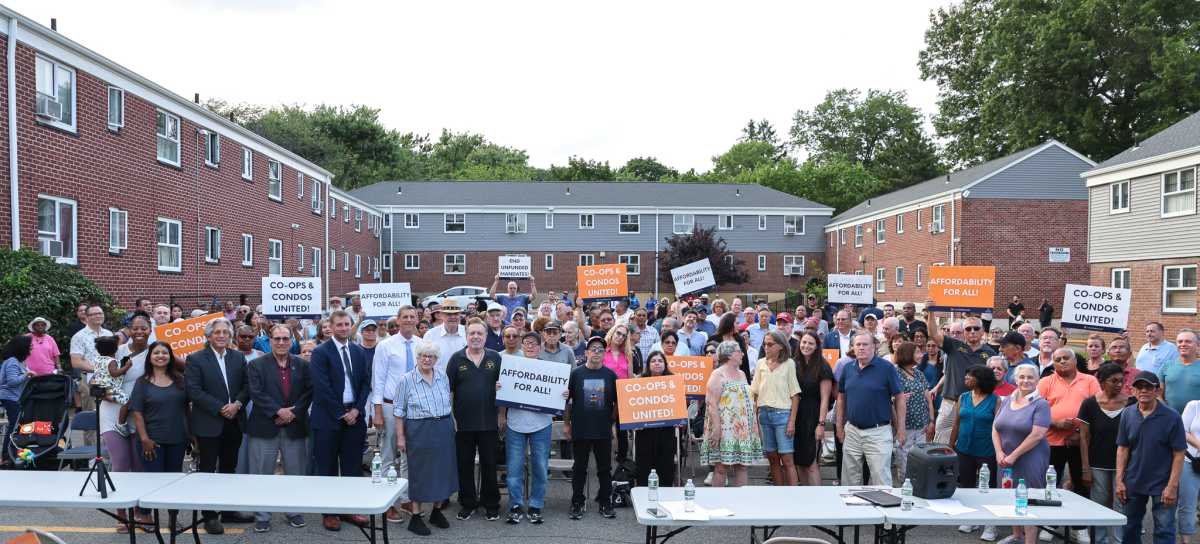
Co-op and Condos United of New York (CCU) is demanding the City Council provide tax relief to co-op and condo owners in Queens and across the city by adopting the J-51 program recently approved by the New York State Legislature.
The coalition gathered at the Bell Park Manor Terrace Co-op in Queens Village on Friday, July 24, to draw attention to what they called “unfunded mandates,” specifically citing Local Law 97 (LL97) — a landmark climate law that sets carbon emission limits on buildings exceeding 25,000 square feet, or multiple tax lot buildings exceeding 50,000 square feet — among other economic factors that they argue threaten housing affordability.
The J-51 program, which was renewed for 10 years in June as part of the enacted New York State budget for the 2027 fiscal year, provides property tax exemptions and abatement to building owners that support major residential renovations, energy updates and apartment modernizations to help meet new state limits for carbon emissions.
Under the new version of the program, the average assessed value eligibility threshold was raised from $45,000 to $60,000, and the eligibility threshold will increase annually based on changes to the consumer price index. It also allows co-ops to use the abatement to cover the J-51 application fees
The CCU said these positive changes will ensure that more middle class co-ops can apply for this vital tax relief to support capital repairs. An estimated 1,500 co-op and condo properties citywide are newly eligible.
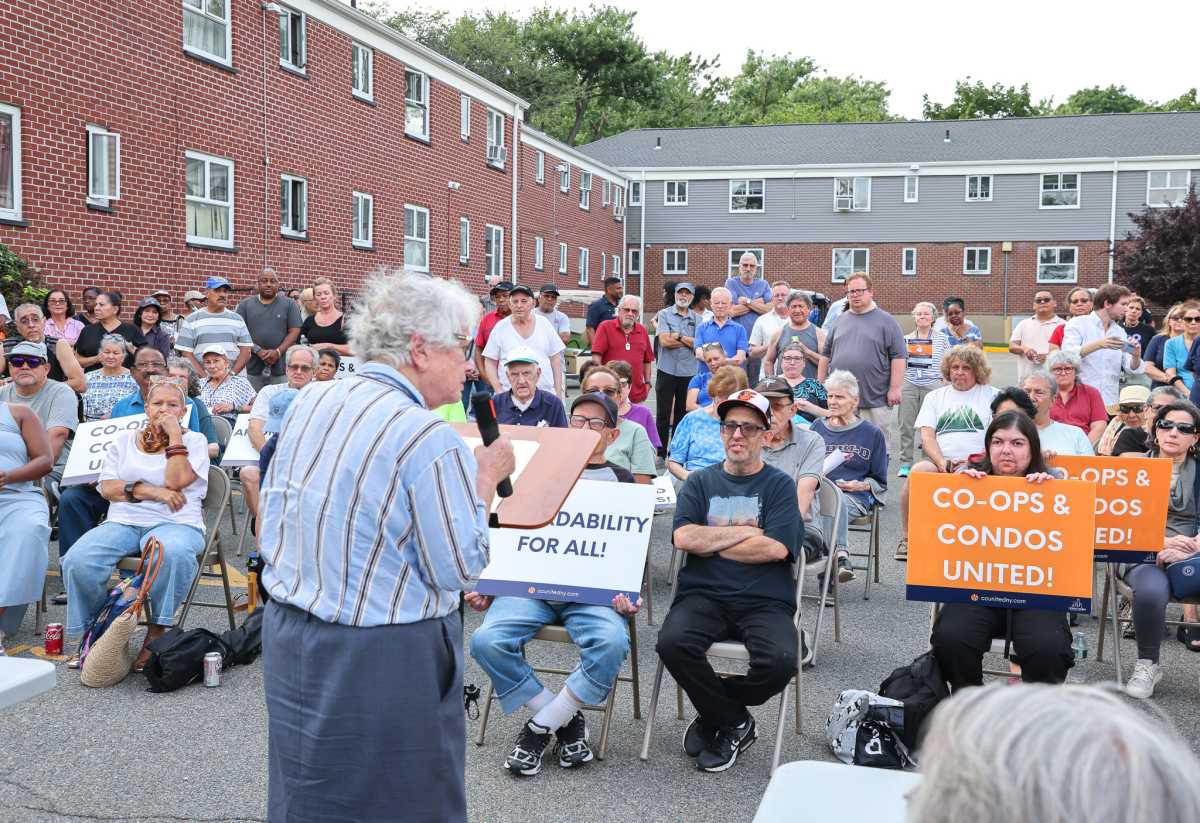 State Sen. Toby Ann Stavisky rallied alongside co-op and condo owners at Bell Park Manor Terrace Co-op.Photos courtesy John Lazzaro
Environmental experts overwhelmingly support LL97 due to its estimated impact on climate change, which could mitigate rising water levels that threaten coastal communities such as Far Rockaway. They also said it would improve human health and emphasized that it would lower asthma rates, which is especially important in Queens where rates are among the highest in the state.
LL97, passed in 2019, requires building owners to report their emissions to the NYC Department of Buildings each year. It set its first compliance deadline in 2024, by which 92% of large buildings met the emission threshold. The long-term goal of the first compliance period, between 2024-29, is to reduce carbon emissions by 40%.
In order to meet these goals, LL97 provided guidelines for reducing emissions through energy efficiency upgrades such as insulating pipes, repairing system leaks, replacing steam traps, upgrading lighting, maintaining heating systems and more.
Since its passage, state officials have acknowledged funding hurdles as a challenge for some building owners to achieve carbon emission limits outlined by the law. In response, they have started providing free technical assistance, financing opportunities, support for new construction and other programs aimed at reducing costs and ensuring building owners have resources to comply with LL97.
However, co-op and condo owners argue these resources are not enough. They said they are disproportionately impacted by the law since the cost of these energy upgrades are passed onto them despite the fact that many of them are from middle-income families.
And, they pointed out, if their building is not compliant with the law by each deadline, they face penalties of up to $268 for every metric ton of carbon emissions above the legal limit per year.
That is why the CCU, a coalition of co-op and condo owners from across the five boroughs that represents the interests of the more than one million New York homeowners who live in this type of housing, demanded the J-51 program be adopted by the City Council.
“The J-51 program is an essential financial lifeline that allows co-ops to make essential capital repairs without passing on exorbitant costs to shareholders,” said Jane Menton, legislative director of the CCU. “J-51 is helping to preserve one of the last pathways to affordable homeownership for the middle class, and it is essential that the City Council adopt the expanded and renewed version of the program. We are grateful for the support of many of our elected officials today who are committed to supporting New York’s vibrant and important co-op community.”
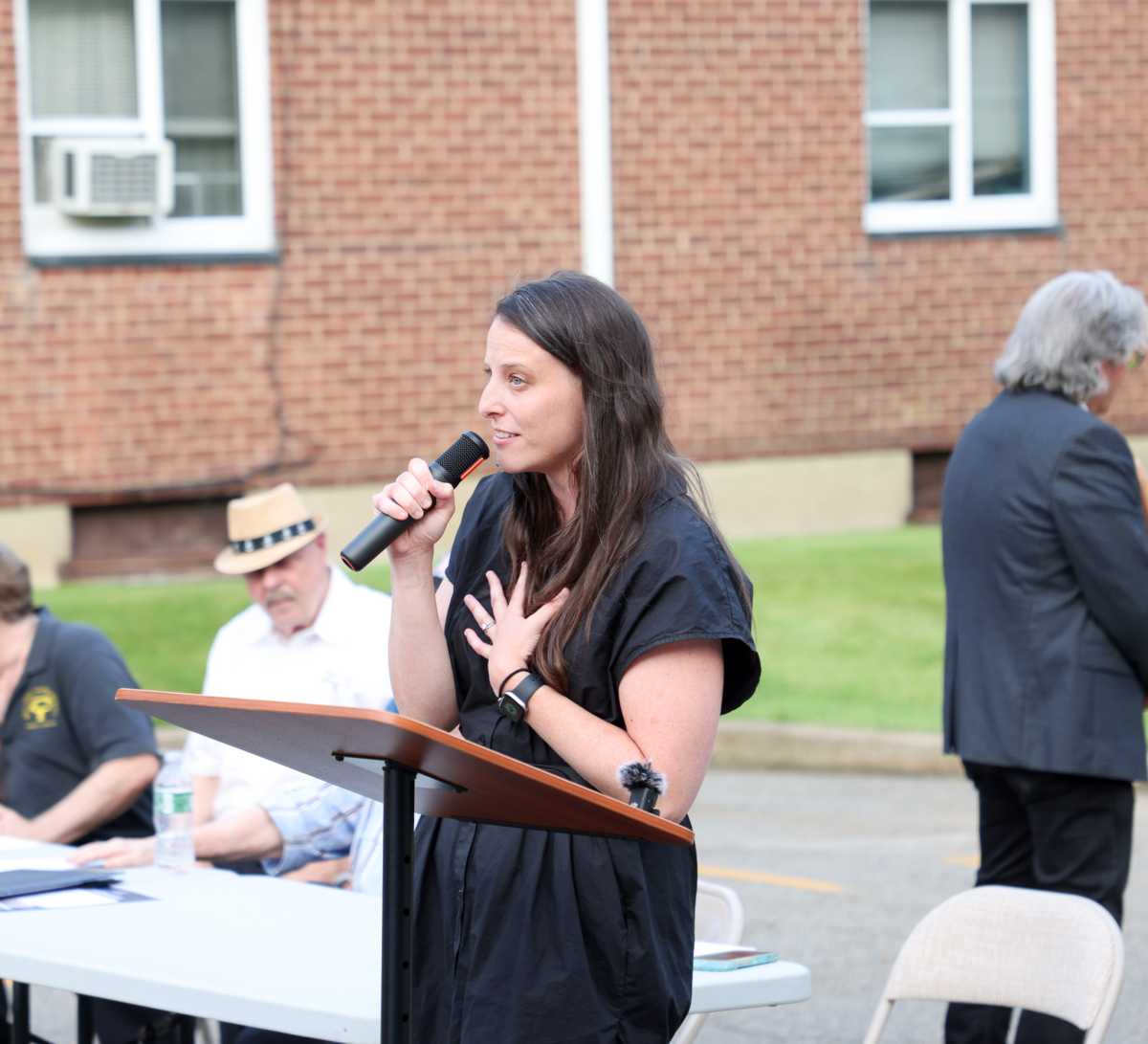 Jane Menton, legislative director of the CCU, spoke during the July 24 rally in support of J-51.Photos courtesy John Lazzaro
Local elected officials, including U.S. Rep. Tom Suozzi, state Sen. Toby Ann Stavisky, Assemblymembers Ed Braunstein and David Weprin, and City Council Members Linda Lee and Vickie Paladino, also expressed support for the expanded J-51 program while also discussing the affordability crisis currently blighting the cooperative housing community. They argued co-ops serve as one of the last attainable paths to homeownership for the middle class.
“You have my commitment that I will continue fighting to protect affordable homeownership, defend our cooperative communities, and ensure that government policies strengthen — not weaken — the neighborhoods that so many families proudly call home,” Suozzi said.
Lee, who is chair of the City Council’s Committee on Finance, said the combination of LL97 compliance penalties and today’s affordability crisis is placing an “unsustainable” burden on families.
“Co-op and condo residents are facing mounting financial pressures as the cost of living continues to rise, and the city must take action to help preserve affordable homeownership,” Lee said. “For generations, co-ops and condos have provided a dependable path to affordable homeownership. As the City works to address these challenges, I remain committed to partnering with the growing coalition of community leaders and organizations like Co-ops and Condos United to ensure residents have a voice and to protect the long-term stability of our neighborhoods.”
For more information on CCU, visit CCUnitedNY.com.