
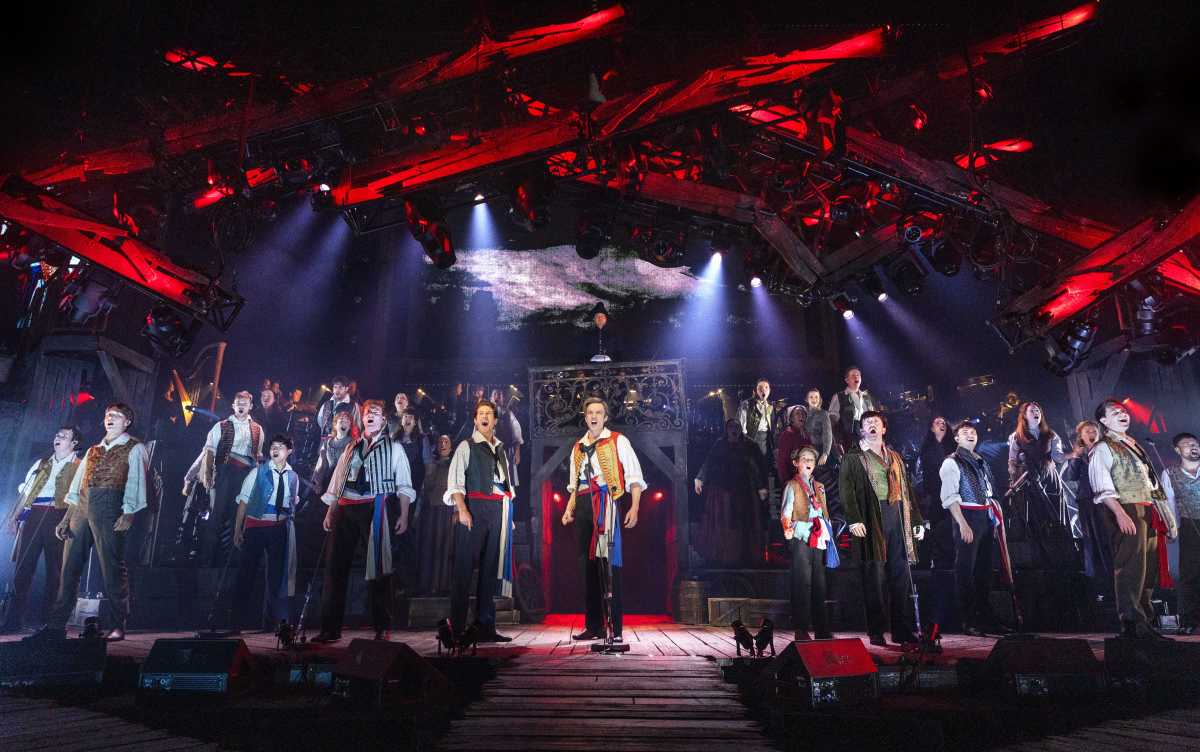
At Radio City Music Hall, one Jean Valjean is apparently not enough.
Whenever the hero of “Les Misérables” steps forward for a solo, his image is transmitted onto four large video screens extending from the stage into the sides of the front orchestra section. Suddenly, the lone ex-convict is joined by four towering duplicates, creating a trippy hall-of-mirrors effect. Strangely, it suits the musical’s confessional solos, magnifying Valjean’s private struggle with redemption.
Nor is one Valjean enough to cover the engagement. The role is shared by Alfie Boe, Killian Donnelly and Gerónimo Rauch, while Bradley Jaden and Jeremy Secomb alternate as Javert. At the Sunday, July 26 matinee I attended, Rauch and Secomb led the cast.
“Les Misérables: The Arena Concert Spectacular,” Cameron Mackintosh’s international concert production, marks the first major professional New York presentation of “Les Miz” since the underwhelming 2014 Broadway revival.
Mackintosh has mounted concert versions for decades, including the 10th- and 25th-anniversary concerts and the 2019 staged concert, all filmed and released for home viewing. The arena production expands upon the 2019 concert, which played more than 200 performances in London. Radio City brings the musical’s official 40th-anniversary celebrations to a close.
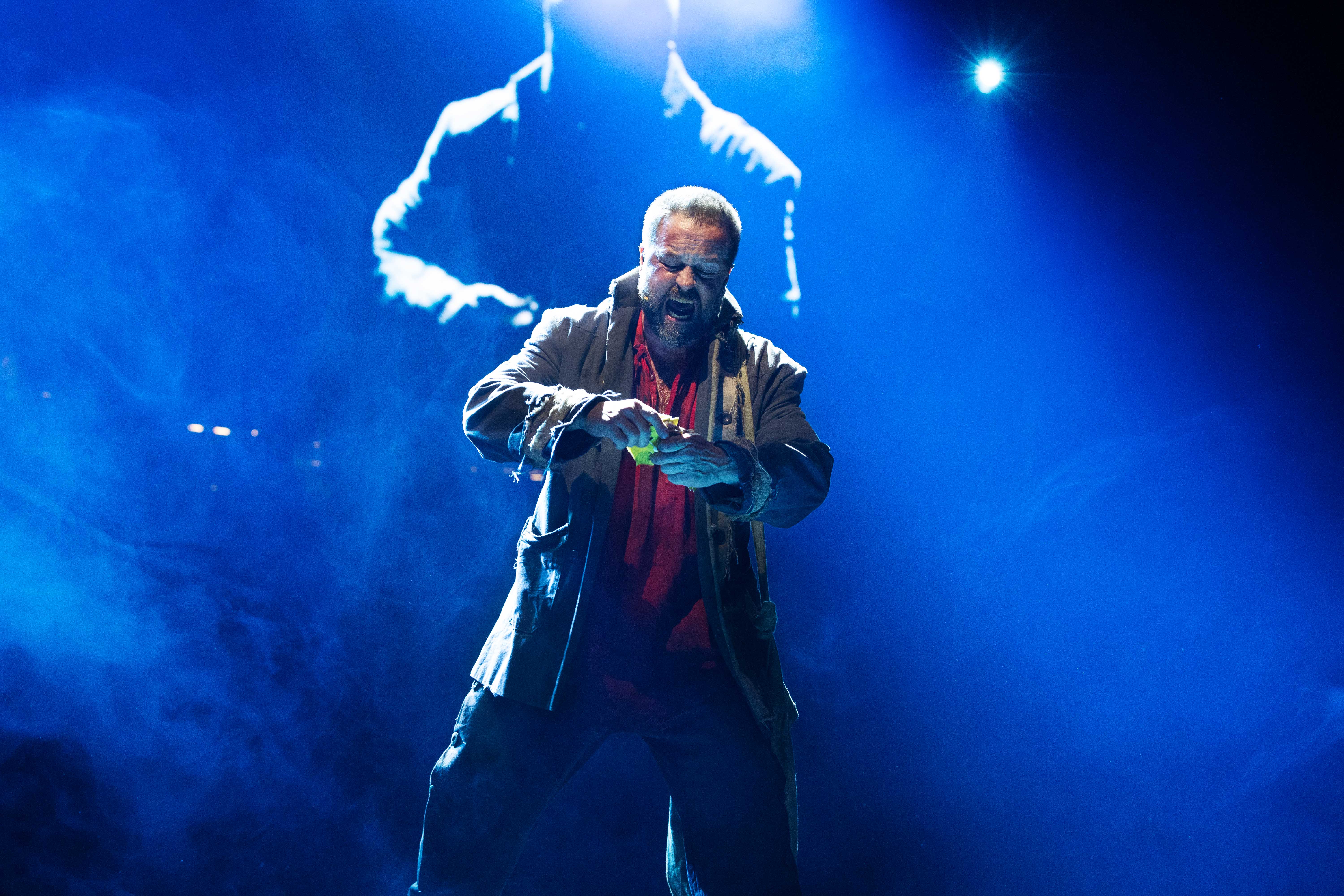 Les Misérables The Arena Concert Spectacular, Alfie Boe as Jean Valjean.Credit: Danny Kaan
Few musicals are better suited to the concert format. “Les Miz” is sung through and filled with impassioned solos such as “I Dreamed a Dream,” “Stars,” “On My Own” and “Bring Him Home.” They need powerful singers far more than a revolving stage or fully constructed barricade.
More than 30 performers sit on tiered risers, with an orchestra of approximately 26 musicians positioned high above them. The actors step forward to sing at standing microphones, with limited movement.
Major incidents, including the battle at the barricade and Valjean’s rescue of a man trapped beneath a runaway cart, are conveyed mainly through music, lighting and performance. The staging is visually modest, but the large cast and orchestra produce tremendous force.
The tradeoff is that newcomers may have trouble following the sprawling plot. The original production famously used projected titles to identify locations and years. Here, illustrations and lighting suggest a factory, an inn, the Paris streets, the sewers and the barricades, but do not always make clear where we are or what is happening.
The biggest stage effect arrives at the end of Act One, when enormous red flags are unveiled and waved during “One Day More,” while the company briefly evokes the original production’s familiar forward-and-back marching choreography.
The live-video screens help distant spectators catch facial expressions and smaller acting choices. Although part of the arena-tour aesthetic, they no longer seem unusual given how often experimental directors such as Ivo van Hove and Jamie Lloyd use live cameras on Broadway.
 Les Misérables The Arena Concert Spectacular, Beatrice Penny-Touré as Cosette.Credit: Danny Kaan
Secomb is a stentorian Javert in appearance and sound, with imposing authority and a booming, inflexible vocal presence. Rauch’s Valjean, by contrast, has a searching quality and sensitivity, suggesting a man examining his conscience and struggling toward grace. Together, they make an especially compelling pair. After Valjean frees Javert at the barricade, Secomb’s stunned disbelief is palpable, as though mercy has shattered the inspector’s understanding of justice.
Shan Ako brings aching sincerity to Éponine, while Jac Yarrow’s Marius comes most fully into focus during “Empty Chairs at Empty Tables.” Matt Lucas and Marina Prior embrace the Thénardiers’ broad comedy. Philip Quast, Javert in the celebrated 10th-anniversary concert, returns as the Bishop.
Samantha Barks, now playing Fantine after portraying Éponine in the film, pushed too hard vocally and had some strained moments at my performance, although she remained dramatically committed.
Most important, the concert sounds glorious. The 2006 and 2014 Broadway revivals lost some of the musical’s power by downsizing the orchestra. Here, the larger ensemble restores the surging transitions, recurring themes and massive climaxes that pull the audience along. It makes a substantial difference in the show’s grip and emotional power.
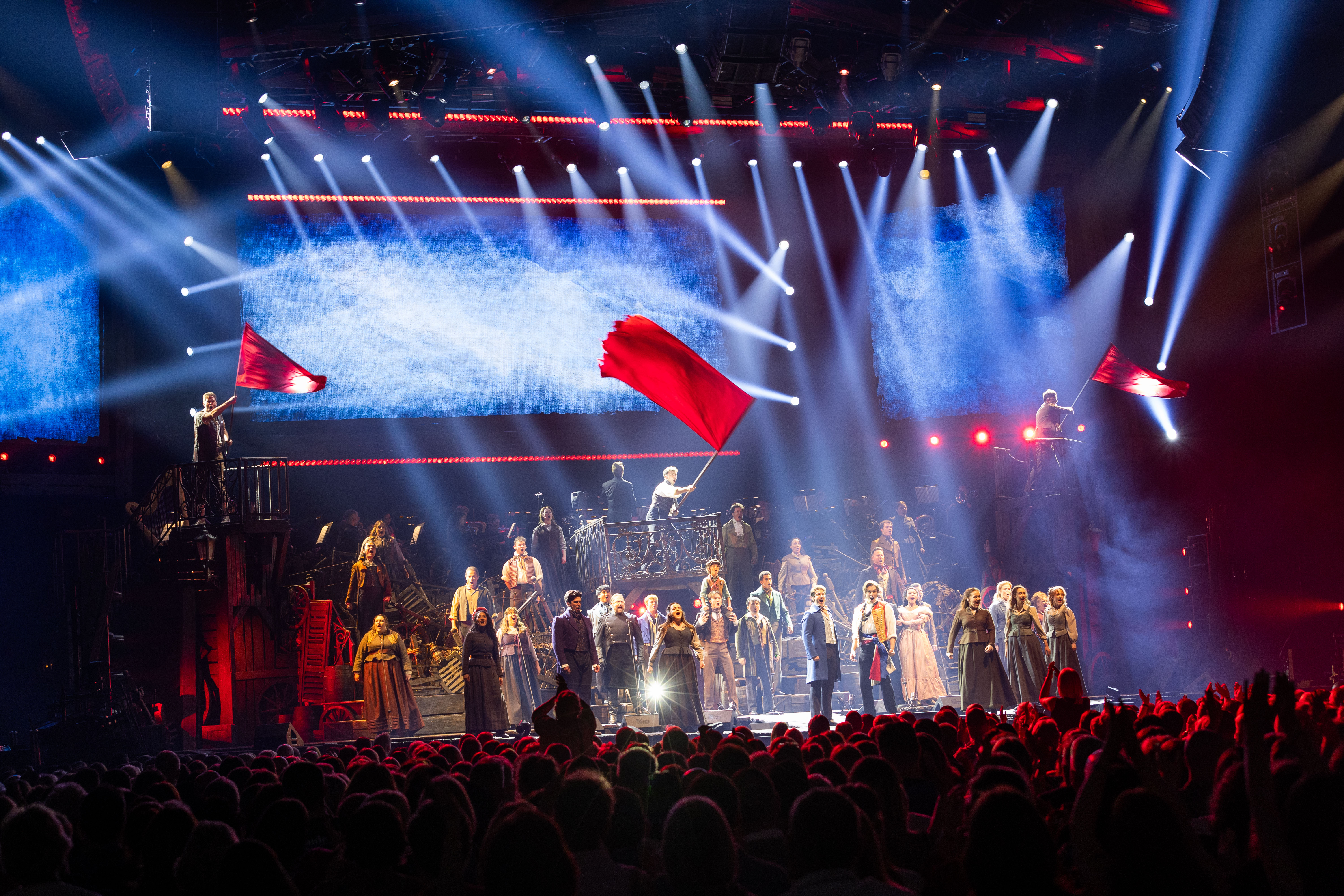 Les Misérables The Arena Concert Spectacular, Ensemble.Credit: Danny Kaan
Radio City’s superb acoustics strengthen the effect. The vocals are clear, the orchestra is rich and balanced, and even quiet passages register.
A very different production will soon open at Hudson Valley Shakespeare’s new home in Garrison. It will presumably be far more intimate, while newly available performance rights should lead to many more regional and community stagings.
“Les Misérables” endures because it works at Radio City and at a summer arts camp, as I learned in 2002, when I assistant-directed one of the first student-edition productions at French Woods Festival of the Performing Arts.
Whether backed by a large Broadway orchestra or a student pit band, the people will continue to sing.
Through Aug. 9 at Radio City Music Hall, 1260 6th Ave., nyc.lesmis.com.