
An American Beauty: Grateful Dead 1965–1995
David Kordansky Gallery
June 23–August 7, 2026
New York
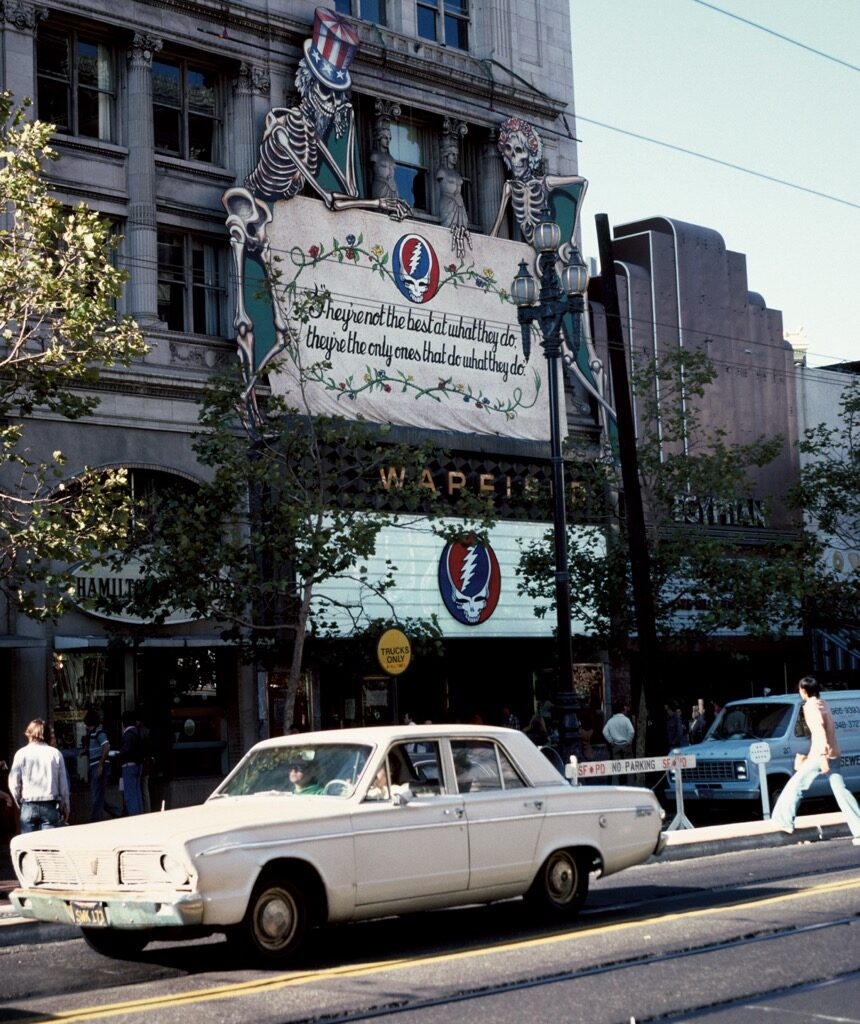
To be a Deadhead is to dedicate your life to explaining the unexplainable, thanks both to our evangelistic fervor and to the music’s demanding, confounding nature. We’re “like licorice,” Jerry Garcia said in a 1983 interview with MTV. “Not everybody likes licorice, but the people who like licorice really like licorice.” A show of rare photographs, up in expanded form at David Kordansky’s New York gallery after its first showing in Los Angeles, An American Beauty: Grateful Dead 1965–1995 largely side-steps the Deadhead apologia and ever-appropriated iconography in favor of the band’s weird, wide cast of characters and the evolution of their relationships—particularly the brotherly bond of co-leads Garcia and Bob Weir—as the band’s sprawling, unclassifiable take on American music spiraled out of the Acid Tests and into stadiums around the country over thirty years, ending with Garcia’s death in 1995. For fans and the unfamiliar, it’s an efficient, thoughtful tribute with a heavy focus on the band’s radical days in the sixties. For those willing to read between the lines a bit (or those committed to Weir’s posthumous proclamation that this be a three-hundred, not thirty-year project) there’s something intimate, even moving about these glimpses into a group of friends, outcasts, and poets as they pushed their financial, technical, and spiritual limits to create a form of uncompromising, ever-changing, mass-participatory art that to this day is furthered by old-heads and newcomers alike, transcending the atomization and nihilism of America’s past, present, and future.
Curated by longtime touring photographer Jay Blakesberg and his daughter Ricki, themselves indelible archivists of both the past and present Dead scenes, the show is a rethinking of a 2024 presentation at the Venetian Resort in Las Vegas on the occasion of Dead & Company’s “Dead Forever” shows at Sphere. (I was there, man.) Where that exhibition concentrated on Blakesberg’s crowd-forward photography, going well beyond the nineties, the selections here are all pre-digital, including a number of up-close portraits and candids from other noted Bay Area scene photographers. While a handful of these shots are straight-up iconic, the Blakesbergs’s approach is firmly rooted in the American documentary tradition, with new and recent high-definition prints of the 35 mm originals allowing the photographers’ more intentional gestures to exist next to run-and-gun snapshots in a manner that’s closer to a family album than a research project. This is especially true of the experimental 1960s, with shades of Vivian Maier in the black-and-whites, but the massive jump in quality—like trading an audience tape for a soundboard recording—grants each decade its own presence and unitary cohesion. This palpable newness can be felt, lending at times a primal urgency to these images and, occasionally, a sense of historic detachment not unlike scrolling through the Blakesbergs’s archival Instagram account.
Taking a sharp left on entry at the earliest point—the gallery is laid out in circular, chronological fashion—we see in Ron Rakow’s black-and-white Grateful Dead Posing on Potrero Hill, San Francisco, CA (1967/2026) the “founding five” members: bassist Phil Lesh, keyboardist/vocalist Ron “Pigpen” McKernan, drummer Bill Kreutzmann, Weir, and Garcia, obviously unsure what to do with themselves in a photoshoot. Lesh is pretending to be an airplane, while Kreutzmann, who cut his teeth as a session player, puts on his best album-cover stare. Pigpen—at this point the most famous member of the Grateful Dead—stands with his arms behind him, while Garcia and Weir seem to cram themselves as far away from the camera as possible. Behind them is the city of San Francisco, with its pre-tech bustle, density, and sense of opportunity palpable. We stay in 1967 as we head down the wall, with Rakow’s full-color and black-and-white candids from the band’s shared 710 Ashbury house, Garcia with his longtime partner Mountain Girl, and various shots of the band’s raucous free concerts in Elysian and Golden Gate Park. It’s not all sunshine and rainbows, though: Elizabeth Sunflower’s striking Bob Weir in city jail, San Francisco, CA (1967/2025) shows the band’s youngest and most kicked-out member, only nineteen here, leaning against jail cell bars with a smile after an infamous SFPD drug bust. More photos introduce us to future second-drummer Mickey Hart and, in Rosie McGee’s Jerry Garcia and Ken Kesey at Newport Pop Festival, Costa Mesa, CA (1968/2026), the band’s relationship to sixties counterculture at large.
With the end of the sixties came seismic shifts for the group, beginning with the violence at Altamont (a concert the Grateful Dead organized but did not play) and a heel-turn to the Americana-inspired folk-rock, which catapulted the band as close to critical legitimacy as they’d ever get—including this show’s namesake, American Beauty (1970). Rakow’s Jerry Garcia at the Château d’Herouville, Hérouville-en-Vexin, France (1971/2026) shows Garcia, who’s abandoned his somewhat goofy psychedelic looks for denim shirts and an archetypal beard, sitting as the band prepares to play its first European concert (impromptu, of course). With the death of Pigpen in 1972, the band had finally wandered away from its bluesy origins and into swirling, lyrical ballads in partnership with poet Robert Hunter. Keyboardist Keith Godchaux—seen smiling on a date Deadheads will immediately recognize in Rakow’s delightful Keith Godchaux in Veneta, OR (1972/2025)—and his wife, Donna Jean, join the band as Hart begins a years-long hiatus after his father embezzled hundreds of thousands of dollars from the group. Weir hires a renegade cowboy/poet to draft his lyrics, and their bond quickly grows close (Andy Leonard’s Bob Weir and John Perry Barlow in Marin County, CA [1972/2025]) as Weir cements himself as both a rhythm guitarist and an iconic lead vocalist. By 1974—a year to which most of the back wall is devoted—we see what many argue is both the peak of the Dead’s technical prowess and its technical excess, with a look (in Kirk West’s Grateful Dead performing at the Iowa State Fairgrounds, Des Moines [1974/2026]) at the band’s custom thirty-six-foot-tall sound system, dubbed the “Wall of Sound,” which simultaneously produced the world’s highest quality concert audio and nearly killed the Grateful Dead for good. (Pick up a copy of Brian Anderson’s Loud and Clear [2025] for the many reasons why.) Beside it, Rakow’s Phil Lesh performing at the Hollywood Bowl, Los Angeles, CA (1974/2025) is the coolest the composer/bassist ever looked, the Wall towering behind him. My favorite image in the whole show is of Garcia playing with a film camera shoved in his face— Leonard’s Grateful Dead filming The Grateful Dead Movie, Winterland Arena, San Francisco, CA (1974/2025)—the results of which stand as both one of the greatest concert movies of all time and one of the band’s costliest, lengthiest endeavors. Created to make money during the band’s post-Wall of Sound exhaustion hiatus, Garcia—not a trained filmmaker—took on editing the hundred-thousand feet of film comprising The Grateful Dead Movie himself. For obvious reasons, the film did not release until three years later, when the band had already reformed and was back on the road.