
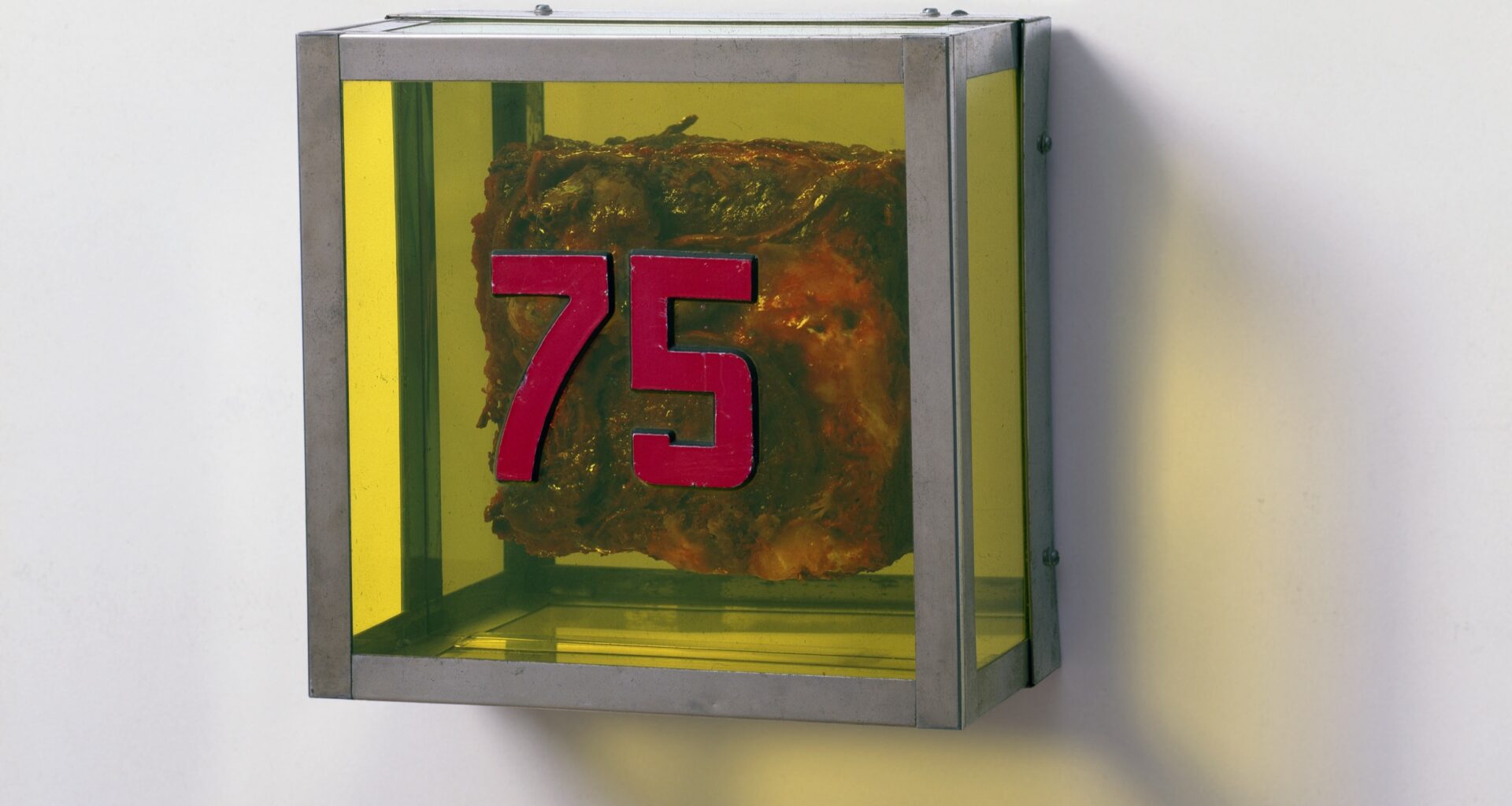
Dream of Vanishing
Pace Gallery
May 15–August 14, 2026
New York
Renowned in his day, Paul Thek, who died in 1988, was at the time called “an artist best known for installations” by the New York Times. But he also created paintings and works on paper using familiar images and words to represent his ideals. Though he showed at the Stable Gallery in New York during the sixties, then a gallery at the forefront of avant-garde art, his last show there was held in 1971. Many decades of the artist working and showing in Europe—mainly France, Germany, Italy, and Switzerland—followed. It was there that his reputation was made.
Today, Pace Gallery has presented a survey of Thek’s work. As a man opposed to the advent of technology in our lives, Pop art, and any art devoid of humanity, his anti-establishment ideas are on full display. A lapsed Catholic born and raised in Brooklyn, he was a rare character of modest means and yet spent a rich life living and traveling abroad, especially in Holland and Italy—two places he loved. With his work, he hoped to lead the viewer down a sacred path, not so much religious as it was empathetic to the world at large.
He thought big, creating large-scale, room-sized installations, envisioning gallery or museum spaces as places in which he could fabricate an imagined world: a playground of diverse visual elements, celebratory and exuberant in nature but didactic in character—a moral to be told and learned. Typical was his 1982 installation for TABLEAUX: Nine Contemporary Sculptors at the Contemporary Arts Center in Cincinnati. Alongside such artists as Marcel Broodthaers, James Casebere, and Richard Artschwager, his work was described in the ARTnews review of the exhibition:
But the pièce de résistance of the show was finally at its center: Thek’s Diameter of a Titan Missile, which inscribed within that diameter the aftermath of an atomic disaster. Though it was loaded with personal symbolism (rites of creation, destruction and rebirth) which was a bit hermetic and obscure, one could not but be affected by missiles shooting out of a baby carriage and radioactive bunnies.
Very much an independent, unbound to the movements or prevailing trends of the sixties, Thek was in a way a role model to a younger generation of artists like Jonathan Borofsky, Petah Coyne, and Barry Le Va, who subsequently created styles and working methodologies all their own. They and others are indebted to Thek in the ways they invented installations that interact with the viewer and created subtext that addresses our society and our modern day culture.