
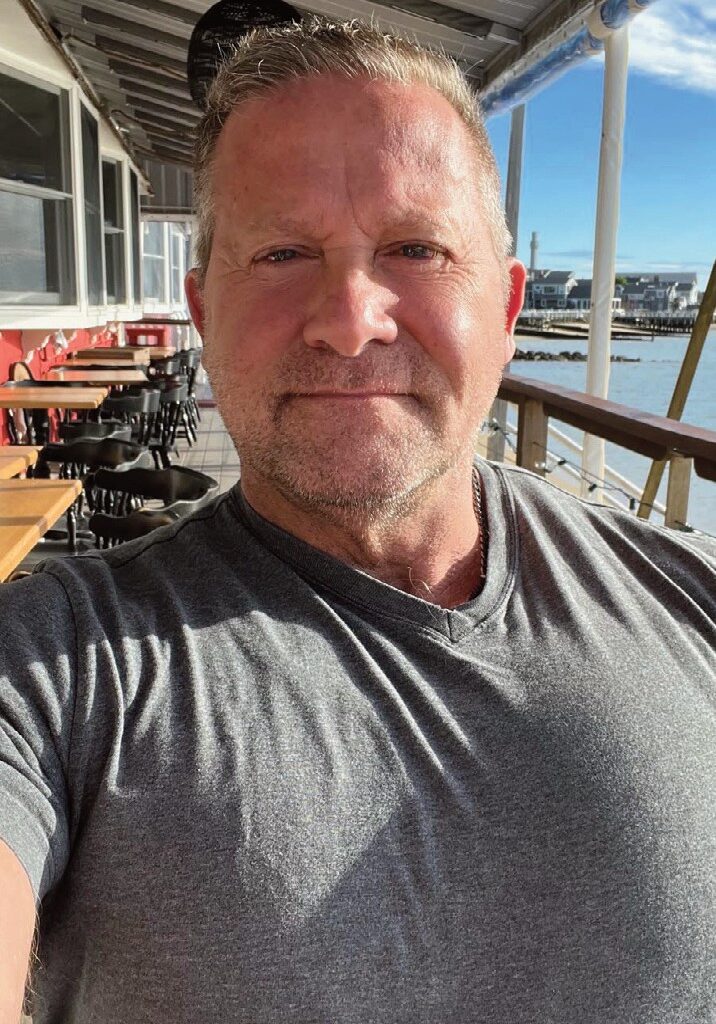

Native of Vouhgliameni, Greece and Martha’s Vineyard, MA, Stelios Mormoris is C.E.O. of Scent Beauty, Inc., which makes beauty products worldwide. Citizen of Greece and the U.S., Stelios was born in New York and lived most of his adult life in Paris. He received a B.A. in Architecture from Princeton University, and an M.B.A. from INSEAD (Institut Européen d’Administration des Affaires) in Fontainebleau, France. He has been published in Agni, Crab Creek Review, Fourth River, Gargoyle, Narrative Magazine, Nassau Literary Review, Spillway, Sugar House Review, Tupelo, Verse, and other literary journals. Stelios’ debut book of poetry, The Oculus, was published by Tupelo Press in October 2022 to strong reviews. His second collection, Perishable, is forthcoming from Tupelo Press.
Stelios’ uncle, Anthony Zitis, and his wife Betty and his five cousins, lived for 50+ years in Whitestone. He spent every Thanksgiving there as a boy, from 1962 until the early seventies. When he was young, his aunt would take him to Main Street in Flushing. Stelios’ other aunt and uncle, Charlotte and George, lived in Cambria Heights. He spent many childhood moments there in the 60’s. He remembers the tree-lined streets and beautiful small Tudor homes. The world seemed to be a more serene and cohesive place. Aside from that, he had occasional forays into Astoria, where as a good Greek-American, Stelios attended his share of Greek dances at bouzoukia with his mother and cousins.
NB: Other than the amazing diversity, what do or did you love most about Queens? And how have you seen Queens change over the years?
SM: I grew up in the ‘60s on Long Island, and my aunt and uncle lived in Whitestone, and my other aunt and uncle lived in Cambria Heights, near Jamaica. In the 60s, I would visit my families in different parts. I’d say Queens then was mostly white immigrant families, so my aunt and uncle were Greek, at a nice house in Cambria Heights. My other aunt and uncle were Greek and Irish, and lived in Whitestone and had a beautiful house, and then my other aunt, who was Irish, lived in Jackson Heights and Woodside. So, I remember it as kind of like the suburbs of New York, which at that time was Manhattan, more leafy, verdant, small houses, nice lawns, well-tended gardens. I didn’t have a sense it was part of a giant city.
And then later in life, I remember going to Flushing, and everything was in different languages, mostly Asian languages, many of which I didn’t even know. But I could see how completely Queens has become a very diverse culture, and I think I remember reading a statistic: It’s the county in the United States with the most spoken languages. I think Queens, unlike Brooklyn, is a little less like leaning toward Manhattan in terms of being trendy. I think Queens has its own culture, with different neighborhoods that are very strong, and I think people have a sense of community. I don’t want to say isolation, but they live in different pockets I would call communities. They’re near Manhattan, but they’re not like, as I’d say, urban, or as urban leaning as what I hear is going on in Brooklyn with neighborhoods like Williamsburg and so forth. I think Queens is radically changed but probably mirrors the change of the United States.
NB: How does Queens inspire you? What are some of your favorite places to be inspired in Queens?
SM: So, Queens inspires me by the fact that you can find many ethnic restaurants, meeting places, that are not influenced by American culture, but live on their own kind of energy. And the place I love, of course, is Astoria, because I’m Greek. And I’ve gone to restaurants like Kyclades, and other little restaurants that are very much proud of the Greek character, have great food, have Greek clientele, have a worldwide clientele. They’re fun and they’re less, I would say, pretentious, and they’re not as expensive as anything in Manhattan.
I think that’s one of the cool parts of Queens. I mean, the other things in Queens I really find beautiful are the beaches on the South Shore, like even Far Rockaway, going all the way to the end. I mean that’s quite amazing to me, that you have these beach communities that are in New York City, in Queens, that feel like they’re in another world and they’re quite beautiful. They have a great view of the sea and people go there all year.
NB: Okay, so this one’s more about poetry, and it has many pieces, so whatever feels right to answer from it. What advice do you have for readers who are hoping to develop their writing or artistic practice? Is writing or artistic talent innate and/or can it be taught/developed? How important is daily practice? Do you ever get stage fright/camera shy/performance anxiety or have advice about overcoming it? What advice do you have about publishing poetry and rejection?
SM: Okay, that’s a giant question. So I think that people who want to write poetry essentially want to communicate. to someone or the world; I shouldn’t say the world, into someone in some way. A yearning to communicate, even to oneself. So I think anyone who has those feelings, yearnings, should indulge them and write, and not be worried about how to write, what’s correct, what is incorrect. I do think that poetry is an incredibly open art form that’s quite inclusive. It’s not like there’s a test or there’s a standard.
I do think that poetry is a craft and does take time over one’s lifetime to actually develop, I believe, in terms of reading. I believe people who are writing in English should find historical authors from the 20th century, the 19th century. And I would say, it can be very confusing in my experience to read many, many, many poets, because there’s so much diversity. There’s as much diversity in poetry as there is diversity in humankind. So it’s very, very daunting. But I think the way to be inspired by reading is to find authors that you like and just get to know them and read their work over and over and really get to know their work, almost as if they were friends, and that could be a historical poet, like William Shakespeare, it could be a 19th century, late 19th century poet, like Walt Whitman. It could be a mid-century modernist, like Elizabeth Bishop. It could be a current poet, like, I don’t know, Mark Doty or Natalie Diaz. There are so many titans of writing at different periods in history, but I think poetry, you’ve a lot to learn from poetry over time, not just what’s being written now. So I think it’s a question of just getting to learn, find poets that inspire you, and get to know them almost like your friends. I think that will help anyone write.
And maybe imitate, but eventually find your own voice. I think that poems and poetry do require, over time, a sense of craft, where you, you hone your voice and you look for ways of, you know, the classic tenets of poetry, show, don’t explain, experience, don’t preach, use imagery, avoid abstractions, avoid excess. Look at classical forms, possibly like sonnets or villanelles or sestinas. There’s a lot to be learned from the history of poetry, the structure of poetry, and you can decide whether or not to follow that. But that, I think, does hone your craft and makes poetry more powerful. I think in terms of the presentation of poetry, everyone has their own method. It can be online, it could be videos, it could be, speaking of bookstores.
I’m a businessman. I run a beauty company that has nothing to do with poetry, but I do a lot of public speaking, but I do think that anyone who has stage fright, can easily overcome it. Stage fright is simply a syndrome that you want to do a great job. You want to make a great impression, and you’re very, you’re very proud of presenting yourself in a very, very, high quality way. So it’s a question of just going in there, speaking naturally, understanding what do you really want to say, not reading. And in the case of poetry, reading poetry that’s been rehearsed, and understand that when you’re speaking to people, they’re very receptive to what you want to hear, and you have a support system.
So, that’s my long answer to a long question.
NB: How important is personal connection and communication (networking) in your industry? And you can answer that about poetry or about your beauty business, either one.
SM: Look, I think that it’s idealistic to say it doesn’t matter. I think personal connections, of course they matter. When you get to know people, they get to understand you or respect you or appreciate your work or like you. It definitely helps in life, in anything. It could be hiring a plumber, it could be running a company, it could be getting a poem published in a journal.
I think poets have a duty if they really want to be published to a broader audience to indulge the community, be part of the community, make connections, go to poetry readings. Get to know people who go to events in New York. Or Queens. Some people call it a civic responsibility when poets are part of the poetry community.
I would say, as a writer, I’m a writer late. I started writing and publishing in my 60s, although I wrote poetry my whole life. I had a long career in business. I didn’t have time to write. I didn’t know the wherewithal to actually think of myself as a poet, but I did later in life. But a lot of that required just getting out of my comfort zone; you know, joining writers’ conferences, getting to know poets, getting to know authors, editors, takes time. It takes time. It’s like anything, it’s probably like sports. You know, I used to play rugby. Okay, a long time ago I played rugby and then I got to know guys who played rugby, joined the rugby team, then I got to know the coach, then I got to know professional rugby players. And one thing leads to another. So it’s like entering any community.
I believe if you write in isolation, that’s certainly valid, but that’s another type of experience compared to publishing your work, which does require writing, refining your craft, sharing your work with others, getting input, making connections, understanding how to get published, have people read your work and appreciate your work because they know you. And I think in that context, I think connections are very important.
NB: Thank you. Before I jump to the next question, do you want to add anything else about coming to publishing your poetry later in life or advice you have for other people about how life is long and how you can approach different aspects of interest?
SM: Life can be long. Well, I don’t know. I think life just has different chapters. At least for me, I had different chapters in my life. I’m someone who’s lived between Europe and the United States. I’m Greek. I have Greek parents. I grew up outside of New York. I lived most of my life in Paris, and I moved back to the U.S. later in life. So I’ve had different chapters in my life.
I would say, as far as writing goes, I think that people who want to write, and who are innate writers, I didn’t answer that question earlier, by the way, I was sort of thinking through my response. But I think people who are innate writers will find a place to write and a form to write. It could be, they write to themselves, it could be, they publish, it could be many number of things. But I think they are indulging something that is part of their identity. And I think that, in life, there are chapters in your life where, if things feel right to you, they will last. If things don’t feel right to you, they won’t last.
Like, I’m learning Greek now, but I spoke Greek as a child, so it comes naturally to me, something that’s in me. Other things, if someone said to me, will you learn the piano? I probably wouldn’t learn. It’s not in my nature to play piano. Poetry, I think it’s the same thing. I think there are periods in one’s life where people will have a yearning to write and if they indulge the yearning, they can do it at any time. I think it’s just sort of a question of self-awareness. Like, you reach maybe a creative phase in your life where you say, okay, this is the time. My muse is happening and I’m going to tap into my muse and I am going to move forward, move out in my comfort zone, actually do things that I’ve not done before, see where this goes. And I think people who are highly self-aware can get to that place and actually be very gratified by being a writer, by being an artist, by indulging those yearnings.
NB: I love that. Indulge the yearnings. What are some other yearnings you’ve indulged in later chapters in life that you want to talk about?
SM: Well, I mean, I have probably many facets as a person. I mean, I’m a CEO of a company, so I have, I guess it’s a yearning. I’ll call it a goal, which sounds a little more metric of, you know, creating a very successful, growing big beauty company that makes fragrances, which is what we’re doing. The name of the company is Scent Beauty, Incorporated, based in New York. We make fragrances for all sorts of brands, fashion brands, celebrities, naturals, and, I would say that, in my long career in business, you know, having an MBA and working most of my life in big beauty companies, like L’Oreal or Coty in Paris, creating my own company sort of became a yearning, I suppose. I’ll use that word. That sounds a little more literary, but certainly something that I wanted to do, to create, to create something, a company which employs people and pays people and makes people who use fragrances hopefully happy.
So, that has been a big part of my life. Interestingly, poetry is something completely different and amazing than my work life, which is very intense, when I’m in meetings and traveling, and working with investors and factories and designers and whatever it is. In my private time, I’m writing poetry, and the counterpoint of the writing is running a business, which is actually very good for me, because the two very different things seem to balance each other out.
I enjoy writing. It has nothing to do with business making money, making decisions, it’s sort of private in a way. So I realized, for me, this balance of being a businessman and being a poet is quite good.
NB: Can you tell us more about being the CEO of Scent Beauty Incorporated?
SM: I’ve had a long career in the beauty industry. Crazily enough, I’ve been in the beauty industry for 40 plus years; how I ended up in the beauty industry is probably a separate story. Like many things in life, accidentally, but I started my career at Procter & Gamble, and I worked as a brand manager on Cover Girl makeup. So I was like 25, living in Baltimore, learning all about makeup and lipstick and foundation and mascara, and I worked on a branch called Noxzema skin cream. I was young. I mean, I was, and I realized it’s a business, but it’s also creative. And then I was hired away by L’Oreal, L’Oreal, in American English, based in New York, then I moved to Paris, and I was in Paris for 25 years, and I worked at L’Oreal on every imaginable beauty category, hairstyling, hair color, skincare, cosmetics, fragrance, long career. And then I went to another French company, called Yves Rocher, which is a botanical French product sold directly to the consumer. Then I worked for a long time in my career at Coty. I was head of marketing for the largest fragrance company in the world. I had a long, fruitful career. So I had an intense, exciting career in big companies. And then things changed. I left Coty after 15 years and decided to found my own company. That was a big change because the context of creating our own company is very different than working for a big company.
Small companies, you have, you know, you have to read seed capital. You have to hire people. If something goes wrong, it’s a disaster because it’s a very small company. And you have to use skill sets you’re not used to in big companies, just practical things here. How do you pay bills? How do you make product? How do you build factories? Many, many practical things. So I was truly tested, I’d say in my late 50s, early 60s, changing gears and being so hands-on building a company, but now the company’s doing very well. We’re growing in sales, we have great employees, a great corporate culture. By the way, today in the world, people are using fragrances at record rates no one has ever seen. It’s a category that’s exploding. So, things are good. I’m very grateful.
NB: I’m curious about this ‘fragrances at record rates.’ Why do you think that’s happening?
SM: That’s a good question. In the last 20 years, skincare has, as a category, been growing dramatically across the world, like multi-billion dollar categories because people became more aware of the impact of the sun and skin, people are more aware of health, skin health, particularly men, where it wasn’t the case 20 years ago.
Cosmetics has been growing until recently, until COVID, then cosmetics as the category is flat, but fragrances has exploded since COVID. Exploded, like, to give you an idea of numbers: the skin care category’s growing about 5 to 6% a year in value, cosmetics category is flat, but the fragrance category is growing like 15 to 20% huge. We see the growth, particularly with young men off the charts using fragrances. So they’re buying not one fragrance, not two but more like 10. They’re experiencing a way of defining themselves through scent, probably the same way they used to buy sneakers or iPods. They now define their selves through how they smell. And it’s status, it’s probably a status issue. And interestingly, in American culture, where wearing a fragrance was considered a feminizing act, today it’s for men, a masculinizing act. So it’s a way of enhancing their masculinity, regardless of their sexual preference. And they’re actually using more fragrances than women, but the whole category is exploding. I also think that when COVID happened, people didn’t have to go to work or offices and they weren’t presenting themselves to the public and public situations.
So, the fragrance category was, scent was for them, and they were living in scent, living at home, experimenting, feeling better. Part of me also thinks, this is my theory, like in the world of social media, which can be very isolating and very virtual. I think there is a lack of intimacy happening in culture where people are only interfacing via phones or not really interacting. So I think fragrance is a way, which they’re feeling more, actually, intimacy and sexual, and sexuality, in this kind of new context. But yeah, it’s interesting. No one really knows why, but it’s definitely the case.
NB: What is the best piece of advice you’ve ever received? What is something you wish you knew a decade or two or three or whatever decade you want to talk about ago?
SM: Well, I received different very good pieces of advice throughout my life. I recall very simple things. I remember my mother, very Greek, very spiritual. She used to read cards, she was like super, super Greek, like very, very, like kind of a creative woman, and she would always tell me, pursue your dreams, like turn every turn, every stone, find out who you are. So she was, I think, giving me advice to dream, dream, dream, pursue your dreams, which I did. For me, that was good advice. It was useful, kind of integral to who I am.
I think later in life, more practical advice I received from different mentors I’ve had in business. Many of them were German, of all things, very different from Greek. But, I had one mentor who always said, Do what you say. And it’s a very powerful piece of advice because it seems so obvious that you do what you say, but it’s not obvious. Like, it’s a very high standard to do what you say. Very, very high. Yeah, those were things, you know, other types of advice from that mentor were, take care of yourself first, you know, very simple things. I mean, those things made a difference. I do believe in mentorship.
I think for any poet or any person who has a sense of achievement, finding mentors, cultivating mentors is important because in the world, you can’t do things yourself. You always need people you can rely on, and be inspired by, it is somewhat of a network. I think to go through life alone or choosing to be alone is a very hard road.
NB: Who are some of your favorite artists, poets, events hosts, writers, CEOs, creatives, or anyone with a Queens’ connection?
SM: I admire the new mayor, Mamdani. Of course, I’ll probably have probably billions of people screaming at me, but I think he’s from Queens. Yeah, yeah, Astorian, yeah. Yeah. So, what I like about him is, he’s challenging politics. He’s very left, you know, introducing socialist ideas. He clearly is the the voice of the underdog, all the neighborhoods in Queens rallying behind him. He’s Muslim, the accusations that he’s a racist, that he hates Jews, that he hates this, he hates that. I mean, what’s good about him is that he’s very positive. He is very articulate. He is very communicative about his ideas. He’s not, he doesn’t seem to be deceitful like prior mayors, I would say, not part of some political system. I do think he cares for people. And it’s rare, in politics today, to have this type of person, by the way, who’s getting slaughtered by the press, you know, by all the sorts of people don’t like them. I mean, the same way Trump gets slaughtered by the media, people don’t like them. He is on the other side, which is unfortunate, you know, issue in America today, but he’s someone I do admire because I think he’s changing the tone of a political leader. I mean, we had, not to get into politics, we had Cuomo, we had de Blasio, we had, you know, all these people who, when you saw them, you know, I’m not sure they’re really relating to people, but I think Mamdani, whether you like him or not, is relating to people. So he’s someone, I would say, coming out of Queens culture. I think is very admirable.
I don’t know enough of who is from Queens or not. I mean, there are people I admire; historical figures like Winston Churchill, Abraham Lincoln, the politics side of FDR. I mean, in the American kind of presidential arena, I think from a poetry standpoint, I have so many poets.
A few that come to mind would be a poet that recently died, Mary Oliver, very famous, inspired by nature, beautiful, accessible poet. I will say a note about her is that she has written beautiful, high-level poetry that’s also accessible, and I think that is a challenge about poetry, because if you go to people and say, Oh, you’re a poet, they’re like, Oh, my God, I can’t. That’s so, that’s, that’s another planet. Like, they perceive poetry as impenetrable, which is really true for much poetry being written. I mean, among poets, people reading poetry kind of understand what’s happening. But outside of the poetry, let’s call it subculture. A lot of poets are not communicating to a larger audience, you know, which is, it is what it is. But, what’s amazing to me, there are a lot of great poets today, I will shout out with a lot of ethnic diversity, writing incredible English, like, Jericho Brown, or Natalie Diaz, or Victoria Chang, or Ada Limon, or Richard Blanco. There are many, many from different provenance and French, different backgrounds that are not English speaking backgrounds, writing incredible poetry in English.
So that speaks to me about the flexibility of American culture, how people from all cultures, even Queens, with all these languages, people can come in, having come from parents, grandparents, speaking different languages from different worlds, not from the United States, and become world class poets, writing in English. So it shows you somehow the culture here is very inclusive. And I think that’s a strong point of America.
NB: I’m curious about how you think other poets might be able to make their writing more accessible.
SM: I don’t have a pat answer for that. My common sense would tell me, one way to make your poetry accessible is read it aloud to yourself. Because I’ve seen in my writing, I write, and then I read out loud what I’ve written, and it’s a totally different experience.
I would also say, when you’re writing a poem, you’re in the poem and you’re in the moment. Detach yourself from it for a while, go back to it. And see if it makes sense to you. And then ask yourself, are you speaking to you? Are you speaking to the people out there? It’s a valid question. Well, the people out there, not that anyone has to understand something, but they have to feel something. So I think it’s a question of deciding whether or not you want to communicate to other people than yourself, which most poets, I think, do. And then I think reading aloud is important. I think even reading with friends or preferred readers is helpful. And I do think workshops, well, I’ve been in many different types of workshops, some great, some terrible. But I do think in a workshop environment, you realize the range of voice there is and you realize what’s accessible and what isn’t. I’m not sure, you know, philosophically, intellectually speaking, I’m not sure accessible is a goal per se, because I think some poems are not, not clear, but are very powerful, or they leave you in a state of suspension, or there’s some emotion they’re generating that’s very powerful but not clear. So I’m not sure accessible is necessarily a goal, but I do think that poets who were successful somehow, for whatever reason, reach readers, the same way music does, where someone listens to something, and it just is beautiful, and it’s attractive, and you want to hear it again and again, and you want to listen to it. Whereas other things sound like noise, right?
It’s probably a good metaphor. So, I think figuring that out just requires a lot of self-reflection.
NB: You’ve answered this a little bit, but in case you wanted to add anything else to this, what are some of your favorite restaurants, cafes, theaters, bookstores, exhibits, museums, communities, and venues in Queens? Favorite places to write, perform, or have your work performed?
SM: Well, I’ve been to Kyclades in Astoria. This is a great restaurant I’ve been to. I do remember a silly thought. I went to the Knights of Columbus all in Astoria, with my mother and uncle, who won a trip, a lottery, a trip to Greece and I went with them. We had so much fun. So I always associate Queens like a fun time. I like going to Forest Hill Gardens. It is quite beautiful architecturally. Like coherent, it’s very elegant. It’s very much, you know, a part of our past. But there are other things you’ll be surprised that I like, I like the bridges. I love the Whitestone Bridge. I love the Throgs Neck Bridge. I love the Triborough Bridge. I love the Queensboro. All these bridges that connect Queens to the other boroughs are just spectacular. When I grew up going over these bridges, they were just marvels of architecture. And not to compare, but Queens is different from The Bronx or Brooklyn or certainly Manhattan or Staten Island. It does have its own vibe and it’s not like Nassau County either. It really has its own vibe.
The way I look at it is, it’s a giant mosaic with many, many, many different little neighborhoods. You know, Jamaica Estates, didn’t Trump grow up in Queens? Okay, there you go. Can you believe it? Is Queens embarrassed about that? You know, which shows the diversity of the country, by the way, but, yeah, there were so many, there were so many interesting neighborhoods. I mean, I don’t know all of Queens. I know Douglaston, Little Neck, these are like very, very nice areas. Of course, I know Flushing. There’s a big cemetery in the middle of Queens also. And my parents are buried in Flushing Cemetery, which, by the way, is magnificent. It’s a beautiful, old world cemetery. And when I go there, it does, bring me back to my childhood. And oddly, when I go to that part of Queens, it doesn’t look like it’s changed very much. Like it almost looks timeless, like it’s been that way forever.
NB: So I have a few more questions, but I’ll just read them all out loud and you can tell me which one you resonate with. What do you wish more people knew about being a poet? What’s something you wish you knew before you became a poet? What’s something you wish I had asked? Do you have any events or projects coming up that you’d like to promote? If you could choose only one poem or piece of writing to represent queens, what would it be and why? What’s a typical day like for you? Can you tell us more about how you’ve gotten so much of your writing published? How much does your BA from Princeton help you or not help you? What’s a wild story, PG-13, you have about the times before cell phones or social media? How do you know when something you’re working on or piece or any type of art is done, finished editing, complete?
SM: Okay, those are all great questions. We’ll need another interview to answer. So I want to answer the last question. This question I like. So how do I know when something’s complete? So, in terms of writing. It’s an interesting question. It’s always a phenomenon all writers have to deal with. When are you done? So, I have this belief that a poem is never done. It’s always moving. It’s always evolving. When you stop it, it’s just the state of the poem at that point in time, but it can change again, even when you revisit it and decide to revise it. Even when it’s published, I believe that the poem at that point is a snapshot of what the poem was at that point in time, but it possibly has changed. So, you have to, I think, look at it as sort of something fluid, like a river or a glacier. It’s something moving. I do believe, or I’ve subscribed to that belief, because it takes the pressure off of me, of having to write something until I think it’s finished, which puts pressure that I have to get it finished.
So now I write to a point where I don’t have a need to change it very much, or when I reread something, it feels right, or the words feel resonant or appropriate, and it’s fitting together, and if I reread it, I don’t really see a need to revise it. Then I say to myself, the poem is, I don’t want to say finished, but mature. Like it’s sort of mature. That’s kind of the way I would see it. I do think that poetry is 20% generative, 80% revision. So I do think that there is a generative process where you’re just writing, and then I think there’s a whole process of revising, for different reasons, for clarity, for structure, or you’re introducing another idea, or you’re realizing that the point of a poem is one piece of it, not the whole thing. Sometimes I struggle with the length of a poem. Should it be shorter. Should it be longer? Usually in my case, I write a longer poem and try to make it shorter. But all this whole process of revision, I do think, is a little bit like sculpture where you’re sculpting something to a point where it begins to shine and begins to have power.
And, I think, to answer the question more bluntly, I think you know something is close to finished when you don’t feel a need to revise it anymore, and you almost read the poem as if it’s singing, like singing to you, and you feel that it, it makes a lot of sense. And, you know, at the end of the day, the poet’s relationship with a poem is important. When something’s published, obviously the poet has said, okay, this part of me is acceptable, and I’m going to put it out there for someone to publish. So, the poet’s made a pact with a poem that this poem is ready to go out into the world. And, you know, I think those are feelings that any poet has to tap into and be self-aware of. And I just think it makes for better poetry.
—Nicollette Barsamian
The Local-Express interview series was originated on July 3, 2013 by Nicollette Barsamian.