
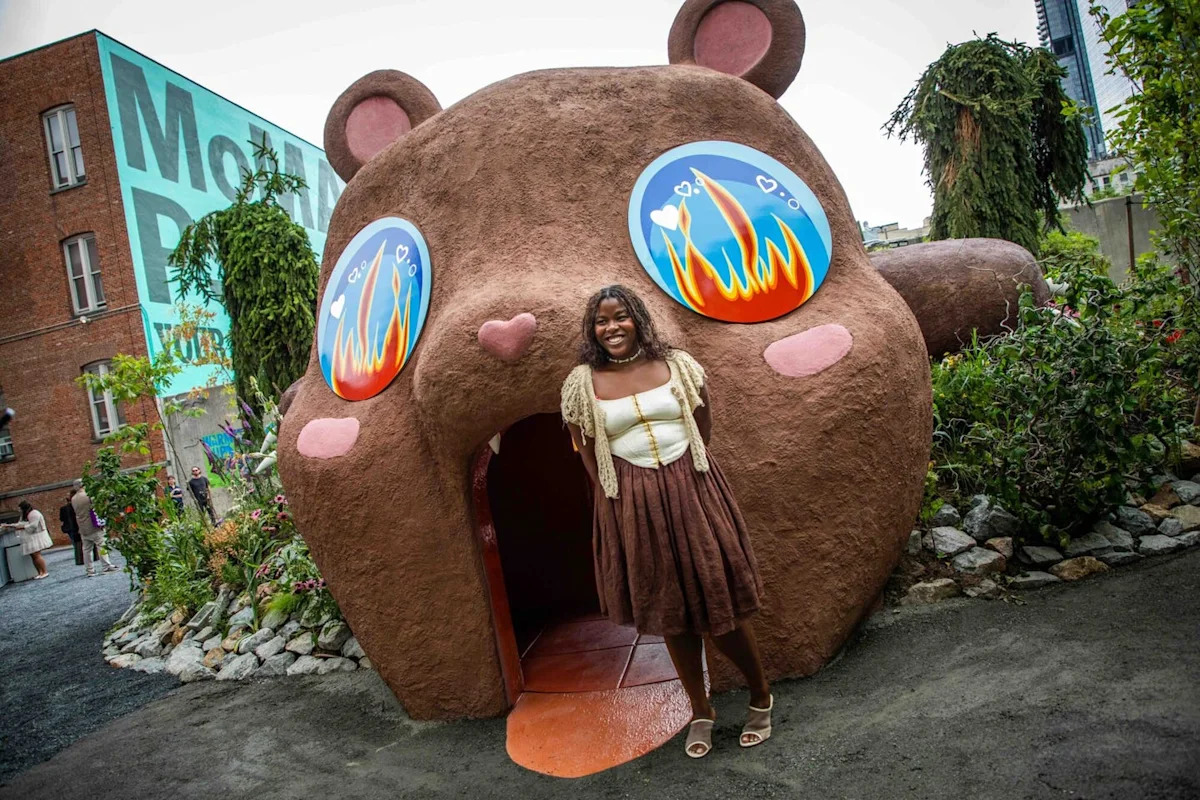
Precious Okoyomon spent some of the hottest days of this summer outside. The 33-year-old artist and poet toiled under the sun for weeks to prepare their MoMA PS1 Courtyard Commission, planting trees and wildflowers in their new garden in front of the museum. In the work, a 25-foot-long teddy bear—a signature of the artist—nestles among some 50 trees and more than 1,500 perennials and annuals. This “labor of love,” as they call it, functions as a sanctuary in a world troubled by climate change and rampant instability.
The resulting garden, Among the Flowers I Learned to Love, A Garden of Decreation (2026), joins a growing list of garden installations planted by Okoyomon. They constructed a garden for last year’s Bienal de São Paulo and seeded a rooftop garden at the Aspen Art Museum in 2022. But this time, the garden’s location imbues the space with a new tenderness, a space Okoyomon intends to frequent after it opens to the public on July 31.
“This is so special because I’m here in New York; it’s my home, and I have a real relationship to it because I’m going to be here every day,” Okoyomon says. “I have an actual relationship and proximity to the garden. It’s so extremely hyper specific to everything that I love, and over such a long scale of time, it’s going to evolve so differently.”
Ruba Katrib, the chief curator at MoMA PS1, says that a project “of this scale and inventiveness” is the perfect fit for an artist like Okoyomon. “Part of my ambition is to create a sense of wonder for our visitors—an experience that transforms our campus while pushing the boundaries and expectations of what outdoor art can be,” she says.

Among the Flowers I Learned to Love, A Garden of Decreation (2026) at MoMA PS1Photo: John Kim
Okoyomon sourced the title of the work from two inspirations: Friedrich Hölderlin’s poem “When I Was a Boy” and French philosopher Simone Weil’s concept of “decreation,” a term meaning the undoing of the self. Hölderlin’s poem starts with the line: “When I was a boy / a god would often rescue me / from the shouting and the violence of humans / Then, safe and well, I would play / with the flowers on the meadow / and heaven’s breezes would play with me.” Okoyomon hopes their garden can offer the same spiritual reprieve, a space where people can fall calmly into “the arms of the gods,” as the poem concludes. “I fell in love with that Hölderlin poem because of this restructuring of what the human is, because even men can’t understand men; it always returns to the Earth,” they say.
Weil’s “decreation” concept comes into play via the oversized teddy bear, on its own titled The Pleasure Principle (2026). The term refers to shedding your ego, breaking down preconceived structures that suffocate or taint your view of the world. The bear features a slide, requiring visitors to climb into its rectum and pop out into the garden. For the artist, the slide symbolizes process. “The dream is the digestion; the brain is the second gut,” they explain. All the while, a new poem by the artist, inspired by Jungian analysis, will play on loudspeakers around the slide.
“I’ve made a giant teddy bear, and I’m asking you to let go and climb the steps into its butt and slide into it and listen to this weird magical poem I wrote that’s going to make you a little uncomfortable and scared, and you’re gonna have to crawl your way out of it,” they say. “I’m asking you to let go in a different way, and how you come out, you’ll be changed, and then you’re spit out into this weird garden. You can smell these funky flowers.”
Beyond this psychological experiment, Okoyomon grapples with the reality of climate change. The environment actively changes around us, and the garden emerges as a blueprint for what a more resilient version of New York’s plant life could look like as the seasons continue to fluctuate drastically. “It’s this very weird forest of things that I believe should grow in New York City, one that will make sense for climate change as we continue to have the hottest and coolest summers,” they say. In that way, the space is simultaneously a sanctuary and a warning call.

The Pleasure Principle (2026) at MoMA PS1Photo: John Kim
“We do need a lot of birch here. We need fruit trees. We need to rethink what our undergrowth looks like in New York,” they explain. “A lot of things we consider invasives are actually adapting rapidly to meet where we’re at, so much of that is in the garden. It’s a lot of things that you would consider weeds, a lot of wildflowers that we have cultivated.”
Okoyomon remains oddly optimistic about the future. On our call, they offer a reframe of the fact that each summer seems to be our hottest ever: instead, they say this is the “coldest” summer we’ll have moving forward. This might first read as cynical—I thought so, too—but really, the artist underscores how we still have time to change things, something they intend to show us in the garden. A Garden of Decreation will allow us to observe what’s possible for the future, right alongside the artist.
“Every time you come to it again, it’ll change,” they say. “It’ll always be changing, and you’ll change inside of that, and your experience will change. It’s a special fragment of possibility. … The thing about being a gardener is it’s a practice of futurity,” they say. “I’m always planting a seed that I don’t know how it’s going to happen—that’s the miracle.”
You Might Also Like