
The Turning Season
Pace Gallery with D Lan Galleries
May 15–August 14, 2026
New York
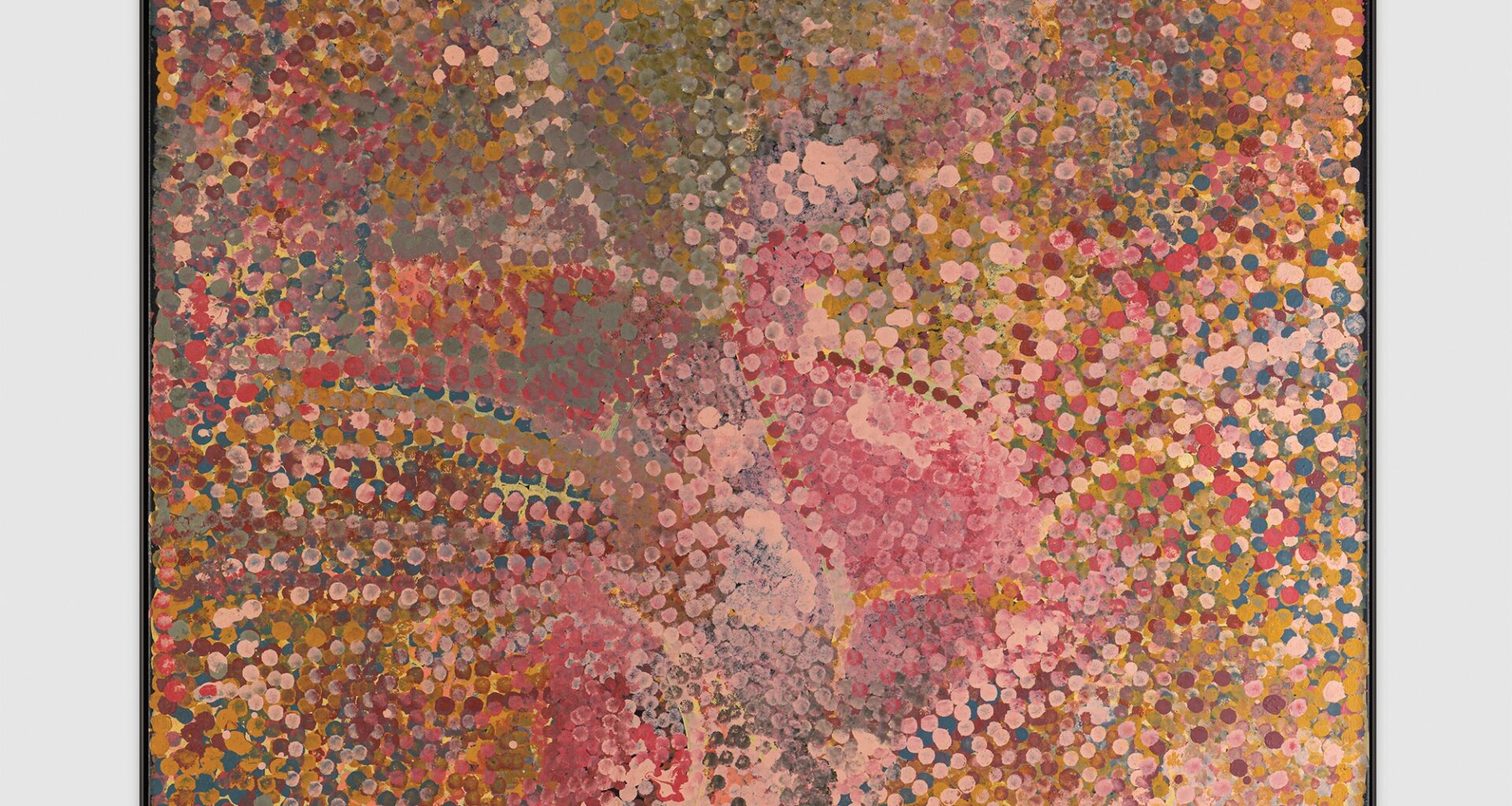
“If you close your eyes and imagine the paintings in your mind’s eye, you will see them transform … That powerful Country changes color, just like the paintings do. The Country transforms itself, and those paintings do as well. That’s why the old woman is famous.”1 The old woman her kinswomen and neighbors were talking about is Emily Kam Kngwarray (b. 1914; d. 1996), and the Country she came from is Alhalker in Australia’s Northern Territory, known to settler “whitefellers” as Utopia. Kngwarray was called the old woman not only because she was old—her life encompassed nearly the whole of the twentieth century; she witnessed first-hand Australia’s grappling with its treatment of the continent’s original inhabitants—but because her artistic practice began when she was in her fifties. As a founding member of the Utopia Women’s Batik Group, a collective of several dozen women that was introduced to the practice in 1977, Kngwarray was likely its eldest participant.2
Kngwarray already knew how to tie dye, but batik changed her life. In batik, Kngwarray replicated the natural world around her. The Turning Season at Pace includes a room with five batik panels, three of which are abstracted depictions of local flora or tracks made in 2007 by Kngwarray kinswomen—Ruby Kngwarray Morton, Judy Kngwarray Greenie, and Audrey Kngwarray Morton—and two rare examples of Emily Kam Kngwarray’s own work in the medium (both untitled and dated 1981), which depict native fauna. One of her batiks is roughly square with a bright red background. It is filled with lizards and birds buzzing with internal dots or outlined with feathery flagella. The other is a narrow vertical rectangle in warmer earth tones. Both textiles hang from a ceiling-mounted rod and respond to air currents stirred up by visitors. The latter’s surface is alive with agitated dots and highlighted squiggles, some of which look like they could be arrows or the tracks of emus. Its packed field points to the latter part of Kngwarray’s career. When batik proved to be physically taxing, the artist turned to painting in acrylic on canvas or linen, working in what art historians trained in the Western tradition would call an all-over painting.
Kngwarray’s paintings featuring layered dots or lines made her internationally famous. But while the casual, even admiring, viewer may see them as nonobjective, she herself never understood them to be. Rather, they envision her Country—a region distinguished climatically by dry and wet seasons—as well as the cultural markers of her lived experience. Kngwarray was named Kam for the seeds of the anwerlarr (pencil yam), a tuber that grows rhizomatically across the soil; Kngwarray strongly identified with this plant and its growth patterns. Women of her community paint their bodies with ochre in ceremonial stripes before participating in dance rituals (Awely) meant to protect and care for their homeland. And like many indigenous Australian artists, Kngwarray’s practice often explored the Dreamings, a time when the world was amorphous, seemingly all potential. Dreamtime is regularly described as the moment of creation, but that is too limiting: it also is understood as simultaneity, past, present, and future happening at the same time in every direction, an “everywhen.”