
The city Health Department declared Friday that there is no longer an elevated risk of Legionnaires’ disease on the Upper East Side, saying the source of exposure has been eliminated after two weeks passed without anyone linked to the cluster developing new symptoms.
The outbreak in Carnegie Hill and Yorkville has sickened 92 people and killed seven, according to the department. Seventy-nine people were hospitalized during the outbreak, including five who remained hospitalized as of July 30.
“That is seven deaths too many,” Health Commissioner Dr. Alister Martin said during a Friday morning briefing, offering his condolences to the victims’ families and friends. The city has not released any additional information on the residents who died as a result of the outbreak.
Martin said Friday that the department could end the elevated-risk warning in ZIP codes 10028, 10075, and 10128 because the disease’s incubation period – which can range from two to 14 days after exposure – had passed without the onset of a new cluster-related illness.
“There is no longer an elevated risk of Legionnaires’ disease” in the three ZIP codes, Martin said. “We can confirm the source of this Legionnaires’ disease community cluster has been eliminated.”
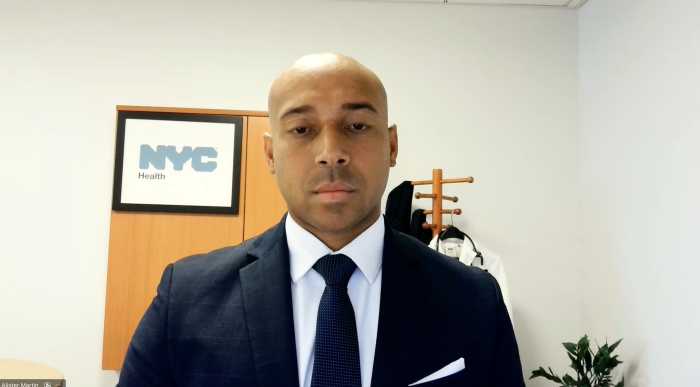 NYC Health Commissioner Dr. Alister Martin briefs reporters on the Upper East Side Legionnaires’ disease cluster on Friday, July 31, 2026.
 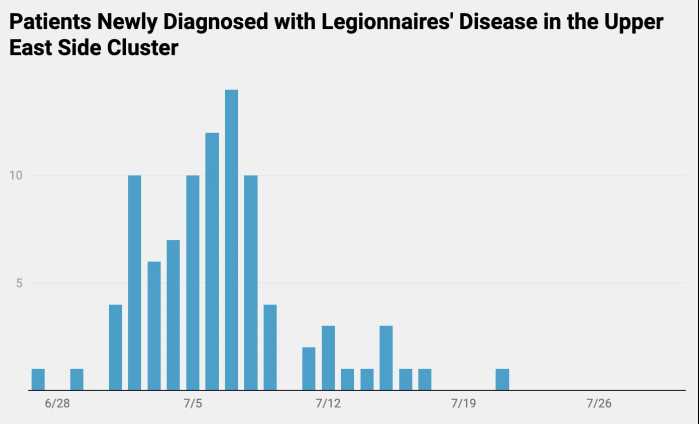 A Health Department graph shows the decline in confirmed Legionnaires’ disease cases linked to the Upper East Side cluster since late June.Photo via DOH
More than 90% of patients began experiencing symptoms before July 7, five days after the department launched its investigation and began directing buildings with positive preliminary tests to remediate their cooling towers, according to the agency.
Though the department has declared that exposure has ended, investigators have not yet determined which cooling tower or towers caused the illnesses.
The department tested 183 cooling towers at 160 buildings in the affected area. Initial PCR screening detected signs of Legionella bacteria in 77 towers at 75 buildings, while slower culture testing confirmed the presence of live bacteria in 59 towers at 58 buildings.
A positive culture result does not establish that a particular cooling tower caused anyone to become ill.
The agency ultimately ordered 83 buildings to fully drain, clean and disinfect their cooling towers. Every building complied, according to the department.
In total, 124 cooling towers tested negative through culture testing.
Whole-genome sequencing is underway to compare bacterial samples collected from patients with samples recovered from cooling towers that tested positive for live Legionella. Results are expected by the end of August and could allow investigators to identify the tower or towers responsible for the outbreak.
The investigation also uncovered widespread violations of the city’s cooling-tower rules.
The department said it completed inspections of all 82 cooling towers under its jurisdiction that tested positive through either PCR screening or confirmatory culture testing.
Sixty percent of those inspections resulted in at least one violation, producing more than 110 violations overall. They included more than 15 public-health hazards, more than 50 critical violations and more than 40 general violations.
The cooling tower with the most violations was an unregistered system at 300 E. 83rd St., according to the department.
Investigators identified the tower by comparing Department of Buildings construction permits with cooling-tower registration data and conducting targeted inspections of locations that might have unregistered systems.
Inspectors found that the building’s owners had failed to develop a required maintenance program and plan, document water treatment or conduct Legionella sampling for more than a year. The department cited 11 violations and issued $11,000 in fines to the owners.
The cooling tower with the second-highest number of violations was at 1520 York Ave., where inspectors cited nine violations and issued $9,000 in fines.
The violations there included failures to establish a required maintenance program, document water treatment and conduct newly required monthly Legionella sampling, according to the department.
Health officials acknowledged during Friday’s press briefing that there could be opportunities to increase cooling-tower fines and said the agency was interested in continuing discussions with the City Council about strengthening the regulatory system.
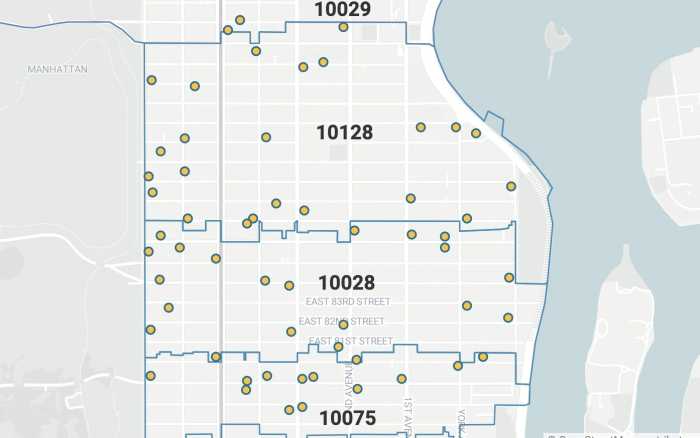 A Health Department map shows Upper East Side cooling towers that tested culture-positive, meaning live Legionella bacteria were present when the samples were collectedPhoto via DOH
Officials also said the department aims to inspect cooling towers annually but is still building its staff to meet that target.
The agency has 56 water-ecology positions, according to a Health Department official. Forty employees are currently working in the field, nine are onboarding and seven positions remain vacant.
Officials emphasized that building owners are responsible for complying with cooling-tower regulations every day, regardless of when a city inspection occurs.
The department said compliance with the city’s new monthly testing requirement increased sharply during the outbreak.
Among the 82 cooling towers whose inspections were completed, 74% had submitted records demonstrating compliance as of July 11, one day after the department publicly released a preliminary list of buildings with positive PCR results. That figure rose to 97% by July 24.
Among all 183 cooling towers sampled in the affected area, compliance increased from 73% to 92%, while citywide compliance increased from 77% to 80%, according to the department.
The agency credited its public release of the buildings with positive test results for helping drive the increase. It noted that some towers without reports may not have been subject to the requirement because they were not operating during the reporting period.
The department began investigating the Upper East Side cluster on July 2 after identifying two cases, even though officials said the usual threshold for opening a community-cluster investigation is three confirmed cases.
A Health Department official said the response reflected lessons learned from a Legionnaires’ disease outbreak in Harlem last year.
During the Upper East Side investigation, the department released the addresses of buildings with preliminary positive results rather than waiting as long as two weeks for culture results. It also ordered full cleaning and disinfection as soon as a tower tested positive through PCR screening, rather than waiting for confirmation that the bacteria detected were alive.
The department’s approach had drawn criticism from City Council Speaker Julie Menin, who argued on July 21 that officials should have immediately disinfected cooling towers near the suspected epicenter and those whose operators had not submitted required testing information, rather than waiting for preliminary test results.
Menin argued that more aggressive preventive disinfection could have reduced the number of illnesses and deaths, though she acknowledged that the Council did not yet know which cooling tower or towers caused the outbreak.
She also announced a September oversight hearing into the department’s handling of the cluster.
 City Council Speaker Julie Menin leads a press conference on the Upper East Side Legionnaires’ disease outbreak at Lenox Hill Hospital on Tuesday, July 21Photo by Gerardo Romo / NYC Council Media Unit.
Health Department officials defended the decision to sample towers before ordering remediation across the entire area, saying their approach was consistent with Centers for Disease Control and Prevention guidance to identify a source or potential source through testing and then treat it.
Officials said sampling was also necessary to determine how the outbreak happened and whether it resulted from a building owner’s failure to comply with the rules or a gap in the city’s regulatory system.
They also argued against indiscriminately applying biocide to every cooling tower, saying repeated chemical treatment can corrode equipment and create rust that helps bacteria form biofilm and grow in the future.
More than 260 Health Department employees worked on the response, interviewing patients and reviewing records for more than 150 potential cases, collecting samples from more than 180 cooling towers and conducting more than 360 tests.