
When I saw that “Les Misérables” was coming to Radio City Music Hall this summer for a limited 3-week run — part of a special arena tour staged for the show’s 40th anniversary — I immediately thought of my younger brother. Adam passed away last year, at 45. “Les Miz” was his favorite musical, but it took on deeper meaning for my family during Adam’s childhood, when he suffered a leukemia relapse and wasn’t expected to live.
Though Adam and I were only three years apart, the gap felt wider because he had Down syndrome. We didn’t fight, like other siblings, or confide our deepest secrets. One thing we did share was a love for “Les Miz.” We’d sing together in the car, a cappella in the grocery store or sometimes in his bedroom, accompanied by his beloved Fisher Price tape player.
When Adam’s leukemia returned at 10, “Les Miz” became an outlet for my family’s hope. The musical, set in 19th century France and spanning decades, tells the story of Jean Valjean, who turns to God and gets a second chance at life.
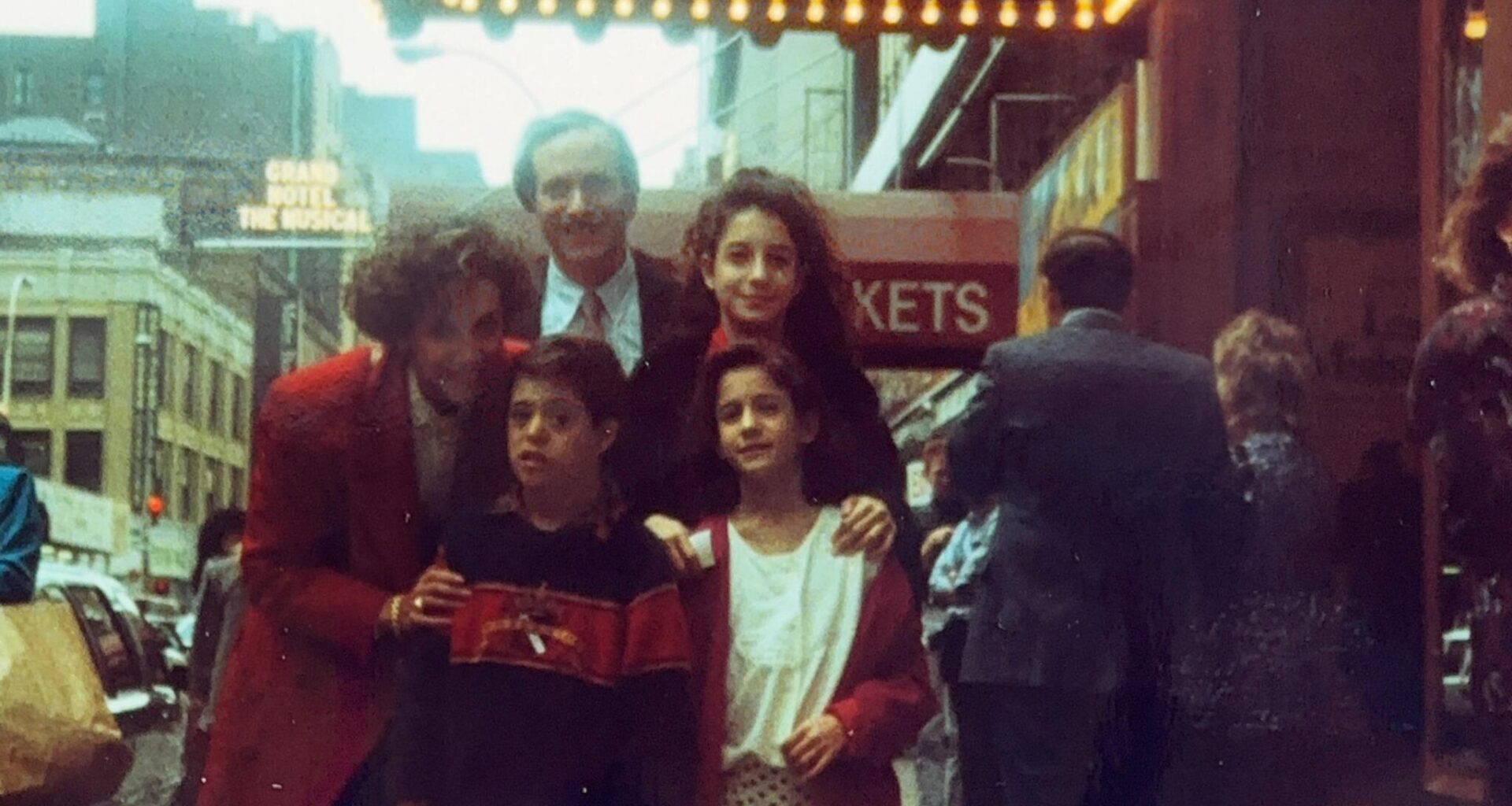
The Make-A-Wish Foundation bought us tickets to see the show on Broadway. Despite the circumstances, I was ecstatic. I had never seen it on stage before. On a November day in 1990, my family drove from our home in the Hudson Valley to New York City’s Imperial Theater. I expected that my brother would love the performance.
But he didn’t.
It started with the opening notes. He hummed them loudly, as he always did when we sang at home. When I shushed him, he slumped in his seat. Then, at another point, I saw him dozing off. I wasn’t sure how to feel. I wanted him to love it as much as I did, and yet he seemed so detached.
 The author with her brother Adam: a selfie (left) and by Jacqueline Schlossman (right). (Courtesy Alyson Pomerantz)
After the show, we met the actor Ed Dixon, who played Adam’s favorite character, the villain Monsieur Thénardier. The innkeeper Thénardier sings “Master of the House,” a song about how he fleeces his guests. Perhaps an odd choice for a boy who seemed incapable of guile, but I can see why Adam loved the show’s sole comedic number. He sang it flawlessly and with humor, albeit in an English accent (we had the London cast album).
When Ed greeted us, he was still in Thénardier’s white face paint from the final scene. We all fawned. Everyone, except Adam, who impatiently tapped his hand against his thigh. Time to go, his body told us.
The theater staff watched my brother closely. Perhaps they were disappointed, or worried about his health? The day my parents had told me about Adam’s illness — and that there was a chance he might not make it — I was devastated. But as Adam sailed through his treatment, I found it increasingly difficult to believe my brother could actually die. My parents joked about Adam’s attitude at the hospital, how even after a painful procedure he seemed more focused on what was for supper than what he was going through. It just didn’t seem real — even at the theater.
Adam relaxed into the melody, and we watched, mesmerized, as he performed his favorite song on a Broadway stage.
Eventually, it was time to go. As we said goodbye, Adam surprised us all by swinging around and addressing the actor.
“Welcome, monsieur,” he began, singing the opening notes to “Master of the House.” Adam relaxed into the melody, and we watched, mesmerized, as he performed his favorite song on a Broadway stage. Ed watched too, kneeling down in front of my brother and resting his chin on his hand. He seemed delighted by Adam’s rendition.
Perhaps wanting to extend the night’s magic, my mother offered Ed a ride home. At first, he declined, but my mother was persistent. I was starstruck. A Broadway actor in our minivan? I managed a weak goodbye when we left Ed on a corner in the Village, then fought my sister for Ed’s seat.
It was a magical night, but what came next, back home, defied our expectations: Adam’s health improved. Despite what we’d been told by the doctors, he officially entered remission the next year. We got our miracle.
Years passed, and “Les Miz” continued to connect my brother and me when I’d visit home. Singing it also gave my family solace when my mother passed away in 2002. And then, almost a decade later, I was reminded of our special day when I came across Ed Dixon’s name on Facebook.
I messaged him, letting him know that my brother had lived. His response was both warm and cryptic. He told me he had something devastating to tell me about the day we met.
While my brother was fighting for his life, so was Ed. He’d developed a drug addiction while performing in the show. Even more shocking, by the time we met him, he was homeless. I immediately thought of the hovering staff. They probably weren’t worried about my brother. They were worried about Ed.
My mother had offered him a ride home, but he had no home to go to. He came with us anyway. When she asked for an address, he did what any well-trained actor might: He made one up. Eventually, Ed’s union helped him get treatment, and his career flourished as an actor, composer and author.
After we reconnected in 2010, Ed mentioned that he was performing that summer in “Sweeney Todd.” My wife and I traveled to Great Barrington and watched him perform the role of Judge Turpin (another despicable character). Seeing him onstage again pulled me back to my family’s Les Miz visit. Then, at the bar after the show, I nearly spilled my drink when I noticed the bar’s name in neon lights: Sheila. The same name as my mother. She had been gone 8 years, but there she was. After the show, we met Ed at the stage door, and I finally got to tell him in person how much he meant to our family.
While writing my brother’s obituary, I came across something Ed wrote to me when I first reached out to him. “People need to know that almost anything can be surmounted.” Awash in grief, it didn’t feel that way, but I swallowed Ed’s words like medicine.
“Les Miz” played such a big role in my brother’s life that perhaps I shouldn’t have been surprised when, just days after his death, my son mentioned that a local theater group was performing the play and asked if we could go.
I didn’t want to. “Les Miz” was all about second chances, but this time, Adam was gone. Despite my grief, something told me to go anyway. Maybe it was the same voice that told Ed to take a ride with our family that night in 1990.
I was tense at first, but the music immediately brought me closer to my brother. Toward the end, when the cast asked if there was a world I longed to see, an emotion surfaced that I hadn’t felt in months.
Hope.
As we walked back to the car, my son raved about the show.
“What was your favorite song?” I asked.
“Welcome, monsieur…” he sang.
Adam would have loved it.