
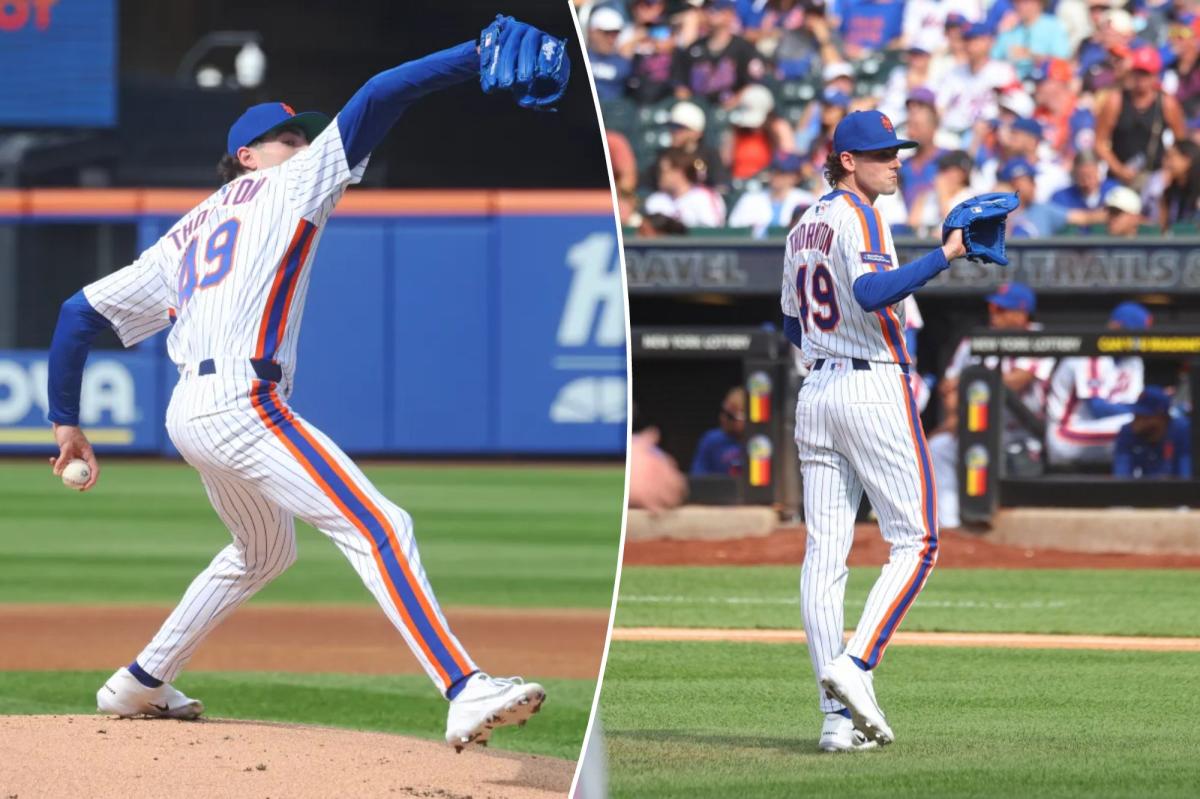
Pitching in front of a 1986 Mets team that can appreciate such traits, Zac Thornton showed more grit than gas.
More savvy than stuff.
More resilience than results.
So there were a few reasons to be encouraged.
And there were probably more reasons to be discouraged.
For the first time, Thornton was knocked around — which is a concern for a pitcher with plenty to prove.
But while wearing a uniform with racing stripes along the side of his body, the young Mets lefty handled the first adversity of his major league career well.
Zac Thornton reacts after allowing a home run during the Mets’ Aug. 1 loss. Robert Sabo for the NY Post
If there is a quality that the ’86 Mets personified, it would be the fight that Thornton demonstrated Saturday afternoon.
On a day the Mets organization and fans celebrated their most recent World Series title, the 2026 version of the team ensured virtually no attention was paid to when the next one will arrive.
The Mets lost again, 6-2 to the Marlins, in front of 30,078 at Citi Field who thanked the past and cursed the present.
The best and maybe only positive thing to arise from this year’s disastrous club (47-65) is what looks like the formation of a young rotation that might carry them in the future.
Behind Nolan McLean and Christian Scott, Thornton has emerged over the past five-plus weeks and looked like a keeper.
These Mets games don’t matter, but Thornton — who was called up for good in late June and entered play having allowed four runs in 25 ¹/₃ innings (1.42 ERA) in four starts since — does.
Which is why Saturday’s outing, in which he allowed four runs (three earned) on six hits and three walks with two strikeouts in 4 ²/₃ innings, was not ideal.
“I just wasn’t in-zone as much as I should have been,” Thornton, typically a strike-thrower, said after just 56 of his career-high 94 pitches were strikes and his three walks set a career high. “Fell behind in too many counts and paid for it.”
It also was not a hollow effort.
Zac Thornton prepares to throw a pitch during the Mets’ Aug. 1 loss. Robert Sabo for the NY Post
The 24-year-old rookie was not going to dazzle every start. Limiting damage without his best stuff — holding Miami to 1-for-6 with runners in scoring position — is a lesson worth learning.
“He grinded today,” interim manager Andy Green said after Thornton’s shortest start since his May 20 debut. “… Not his best, but appreciated the way he bounced back and competed.”
After an unearned run in the first — a result of a Francisco Lindor error and Otto Lopez wreaking havoc on the bases — the trouble really began in the second.
Kyle Stowers opened the inning with a single before Javier Sanoja waited on a Thornton cutter and slugged it over the left field wall.
Three runs were scored before Thornton recorded a fourth out — or one fewer run than Thornton had given up in his past four starts combined.
“Just a bad day pitching overall,” said Thornton, who proceeded to load the bases in the 35-pitch inning but induced a fly out from Xavier Edwards to escape a frame that for a while looked as if it might be his last.
Delivering insights on all things Amazin’s
Sign up for Inside the Mets by Mike Puma, exclusively on Sports+
Thank you
Thornton rebounded with a strong third and again encountered trouble in the fourth, hitting Esteury Ruiz and allowing a single to Griffin Conine to put runners on the corners without an out.
But again, at a moment when the game might have become far more lopsided, he allowed just a sacrifice fly before getting out of the inning.
Francisco Lindor reacts during the Mets’ Aug. 1 loss to the Marlins. Jason Szenes for the NY Post
He recorded two more outs in the fifth before walking Stowers and getting pulled, his ERA rising from 2.43 to 2.88.
On a day the Mets only scored with a two-run home run from Tyrone Taylor, they were not going to have much of a chance even if Thornton were excellent.
MEts merch shop
New York Post receives revenue from affiliate and advertising partnerships for sharing this content and when you make a purchase.
He wasn’t, but he also was not crushed on an afternoon he could have been.
“Wasn’t as sharp as he has been,” Green said, “but he really battled.”