
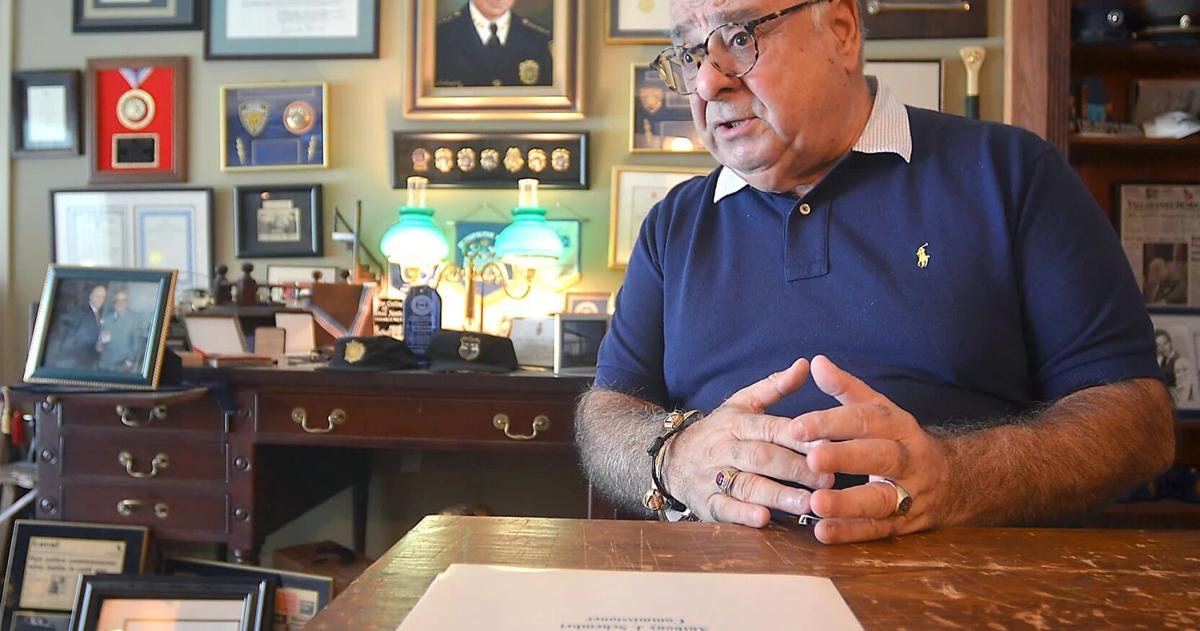


In this Chronicle file photo, former Citrus County administrator Anthony Schembri talks about his life and career. Now retired and living in Sarasota, he is still telling stories about his career as a Brooklyn detective, former NYPD police commissioner, lawyer, professor. Add to the list: novelist. His book, “In Russia: A Brooklyn Solution,” is available on Amazon.com.
Chronicle file photo
Anthony Schembri knows how to tell a story.
“When I was 14, my neighbor’s uncle went missing,” he said from his home in Sarasota. “So my mother said, ‘Take her to the police station.’
“We got there and the people in front of us were reporting a lost dog. The lieutenant said, ‘We will put out a bulletin. We’ll send out pictures and all of the cars will look for the dog.’
“Then it was our turn,” he said.
The lieutenant asked how long the man had been missing.
“Twelve hours,” Schembri’s neighbor replied.
The lieutenant said, “We don’t look for anybody unless it’s been 48 hours — that’s our policy.”
In his unmistakable Brooklyn accent, Schembri said, “So I tell him, ‘He was walking his dog at the time.’
“I got a dirty look from the lieutenant because now he had to take the report,” he said.
A detective overheard the conversation.
“He was going upstairs and he says, ‘Come up here, kid.’ So I went … and he says, ‘Kid, that’s pretty good. You can think on your feet.’
“He said, ‘What do you want to be when you get older?’ I said, ‘I want to be a cop.’
“So he was typing with one finger. And I just took a course in typing. So I said, ‘That’s the way you type?
“He says, ‘You can do better?’ I said, ‘Better than two fingers.’”
The detective gave him a report to type and then offered 14-year-old Schembri a job typing reports.
“We’ll always buy you dinner,” the detective told him. “We’ll buy you lunch.”
Schebri said he’d do it for nothing — he just wanted to be around them.
“They used to send a police car to pick me up,” Schembri said with a chuckle. “My neighbors saw me getting in and out of a police car. They thought I was a bad kid.”
It was the beginning of a career that would span decades in law enforcement, lead him to become police commissioner and, years later, inspire the television series “The Commish.”
As a young teen hanging around cops, Schembri learned the art of de-escalation in tense situations.
One night he was riding in an unmarked car with two detectives and they came upon a man with a gun pointed at his wife’s head.
“He’s sweating and he says, ‘Stay back, I’m going to kill her.’ So one of the detectives, Johnny Burke, says, ‘Kill her. She doesn’t mean anything to me. What do I care?’
“I’m thinking, ‘Wait a minute. What’s going on here?’ So the other detective says, ‘Oh, by the way. After you kill her, my partner’s going to kill you. And he’s going to get promoted. And he’s going to get a medal and a raise.’
“So the guy says, ‘I’m not going to kill her so he gets promoted.’ And he throws the gun down,” Schembri said.
“I’m thinking, ‘They don’t even have their guns out. This is not the way they do it on television.’
I watched these detectives,” he said. “They were geniuses. They had PhDs in people.”
Reading people, not just crimes
Schembri said quick thinking and Brooklyn humor prevented a lot of bad situations from becoming worse.
One day, a guy came into his office and asked how to get to the top of the building.
“It was a busy office — the criminal court building in Brooklyn — but it was a slow day and my gun was in my desk,” he said.
“I said, ‘Why do you want to go to the top of the building? He said, ‘I want to jump off.’
“Any man who’s going to commit suicide will take you with him,” Schembri said. “He’s a dangerous guy. He’s got to be treated as such.
“I said, ‘Do you have a permit to jump off the building?’
“He said, no. I said, ‘Well, you can get in trouble for jumping off the building because this is a city building. You need a permit.’
“I’m waiting for my detectives to come back so we can jump on this guy and tackle him,” Schembri said. “I’m telling him that he had to see a doctor who’s in charge of buildings and jumpers at Kings County Hospital.”
“He says, ‘How would I get there?’
“I said, ‘We have a police car going there in a few minutes. I think I could talk them into giving you a lift.’
“He said, ‘How nice.’ I tell him to have a seat and I call for two uniforms. They come up, and I whisper to one of them, ‘You see the guy sitting on the couch? He’s a psycho. Take him to Kings County Hospital.’
“I wrote him a note on my official pad to take with him asking to issue one roof-jumping permit … About an hour later, I get a call from a doctor. ‘Are you Detective Schembri? I have a guy here. You want me to issue him a roof-jumping permit?
“I say, ‘No, doctor. He’s suicidal.’
“He says, ‘Oh, you want me to keep him.’
“What a good idea,” I tell him.
“That’s Brooklyn humor.”
Decades after that first trip to a Brooklyn police station, Schembri is still telling stories. This time, instead of around a detective’s desk, they’re told in the pages of his first novel.
He never intended to write one.
During law school, Schembri wrote a curriculum about corruption, which made the front page of the law journal. That caught the attention of the Russian embassy.
“They called me to meet with the ambassador — they wanted to put an attaché in my class,” he said. “Then they wanted me to go over to Russia and teach a similar course.”
While at the embassy, Schembri asked if they had any serial crimes in Russia.
“They said they had just executed a man who killed 50 children over a five-year period, but he turned out to be the wrong man,” he said.
When he left the embassy, he pulled out a yellow legal pad and outlined the plot and four main characters.
The result was “In Russia: A Brooklyn Solution,” a novel about an NYPD lieutenant who travels to Moscow to help solve what is believed to be Russia’s first serial killer case.
“So that was my idea. My book begins where that leaves off — the search for the real killer,” he said.
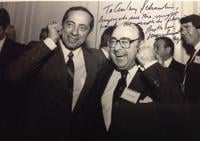
Throughout his career with the NYPD, Anthony Schembri (right) rubbed elbows with people in high places. He’s seen here with the late Mario Cuomo, former governor of New York (left).
Special to the Chronicle
Over the years, Schembri has served as a detective, police commissioner, lawyer, professor, secretary of Florida’s Department of Juvenile Justice, Citrus County administrator and, now, novelist.
“I started out as a cop,” he said. “I was in the prosecutor’s office and they said, ‘You wouldn’t understand these cases because you’re not a lawyer.’
“So I became a lawyer. That’s how I kind of did things.
“But I’ve always been a cop in my heart.”