
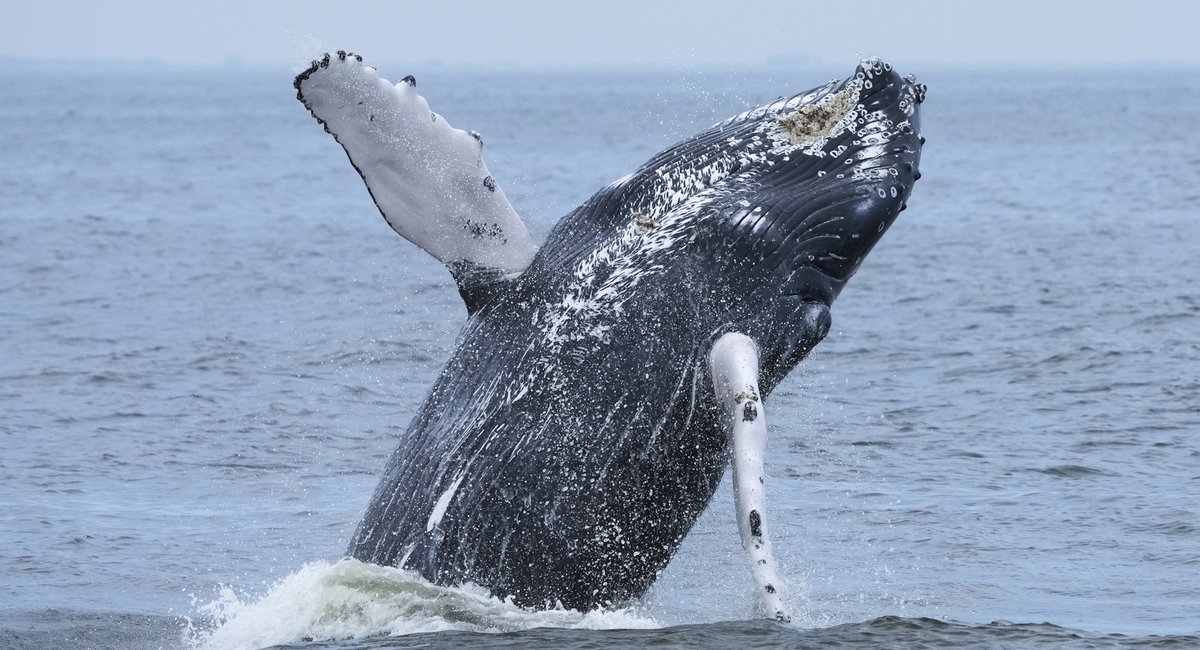
Whale watchers in New York and New Jersey have documented their 500th individual humpback whale in local waters, a milestone they said highlights the creatures’ growing role in the local ecosystem.
A confluence of factors has made the region more attractive to humpback whales, according to Chris St. Lawrence, a spokesperson for Gotham Whale, a Staten Island-based nonprofit that has spearheaded an effort to catalog humpback whales in the New York City region since 2012.
The waters around New York and New Jersey have gotten cleaner in recent decades, allowing more fish to thrive in the area. That’s big for whales, who have had their traditional feeding grounds in New England and Canada disrupted as climate change warms ocean temperatures, and changes the distribution of prey species.
“ These whales are looking for new food sources, and right here in New York, thanks to fishery management, thanks to cleaner water, now we have a new food resource for them to exploit,” St. Lawrence said.
But the whales coming to New York and New Jersey face serious risk of being hit by ships and boats in one of the nation’s busiest waterways. The Port of New York and New Jersey was the second-busiest port for cargo imports in the country in June, according to the Port Authority. Whales spotted in the area are frequently found with wounds or scars from propeller strikes.
Gotham Whale leads a network of local whale watching boats from Belmar down the Jersey Shore to Freeport on Long Island, and volunteers in between, take photos of whales and submit them for the New York City Humpback Whale Catalog.
Tracking which whales are visiting where and when has helped researchers better understand how humpback whales behave in the area, and why they are here at all. St. Lawrence said many of the whales tend to stay for weeks and months at a time, fattening up in the summer months before migrating south and fasting during the winter. That behavior appears to be a recent change.
“ Historical records suggest that humpbacks were far less common than other species like fin whales and right whales, especially closer to shore,” St. Lawrence said.
The whales are then identified and differentiated by the markings on the underside of their tail flukes. St. Lawrence said those markings are “ as unique to each individual as our fingerprints are to each individual person.”
Other species of whales are found in the area, but St. Lawrence said they are seen less consistently than humpbacks and tend to stay farther offshore.
When Gotham Whale first launched the cataloging effort, the network was spotting between 10 and 30 new humpback whales each year. That has increased over time, and is now up to 80 to 100 new whales each year.
“ More people are learning that there are whales here, and so more people are knowing what to do when they see one,” St. Lawrence said. “So it’s easy to think that this might mean that there are more whales, and that might be part of it, but it’s also that there’s a lot larger awareness that these animals are in our waters.”
Federal authorities have declared an ongoing “unusual mortality event” for humpback whales along the Atlantic Coast, dating back to 2016. There have been 266 documented humpback whale deaths as part of that event, with New York and New Jersey reporting the highest numbers of all states along the Eastern seaboard.
About half of those 266 whales received necropsies, and of those that were examined about half were determined to have been hit by a vessel or been entangled in fishing gear. A 2024 study from Stony Brook University and the National Oceanic and Atmospheric Administration determined that vessel strikes, exacerbated by an influx of “naïve, juvenile” humpback whales to the region, is the major driver of whale deaths along the Atlantic Coast.
St. Lawrence said a major goal of Gotham Whale’s cataloging work is to provide data that can help inform future strategies for protecting the whales.
“ There’s more whales spending more time in these risky places. We see animals hanging out in the shipping lanes,” St. Lawrence said. “ All of these things that go into how the whales are using our local waters might be able to better inform how we can reduce that risk to whales and to better protect them locally.”