
BUFFALO, N.Y. — Everybody needs to eat, but that’s sometimes easier said than done.
Each Congressional district in upstate and Western New York has some sort of food desert, according to the Institute for Local Self-Reliance.
Local representatives are trying to do something about that. They point out that the problem does seem to be compounding.
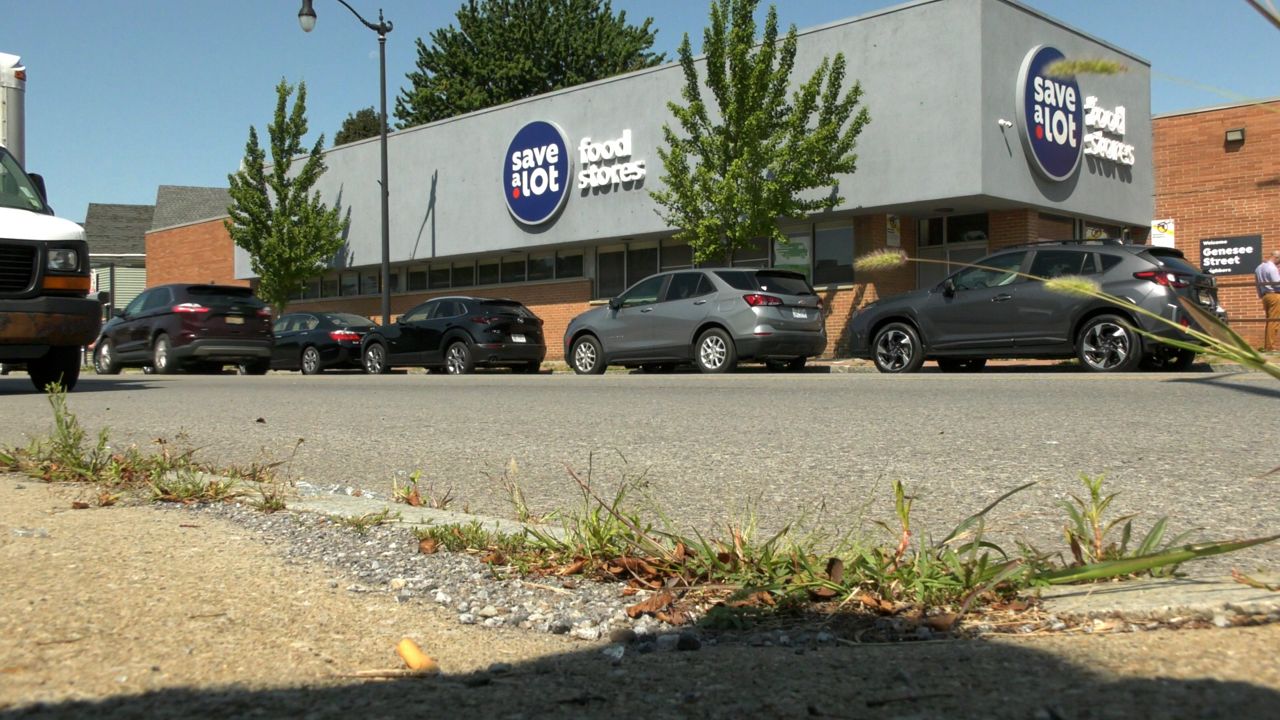
A press conference Tuesday was held outside one of seven grocery stores in Western New York that have closed their doors since 2019. When you’re talking about communities that rely on walking, or public transit, every one of those makes a huge difference. That’s why there’s a push to pass legislation in Washington to help with that.
“The shelves are empty, doors are locked, and this neighborhood has lost a grocery store — one that was easy to get to by car, by bus or by foot,” said Rep. Tim Kennedy.
It’s a single closure that helps create a food desert. Healthy food, including fresh fruits and vegetables, are now a hike to get to. One that many in the neighborhood might not be able to take.
“When families lose their grocery stores and [have] to rely on corner stores instead, they’re paying more for less at the worst possible time,” Kennedy explained.
According to the Institute for Local Self-Reliance, congressional districts in upstate and Western New York are seeing anywhere from 7 to 15% of people living in food deserts.
“Every community across the state in the nation is impacted by food deserts,” noted Kennedy.
That’s not just a concern for what’s going on their plate, but also for the long-term impacts of potential malnutrition.
“We are more at risk for chronic diseases like diabetes and hypertension, and obesity. Food insecurity can impact our mental health,” explained Catherine Shick, the chief communications officer for Feedmore WNY. “Food insecure children may experience developmental differences and poor academic performances.”
That’s why officials were pushing for a trio of bills to be passed:
The Food Deserts Act — to support loans for grocery stores in underserved communities.
The Health Food Access for All Americans Act — for tax credits and grants for those markets operating in food deserts.
The Healthy Food Financing Initiative Reauthorization Act — to help fund a public-private partnership bringing grocery stores to underserved neighborhoods.
“The work that co-ops are doing in the community — it’s valuable,” said Tandy Harvey, the CEO for National Co-op Grocers. “This is a need that’s being met.”
For places like the Lexington Co-Op, being in the community is key.
“You see lots of homes and rooftops around here,” Harvey said. “It’s very walkable for the community and [has] a ton of local products.”
Accessibility and affordability are at the forefront for legislators too.
“Food is a basic necessity for people to live. It is not a luxury and it is not a privilege,” said Deputy Erie County Executive Lisa Chimera.
That trio of bills has not yet come to a vote.