
Opening Credits
Sadie Coles HQ
June 4–September 12, 2026
London
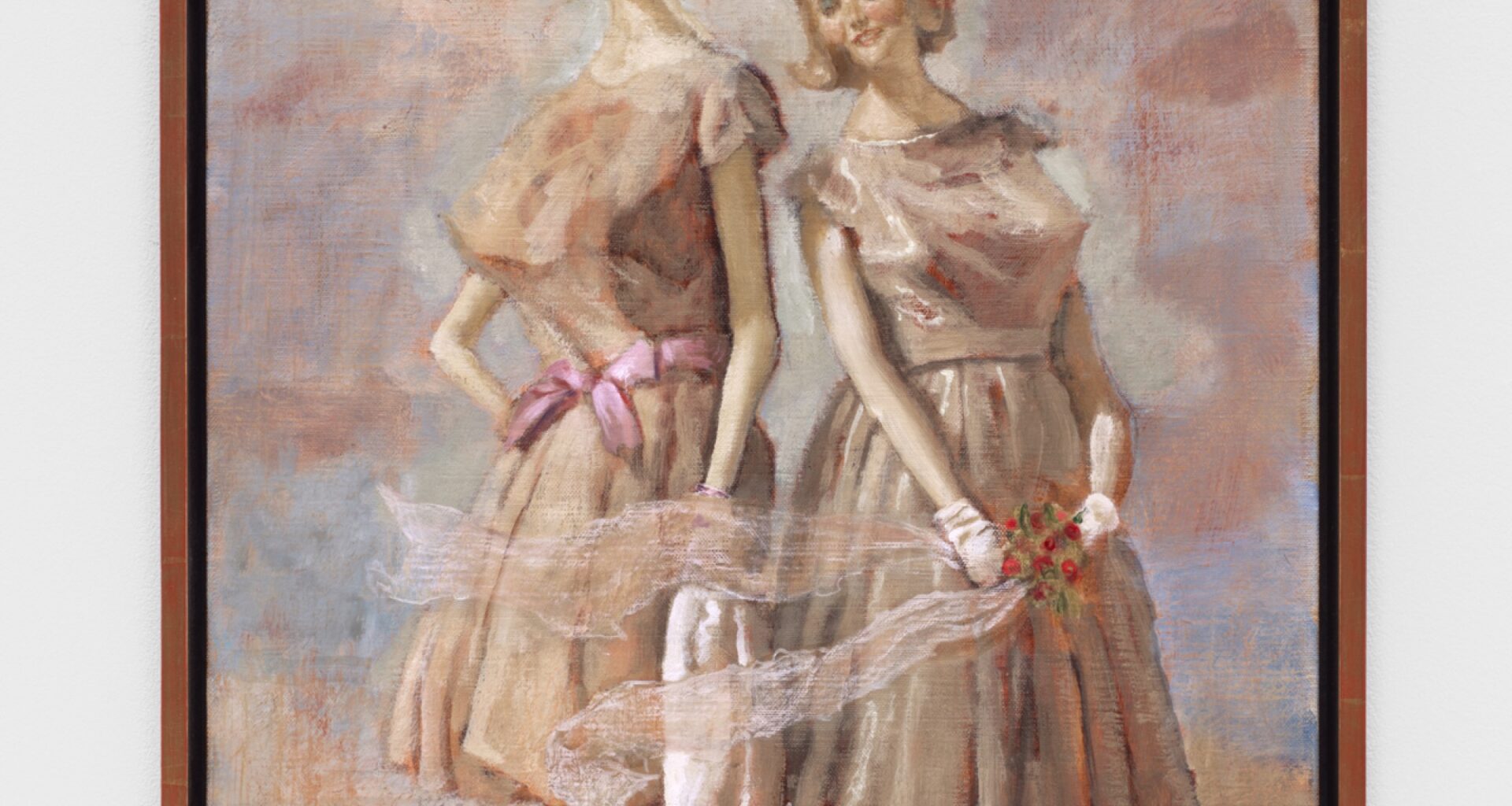
John Currin’s new paintings unite two very different visions of that bucolic earthly paradise Arcadia. Into wooded landscapes inspired by the seventeenth-century French neoclassical painter Nicolas Poussin, Currin inserts blonde and smiling female figures, lifted—with varying degrees of directness—from 1970s clothing catalogues. They’re representatives of a visual world where gesture and expression are as stylized and as coded as anything to be found in old master painting. This might sound like an intriguing but relatively easy fit, but Currin being Currin, there’s a lot more to it than that.
These all-American golden girls’ feminine attributes are absurdly exaggerated, with breasts inflated into immense football-like spheres (that’s English rather than American football) that drag down well below their waists. In other cases they’re shrunk down into pert little apples poking from beneath silk or velvet. Stomachs laid bare are subtly broadened, reducing legs to tapering pins and heads to grinning pinballs, oblivious to their over-sized or under-sized encumbrances.
No one comes to a John Currin exhibition expecting neatly framed meanings. This meta-mannerist’s signature merging of the innocent and the sinister, the folksy and the grotesque, is all the more unsettling for its ambiguity. Family rituals have an inbred quality that feels cultural as much as physiological, cheery group portraits invaded by hardcore porn. Yet Currin’s agile brush remains resolutely neutral. “The people I paint don’t exist,” he has said. “The only thing that’s real is the painting.”
For the British viewer, the work’s Americanness is another complicating factor: the stock Americana Currin sends up in both characters and settings is familiar to us from a host of sources but remains exotically foreign. More than that, the scale of Currin’s American reputation is faintly intimidating. If he’s that big over there, interpreting his work should somehow be a lot easier than it appears to be.
If the twelve medium-sized paintings, all completed this year, are viewed first and foremost in terms of paint, the handling is a lot looser than we’ve come to expect from Currin. While he has made much in interviews of Poussin’s arcadianism as a yearning for childhood innocence and a rejection of the values of his own time, the fast and free brushwork is more reminiscent of Thomas Gainsborough’s eighteenth-century Rococo proto-Impressionism than Poussin’s minutely focused classical moodscapes.