
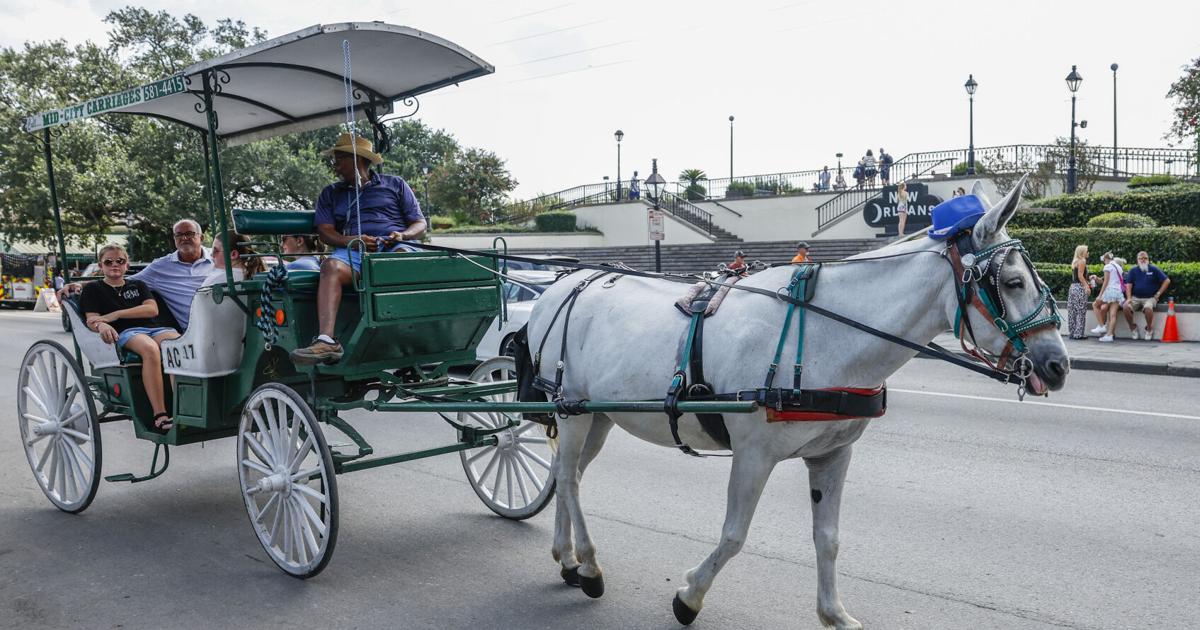
On a sweltering Saturday morning outside Jackson Square, Willy Picket rested his shoes on the front of his wooden carriage and looked at his 14-year-old white-haired mule, Baby Girl.
Picket was dressed for the weather, with breathable shorts, a straw hat, an Under Armour shirt and slip-on shoes he said were built to withstand mule urine. Baby Girl stood in front, wearing a tiny blue Mardi Gras krewe hat. It was late July, as New Orleans settled into the long stretch of high temperatures and humidity that arrives each year, and as a debate about tourist carriages simmered in other U.S. cities.
New York City is considering banning its iconic horse-drawn carriages, which have been in Central Park for 167 years. In June, an 18-year-old tourist there died after leaping from a runaway carriage whose driver had stepped off to take a picture. The death came not long after a carriage horse there died after eating a poisonous plant and broader questions arose about heat and animal work.
“I can understand where they say they don’t want them working hard,” said Picket, 72, as he sat in the driver’s seat of his four-seat green carriage parked in a row of mule-drawn carriages along Decatur Street. “But I know we don’t treat them bad.”

Baby Girl stands with the other mule carriages by Jackson Square in New Orleans, Saturday, July 25, 2026.
STAFF PHOTO BY SOPHIA GERMER
Picket, who grew up in Uptown New Orleans and started driving in the 1980s, was responding to some animal rights activists’ claims of mistreatment in the carriage industry. In addition to the concerns in New York, in Philadelphia, where Picket himself once did a stint as a horse-drawn carriage driver, officials in June banned its carriages (though the last business closed there in 2023). Other cities like Chicago have also phased out the practice in recent years. Soon San Antonio will, too.
Talks of similar bans haven’t proliferated in New Orleans, where horses and mules have been pulling people in some capacity, whether in carriages or streetcars or parades, for centuries. But the turning tide in some cities is something Picket and his boss, Mid-City Carriages owner Louis Charbonnet III, have on their mind.
Charbonnet, who is 87 and said he is thinking of selling Mid-City Carriages after three dozen years of family ownership, said he’s gotten questions about the recent accident in New York from people contemplating purchasing his business.
“I told them, ‘Go to court, look at the accident rate,’” Charbonnet said of the industry in New Orleans. “They were satisfied.”
‘Stubborn as a mule’
Notably, New Orleans already has its own ban on horse-drawn carriages, and the mules that pull them today are part of a pact made decades ago.
In 1980, two horses died pulling packed carriages through the French Quarter during a summer heat wave. The deaths provoked a flurry of attention on the industry and led to calls to end the practice.
Mule carriages wait for rides by Jackson Square in New Orleans, Saturday, July 25, 2026.
STAFF PHOTO BY SOPHIA GERMER
Instead of outlawing animal-drawn carriages entirely, the New Orleans City Council brokered a compromise with the carriage industry and the Louisiana SPCA. The horses were replaced with mules, a hybrid of horse and donkey, which some veterinarians say are more sure-footed, intelligent and better able to withstand heat than horses.
New Orleans is one of the only places in the U.S. that bans horse-drawn carriages but allows mule-drawn carriages.
“This is one thing that New Orleans got right. It puts mules to work, and not horses,” said Charbonnet, a former state representative who represented the French Quarter at the time the regulations were implemented. “Horses will work until they die; they’ll just drop dead on you. Mules will let you know when they are tired, and it’s time to go to the barn. That’s why they say, ‘stubborn as a mule.’”
In the years since 1980, the city has further ratcheted up its regulations around heat and animal welfare. By city ordinance, mules can’t be used if the temperature reaches 95 degrees or the heat index reaches 105. If they do, owners face a $500 fine.
“99% of the time we’re ready to go before it gets to that,” Picket said. A few summers ago, he recalled, they didn’t work a day in August.
New Orleans currently licenses 30 carriages across four different companies: Mid-City Carriages, Royal Carriages, Rollin 20s, and Good Old Days Buggies. Efforts to reach the other owners were not successful.
‘Different place than up there’
The switch to mules hasn’t quelled all criticisms, though. A small group protested the industry in Jackson Square in 2012 after an unlicensed operator’s carriage animal died, CBS reported.
Ashley Bryne, spokesperson for PETA, the animal-rights advocacy group, said mule-drawn carriages should be banned in New Orleans. The practice is unnecessarily cruel because it requires animals to work through the hot summers and puts them at risk of injury, such as from traffic, Byrne said.
“There is no reason to be putting a horse or mule or any other animal through that kind of misery just for the sake of entertainment,” Byrne said in an interview.
Still, Picket said that in New Orleans, he sees less antagonism toward the industry from animal rights advocates than from frustrated drivers who get stuck behind the slow-moving carriages. (“I pull over,” Picket emphasized.)
Willy Picket drives Baby Girl further up the line of mule-drawn carriages by Jackson Square in New Orleans, Saturday, July 25, 2026.
STAFF PHOTO BY SOPHIA GERMER
When it comes to accidents, a search of New Orleans civil court records from the last two decades involving the two largest companies, Royal Carriages and Mid-City Carriages, shows riders and pedestrians have filed various suits, alleging bruised arms and legs, injured feet, whiplash and vehicle damage from fender benders.
But Matthew Hemmer, a senior trial attorney at the personal injury law firm Morris Bart, who reviewed the court records, said he was “surprised at how few cases there were.”
Though Morris Bart’s website has a page dedicated to mule-drawn carriage personal injury lawsuits, Hemmer said he was not aware of any lawsuits ever filed by the group against one of the carriage companies.
“To maintain mule carriages there needs to be sufficient oversight, sufficient inspections, and the public should know that their safety is being considered,” Ana Zorrilla, the CEO of The Louisiana SPCA, said. Their inspectors stopped conducting quarterly inspections of mule barns in the city after funding was cut following the COVID-19 pandemic, though they still respond to complaints of animal mistreatment.
In the meantime, Picket said he wasn’t so sure it’d be the government that would put an end to the multi-million dollar industry in New Orleans.
He could see it ending if it stopped making financial sense, or if the industry transitioned to electric carriages, he said. But New Orleans is full of people who own horses and mules and ride them in Mardi Gras parades or take them up and down the levee, he said.
“It’s just a different place than up there,” Picket said.