
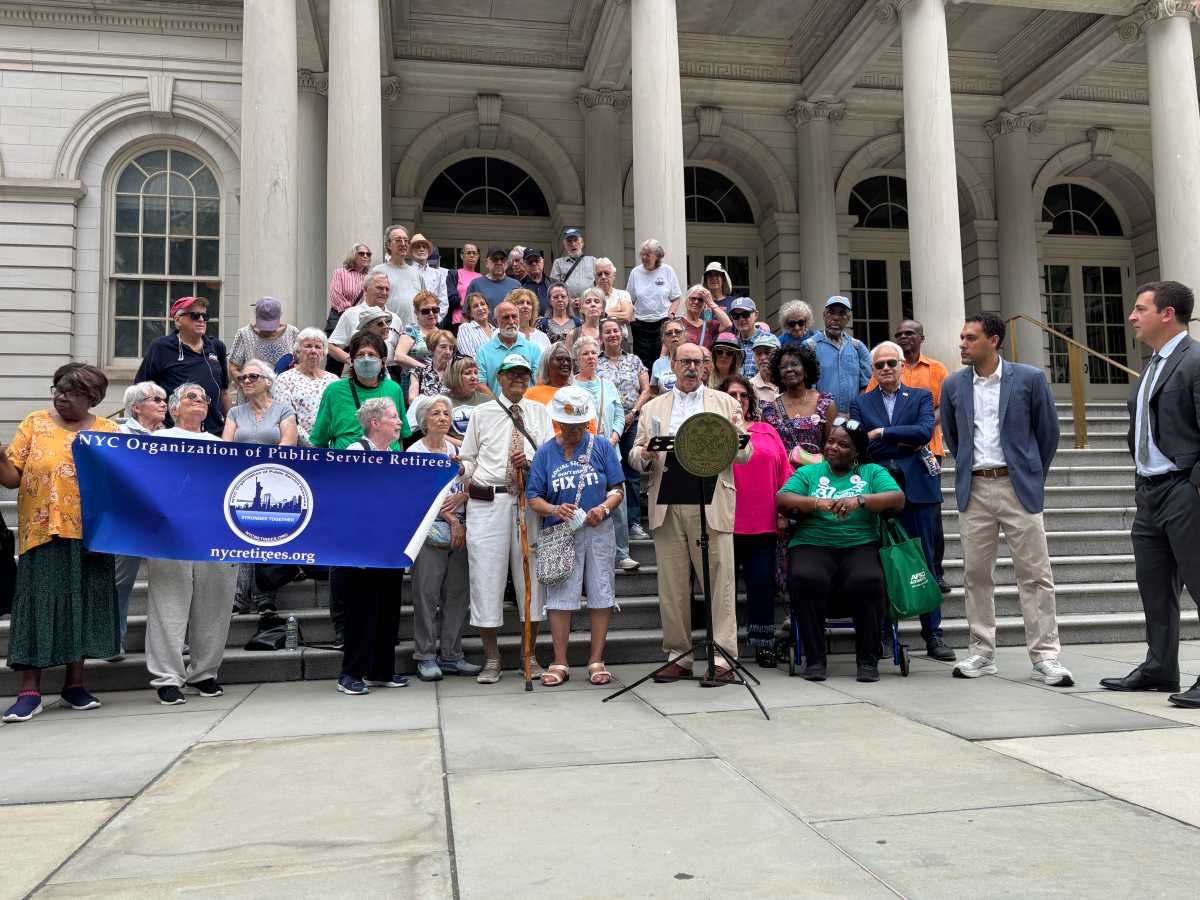
Retired New York City workers and their supporters united on the steps of City Hall on Aug. 5 to celebrate a $53 million settlement regarding past healthcare charges, and to push for legislation to hold down healthcare costs for City retirees.
They chanted “Fight, fight, fight, healthcare is a human right,” as they celebrated the settlement and supported legislation to prevent health insurance hikes for retirees often on fixed incomes.
The class action settlement was between New York City and EmblemHealth and more than 250,000 retired city workers and their family members.
The suit was filed, on behalf of NYC Organization of Public Service Retirees and retirees, on Nov. 29, 2022, as Margaretann Bianculli et al v. City of New York Office of Labor Relations et al, in New York County Supreme Court.
It refers specifically to EmblemHealth’s GHI Senior Care Medicare supplement plan for city employees.
Medicare paid 80% of medical bills, while Senior Care was supposed to pay the remaining 20%. They charged $15 co-pays, which the courts said violated the contract with the City and retirees.
One of the largest settlements in NYC history
The settlement, one of the largest in New York City history, has been signed by both sides and must be approved by New York County Supreme Court Justice Lyle E. Frank.
It refunds 100% of co-pays retirees were charged for medical visits between Jan. 1, 2022, through Jan. 31, 2023.
The settlement also precludes New York City and EmblemHealth from charging retirees co-pays in 2023 and 2024.
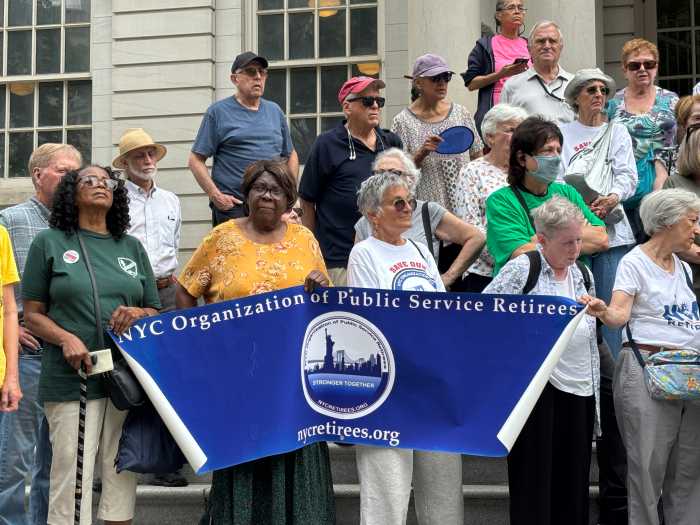 Retired New York City workers and their supporters united on the steps of City Hall on Aug. 5 to celebrate a $53 million settlement regarding past healthcare charges, and to push for legislation to hold down healthcare costs for city retirees.Photo by Claude Solnik
The City and EmblemHealth also agreed not to increase existing $15 Senior Care co-pays, implemented in 2025 by revising the contract, through at least Dec. 31, 2027.
“These people helped bring that to a victory,” said Marianne Pizzitola, president of the New York City Organization of Public Service Retirees, formed five years ago. “This fight is not over. It is just beginning.”
Council Member Christopher Marte (Democrat- District 1, Manhattan) plans to introduce legislation eliminating copays implemented in 2025.
“Medicare retirees were promised that they wouldn’t have costs to their healthcare, because the cost of their plans are well below the statutory benchmark,” Pizzitola, who said she receives a $35,000 pension, said. “It’s important to keep this promise, because retirees don’t have an ability to pay more.”
“An important issue”
Robert Holden, a retired Council Member and CUNY adjunct faculty member who co-sponsored legislation last year, said this is “such an important issue as we get older and need better healthcare.”
“This was a well-deserved victory you had in court. History is on our side,” Marte said. “You were given a promise in a contract. Now the city is trying to undo that.”
Then Mayor Eric Adams re-implemented co-pays in 2025 in an affordability crisis, which retirees are trying to roll back.
Marte is planning to introduce a new version of legislation that had nearly 20 co-sponsors last year, “as early as next week but if not, hopefully in September.”
“There are 250,000 people that rely on this care,” Marte said. “They have to make a choice between healthcare and housing, healthcare and food on their table.”
There has been a rift between some current workers and retirees, as union leaders argue that higher retiree benefits could make it more difficult to provide raises to current workers.
“They try to divide us. They say if we give the retirees what they want, it will affect the cost of current members. We think that’s misinformation,” Marte said. “We have a lot of rank and file members who showed up to rallies and town halls. There is a lot of solidarity between rank and file members and retirees.”
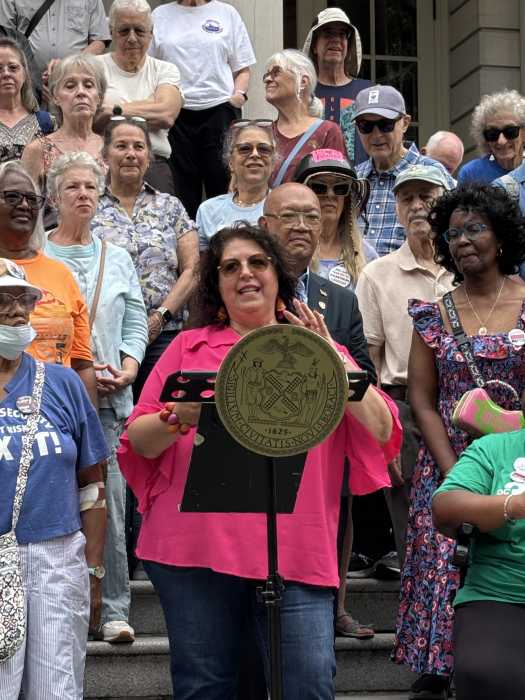 Marianne Pizzitola, president of the NYC Organization of Public Service Retirees.Photo by Clause Solnik
Pizzitola said various funds, designed to help pay for and stabilize healthcare costs going forward, have been tapped for other purposes.
They won an earlier lawsuit, prevailing in 2021 and in two following verdicts, regarding amounts the City pays for retiree healthcare, which the court agreed the City must pay up to the HIP HMO rate.
“They were trying to charge us to stay on traditional Medicare, a plan we had at no cost for the last 60 years,” Pizzitola said. “We won that case.”
Neil Frumkin, a retired case worker and officer of the Association, said he would have faced substantial payments.
“I would’ve had to pay $400 a month (for a couple) to maintain my senior care and traditional Medicare for myself and my wife,” said Frunkin, who worked 36 years and retired in 2002.
Pizzitola said they “want to make sure that no municipal employee has to go through a promise being broken in retirement.”
The NYC Organization of Public Service Retirees said they have collectively saved retirees approximately $3.16 billion since 2022.
They say the organization stopped the City from requiring retirees to pay for Senior Care, which the city valued at $600 million per year.
They also prevented the City and EmblemHealth from charging retirees co-pays in 2023 and 2024, which EmblemHealth valued at approximately $106 million; in addition to the $53 million.
“There’s only so much you can do in court,” said Jacob Gardener, an attorney at Walden Haran Williams representing retirees, noting legislation can “make sure retirees continue to have the healthcare and dignity that they deserve.”
Steve Cohen, an attorney at Pollock Cohen LLP also representing the retirees, also supports legislation. “The fight for access to good, affordable healthcare is going to continue,” Cohen said.
Others at the rally said legislation is the only way to shield retirees, who often took jobs paying less than the private sector in part due to a promise of healthcare benefits, from hikes.
“Legislation is the only way to protect these people,” Pizzitola said. “The City has to keep its promise to these retirees. We have no way of paying more.”