
Prep the bug spray, because New York City announced Thursday that the number of mosquito pools testing positive for West Nile virus this year has nearly doubled compared to the same time period in 2025, Health Department officials said.
As of July 6, no confirmed human cases of the mosquito-transmitted virus have been reported to city health officials, but the Department of Health and Mental Hygiene (DOHMH) urged New Yorkers to take precautionary steps to protect themselves and their loved ones against bites, according to an announcement.
Since West Nile Virus was first detected in the United States in 1999 in NYC, the median age of people infected with documented cases in the city is around 65 years old, according to city health data. NYC Health Commissioner Dr. Alister Martin said in a statement that those who are most at risk to infection should be protecting themselves against exposure.
“Now is the time for every New Yorker, especially older adults and people with weakened immune systems, to take simple precautions to prevent mosquito bites,” Martin said.
Many individuals infected with West Nile virus, around 80%, never show any discernible symptoms, according to Dr. Anna Durbin, a professor of International Health, specializing in epidemiology at Johns Hopkins University. But some cases can develop into mild fever, body aches, and nausea or even potentially severe or life-threatening neurological inflammation like encephalitis or meningitis.
How can New Yorkers stop infected mosquitoes from biting them?
 FILE – A Health Department-contracted truck sprays pesticide to combat mosquitoes carrying the West Nile virus.Screenshot via YouTube/gifterphotos
To prevent infection, the city’s health agency recommended reducing the risk of bites by using EPA-registered repellents, wearing protective clothing, and avoiding outdoor activities around dawn and dusk, when mosquitoes that transmit the virus are particularly active.
The DOHMH also asked New Yorkers to do their part by reducing the opportunities for mosquitoes to breed in the city. Mosquitoes need stagnant or standing water to reproduce, according to the Environmental Protection Agency, meaning that outside of natural sources, pools of water in flowerpots, bird baths, tarps or any other surface that can hold water after a rain or flood, can become a potential breeding ground for mosquitoes and West Nile virus carriers.
Residents should be careful to immediately empty all sources of standing water and report other sources of standing water on private or public property to 311, health officials said.
The city conducts annual surveillance of mosquito activity, testing groups of trapped mosquitoes known as “pools” for the presence of West Nile virus. So far, out of 2,040 pools tested, West Nile virus was detected in 612 across the city, compared with 326 by the same time in 2025.
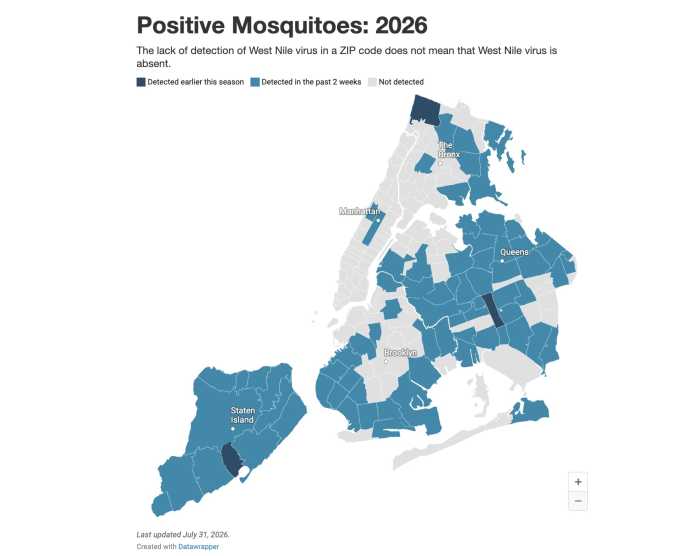 NYC Department of Health and Mental Hygiene publishes a yearly map tracking zip codes which have tested positive for the presence of West Nile Virus in their mosquito populations. Photo: NYC Department of Health and Mental Hygiene
Health officials said that the city takes action to control the infected mosquito population by spraying an environmentally friendly insecticide designed to kill mosquito larvae across nonresidential areas and targeting adult mosquitoes in residential neighborhoods with insecticides deployed from trucks.
Martin said that the city’s system allowed it to preemptively notify the public and take action.
“The detection of West Nile virus in mosquitoes demonstrates that New York City’s mosquito surveillance system is working exactly as intended,” said Martin. “Our system allows us to identify where the virus is circulating early and take targeted action to reduce mosquito populations before more people are at risk.”